
You are sourcing steel for a ship’s hull. You need a material that is strong, certified, and accepted globally. You see "LR AH36" on a supplier’s list. This combination of letters and numbers holds the key to quality and safety on the open sea.
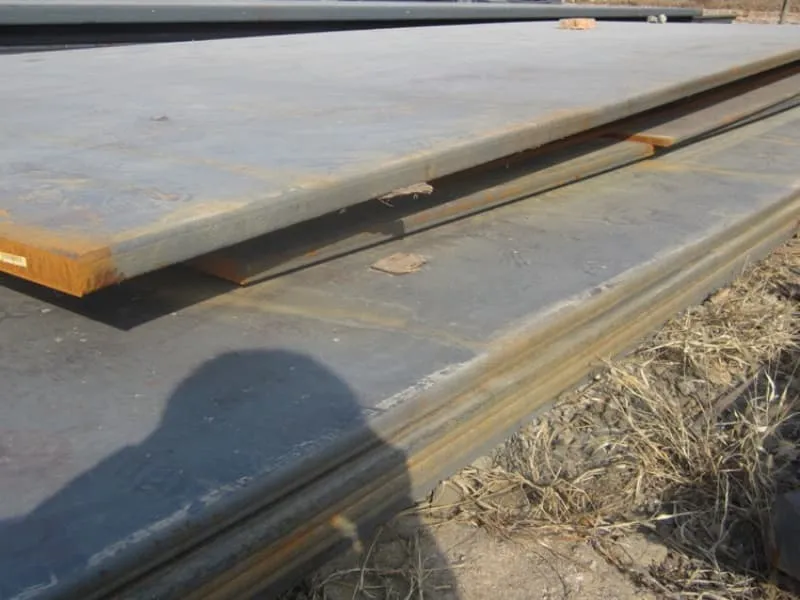
LR AH36 marine steel plate is a high-strength shipbuilding steel. "LR" means it is certified by Lloyd’s Register, a leading marine classification society. "AH36" specifies the grade: A for ambient toughness, H for high strength, and 36 for a minimum yield strength of 355 MPa. It is a top choice for hulls, decks, and offshore structures.
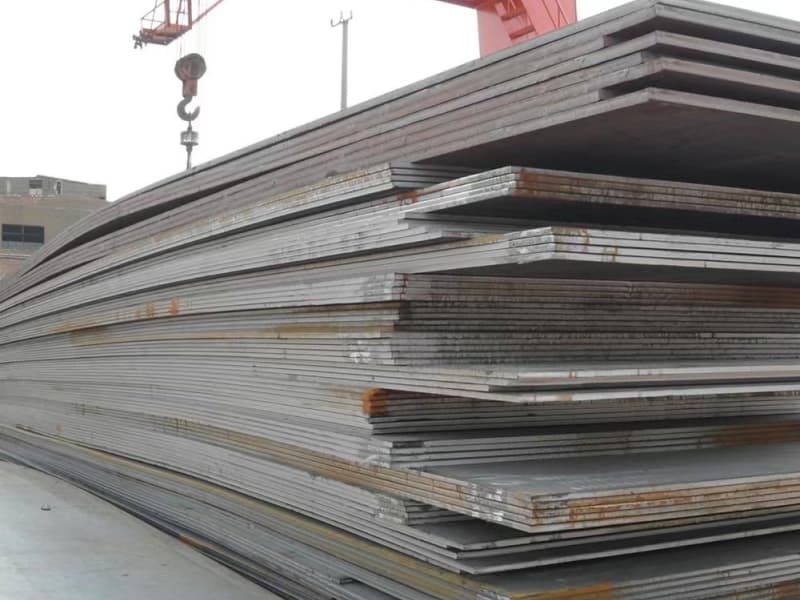
The "LR" prefix is not just a label. It is a promise of verified quality from the mill to your project. Many buyers focus only on the grade, like AH36. But the classification society approval is what makes it truly marine-grade. I supply this material to shipyards worldwide. They trust the LR stamp because it means the steel has passed rigorous external checks. Let’s break down exactly what LR AH36 means, starting with a common point of confusion.
What is the difference between A36 and AH36 steel?
Both A36 and AH36 are common structural steels. Their names look similar, but one is for general construction on land, and the other is for building ships that sail across oceans. Mixing them up is a serious error.
The main difference is strength, application, and certification. ASTM A36 is a general construction steel with a yield strength of 250 MPa. AH36 is a high-strength shipbuilding steel with a yield strength of 355 MPa. AH36 requires tougher impact testing and must be produced under classification society rules for marine use.
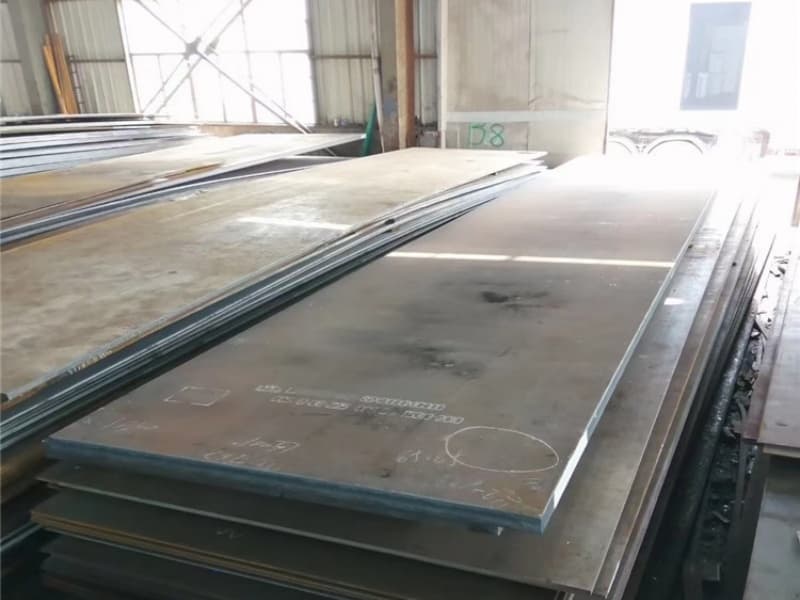
Land vs Sea: A Fundamental Distinction
A36 and AH36 come from different worlds with different rules. Understanding these rules explains why you cannot substitute one for the other in critical applications.
First, look at the standards and governing bodies.
- ASTM A36: This standard is set by ASTM International, a general standards organization. It is used for bridges, buildings, and general fabrication. The focus is on basic strength and weldability.
- AH36: This designation comes from the rules of marine classification societies like Lloyd’s Register (LR), American Bureau of Shipping (ABS), or DNV. These are specialized bodies that set rules for ship safety. Their standards include strict requirements for toughness, chemical composition, and manufacturing process control that go far beyond A36.
Second, compare the mechanical properties directly. The numbers tell a clear story.
- Yield Strength: This is the most critical difference. A36 has a minimum yield strength of 250 MPa (36 ksi). AH36 has a minimum yield strength of 355 MPa (51 ksi). That is over 40% stronger. This allows ship designers to use thinner, lighter plates for the hull, saving weight and increasing cargo capacity.
- Tensile Strength: A36: 400-550 MPa. AH36: 490-620 MPa. AH36 has a higher minimum requirement.
- Impact Toughness: This is a key divider. Standard A36 has no mandatory Charpy impact test requirement. AH36 must pass Charpy V-notch impact tests. The test energy and temperature are specified by the classification society. This ensures the steel won’t become brittle and crack in cold seawater.
Third, the chemical composition is controlled differently. AH36 chemistry is designed for better weldability and toughness at higher strength levels. It often has lower maximum limits for carbon, sulfur, and phosphorus compared to some A36 productions. The Carbon Equivalent (CE) is also carefully controlled to prevent welding cracks.
Here is a side-by-side comparison table:
| Property | ASTM A36 Steel | AH36 Shipbuilding Steel (e.g., per LR Rules) |
|---|---|---|
| Governing Standard | ASTM A36 (General construction) | Lloyd’s Register (LR) Rules / IACS Unified Requirements |
| Primary Application | Buildings, bridges, general structures. | Ship hulls, offshore platforms, marine structures. |
| Minimum Yield Strength | 250 MPa (36,000 psi) | 355 MPa (51,500 psi) |
| Tensile Strength Range | 400 – 550 MPa | 490 – 620 MPa |
| Charpy Impact Test | Not required by the ASTM standard. | Mandatory. Specific energy required (e.g., 34 J avg. at 0°C or -20°C for thicker plates). |
| Typical Thickness Range | Up to 200mm (8 in) for plates. | Commonly up to 50mm for hull plates, but can be thicker. |
| Certification | Mill Test Certificate (MTC) to ASTM A36. | Classification Society Certificate (e.g., LR Certificate) + MTC with society stamp. |
| Production Approval | Mill needs general quality system. | Mill must be approved by the classification society (LR, ABS, etc.). |
From a procurement standpoint, the difference is clear. A project contractor in Qatar might use A36 for a warehouse. But for the hull of an oil tanker being built in a Qatari shipyard, they will specify and purchase LR AH36. The LR AH36 plate will cost more. The extra cost pays for the higher strength, the guaranteed toughness, and the assurance of the LR certification. This assurance is non-negotiable for insurance and safety. When clients like Gulf Metal Solutions ask for marine steel, we immediately confirm the required classification society (LR, ABS, DNV) to ensure we quote the correct certified material.
What is A36 steel plate equivalent to?
You have a design using A36 steel. Now you need to source it globally. Different countries use different standard names. Knowing the equivalents prevents delays and ensures you get the right material.
In terms of mechanical properties, ASTM A36 steel plate is broadly equivalent to European grade S235JR (EN 10025-2) and Chinese grade Q235B (GB/T 700). However, "equivalent" does not mean identical. There are always differences in chemical composition, testing, and delivery conditions that must be checked.
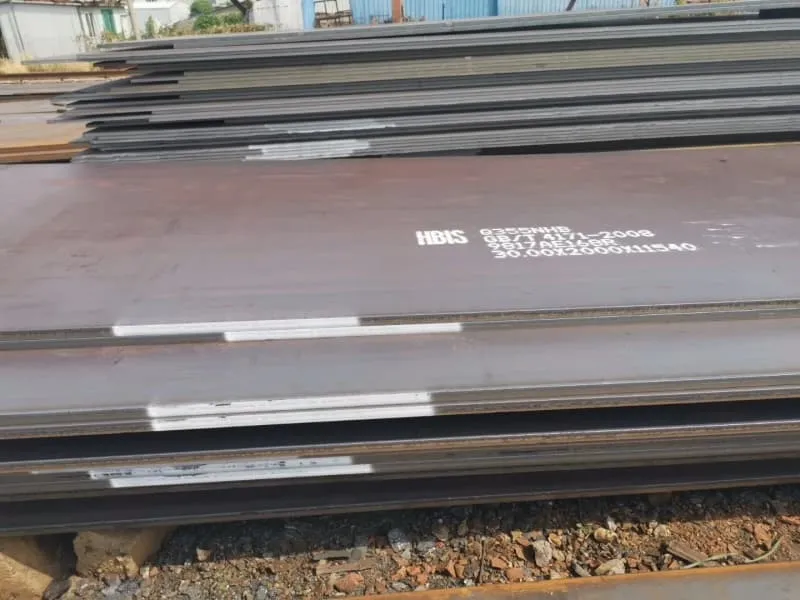
The Challenge of Finding True Equivalents
The word "equivalent" is tricky in the steel world. Two grades might have similar yield strength but different rules for chemistry or toughness. You must compare the specific requirements.
First, we must define what we mean by "equivalent." For structural steel, the most common basis for equivalence is the minimum yield strength. This is the property engineers use for design calculations. So, we look for grades with a similar yield strength (around 235-250 MPa).
Second, let’s look at the most common equivalents.
-
European Equivalent (EN 10025-2): S235JR
- Yield Strength: Min 235 MPa (for thickness ≤16mm). This is slightly lower than A36’s 250 MPa, but in practice, they are often used interchangeably for many applications.
- Key Difference: S235JR has a mandatory Charpy impact test at +20°C with a minimum 27 Joules. A36 has no impact requirement. So S235JR actually has a defined toughness guarantee that A36 lacks.
- Other EU Grades: S235J0 (tested at 0°C) and S235J2 (tested at -20°C) offer higher toughness and may be specified where impact resistance is needed.
-
Chinese Equivalent (GB/T 700): Q235B
- Yield Strength: Min 235 MPa (for thickness ≤16mm).
- Key Difference: The Q235 series (A, B, C, D) is differentiated by impact temperature and deoxidation method. Q235B requires an impact test at +20°C. The chemical composition, especially for Phosphorus and Sulfur, is generally higher in Q235B than in typical A36. This is an important detail for weldability and brittle fracture resistance.
-
Japanese Equivalent (JIS G3101): SS400
- Yield Strength: SS400 does not have a specified minimum yield strength. It guarantees a minimum tensile strength of 400 MPa. This is a fundamental difference in philosophy. Engineers must use a different design approach. They are not direct equivalents.
Third, you cannot simply substitute one for another without checking. The project specifications or the client’s engineer must approve the substitution. The approval process will look at:
- The design yield strength used in calculations.
- Any required impact toughness for the service environment.
- Weld procedure specifications (WPS) which are based on the steel’s chemistry.
The table below shows a detailed comparison:
| Grade Standard | Grade Name | Min Yield Strength (MPa) | Min Tensile Strength (MPa) | Impact Test Requirement | Primary Note on Equivalency |
|---|---|---|---|---|---|
| ASTM A36 | A36 | 250 | 400-550 | Not Required by standard. | The baseline for comparison. |
| EN 10025-2 | S235JR | 235 | 360-510 | 27 J at +20°C | Closest common EU grade. Slightly lower yield, but has impact test. |
| GB/T 700 | Q235B | 235 | 375-500 | 27 J at +20°C | Common Chinese grade. Watch for higher P,S content vs. typical A36. |
| JIS G3101 | SS400 | Not Specified | 400-510 | Not Required | Not a yield-strength grade. Not a direct equivalent. Requires designer approval. |
In our daily business, we handle these equivalencies all the time. A buyer in the Philippines might have drawings calling for A36. But their local stock or a cheaper offer might be for Q235B. They ask us if it’s the same. We explain the differences in yield strength and chemistry. We advise them to get approval from their engineer before switching. For marine projects, equivalency is even stricter. There is no true "equivalent" to AH36 in general structural standards. It must be a classified marine grade. This clarity in explaining grades builds trust with rational, results-driven buyers who value accurate technical communication.
What is AH-36 steel?
You see AH-36, AH36, or A36. The hyphen and the letter ‘H’ change everything. This grade is engineered specifically for the harsh environment of the ocean.
AH-36 steel is a high-strength, hull-grade steel used in shipbuilding. The ‘A’ indicates it meets impact testing requirements for ambient temperatures. The ‘H’ means it is high-strength. The ’36’ denotes a minimum yield strength of 36 kgf/mm², which is 355 MPa. It is a standardized grade approved by all major marine classification societies.
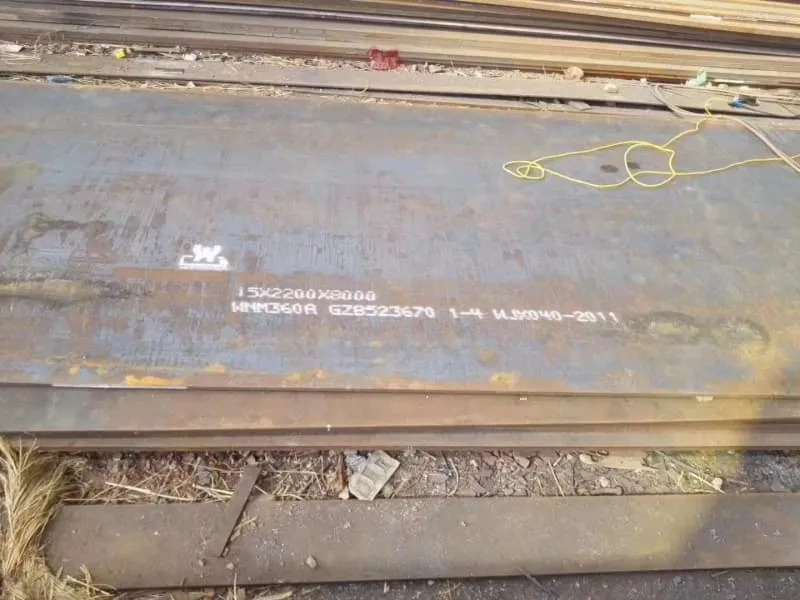
Decoding the AH-36 Specification
AH-36 is part of a precise system developed by the International Association of Classification Societies (IACS). This system ensures uniformity in ship steel worldwide.
First, let’s break down the code letter by letter.
- A: This is the toughness grade. ‘A’ is the standard grade for ambient temperature service. It requires Charpy V-notch impact testing. The specific test temperature (like 0°C) depends on the thickness of the plate as per society rules. For thicker AH36 plates, the test temperature might be -20°C.
- H: This stands for High tensile strength. It distinguishes it from ordinary strength shipbuilding steels (Grades A, B, D, E without the ‘H’), which have a yield strength of 235 MPa.
- 36: This number represents the minimum yield strength in kilograms-force per square millimeter (kgf/mm²). 36 kgf/mm² equals 353 MPa, which is rounded to 355 MPa in modern SI units. Some older drawings may still call it "36 kg" steel.
Second, understand its place in the family. AH-36 has siblings:
- AH32: Lower strength, with a yield of 315 MPa (32 kgf/mm²).
- DH36: Same strength as AH36 (355 MPa), but with improved low-temperature toughness (Grade D).
- EH36: Same strength, with the highest level of low-temperature toughness (Grade E).
This family allows naval architects to choose the right balance of strength and toughness for each part of the ship.
Third, the production of AH-36 is strictly controlled. It is not just a chemical formula. It is a performance specification with rules for:
- Manufacturing Process: It is typically made by fine-grain practice, often using normalized rolling or thermo-mechanical controlled process (TMCP). This ensures the required toughness.
- Chemical Composition: Limits are set for carbon, manganese, silicon, sulfur, phosphorus, and alloying elements like aluminum, niobium, or vanadium. The Carbon Equivalent (CE) is capped to ensure good weldability.
- Testing: Each plate or batch undergoes tensile testing and Charpy impact testing. The results are recorded on the classification society certificate.
Here is a detailed specification profile for AH-36 steel:
| Property | Requirement for AH-36 Steel | Notes & Explanation |
|---|---|---|
| Yield Strength (Min) | 355 MPa (51,500 psi) | This is the defining characteristic. Allows for lighter ship structures. |
| Tensile Strength | 490 – 620 MPa | Must fall within this range. Too low is weak, too high can harm toughness. |
| Elongation (Min) | Typically 21% (depends on thickness) | Measures ductility; the steel must be able to stretch without breaking. |
| Charpy V-Impact Energy | As per classification society rules. e.g., 34 J average at specified temp. | Mandatory test to prove toughness. Temperature depends on grade (A) and plate thickness. |
| Carbon Equivalent (CE) Max | Usually ~0.41% (Pcm or IIW formula) | A calculated value from chemistry. Lower CE means easier, safer welding. |
| Common Thickness Range | 6mm to 50mm+ for hull plates. | Thicker plates may require testing at lower temperatures. |
| Primary Application | Hull plating, decks, bulkheads, longitudinal stiffeners (as bulb flat). | Used in all major commercial vessels: tankers, bulk carriers, container ships. |
Why is AH-36 so common? It hits the sweet spot. Most commercial ships operate in sea temperatures where ‘A’ grade toughness is sufficient. The jump from 235 MPa to 355 MPa offers major weight savings. The grade is produced in large quantities by approved mills worldwide, making it readily available and cost-effective. When a shipyard in Romania orders plate for a new container ship, AH36 is very often the default choice for the hull. We supply LR AH36 because Lloyd’s Register is widely accepted and trusted. The mill’s LR approval is our guarantee that the AH-36 steel meets the highest international standards.
Is A36 steel the same as grade 50?
This is a common mix-up. Both are structural steels, and both use numbers. But "36" and "50" refer to completely different properties. Confusing them can lead to an under-designed and dangerous structure.
No, A36 steel is not the same as Grade 50. The numbers refer to different strength properties. In A36, the "36" is the yield strength in ksi (36,000 psi). In Grade 50 (such as ASTM A572 Gr. 50), the "50" is also the yield strength in ksi (50,000 psi). Grade 50 is significantly stronger than A36.
Yield Strength: The Critical Number
The mix-up happens because people see the number and think "bigger is better." But you must know what the number measures. Using a lower strength steel where a higher one is specified is a critical failure.
First, we must identify the full grade names.
- ASTM A36: This is the complete standard. The "36" is part of the name and denotes a minimum yield of 36 ksi.
- Grade 50: This is usually shorthand for ASTM A572 Grade 50. This is a different standard altogether. A572 is a specification for high-strength low-alloy steel. Grade 50 is one of several grades under it (others are 42, 55, 60, 65). It could also refer to ASTM A992, which is the standard for structural shapes (like wide-flange beams) with a yield of 50 ksi.
Second, let’s compare their key properties. The strength difference is major.
- Yield Strength:
- A36: 36 ksi (250 MPa)
- A572 Gr. 50: 50 ksi (345 MPa)
- This means Grade 50 is about 39% stronger than A36 in yield strength.
- Tensile Strength:
- A36: 58-80 ksi (400-550 MPa)
- A572 Gr. 50: 65 ksi min (450 MPa min)
- Application:
- A36: Used for general construction where moderate strength is enough. Common for plates, angles, and bars in buildings and bridges.
- A572 Gr. 50: Used where higher strength and/or lighter weight is needed. Common in high-rise buildings, long-span bridges, and heavy equipment. It is not typically a marine steel.
Third, can you substitute one for the other? Almost never in a designed structure. If an engineer specifies A572 Gr. 50, they have calculated loads based on that 50 ksi yield strength. If you use A36 instead, the member will be significantly under-strength. It could bend or fail under the expected load. The reverse is also problematic. Using a stronger, more expensive Grade 50 where A36 is specified is wasteful and can cause issues with connection design and ductility.
What about AH36? Now it gets interesting. Remember, AH36 has a yield of 355 MPa. Let’s convert that: 355 MPa is approximately 51.5 ksi. So, in terms of yield strength, AH36 is very close to A572 Grade 50. But again, they are not the same. AH36 is a marine-grade steel with toughness and certification requirements for shipbuilding. A572 Gr. 50 is a general structural grade for land-based use. They are strength-similar but application-worlds apart.
Here is a clear comparison table:
| Grade | Full Standard | Min Yield Strength | Min Tensile Strength | Common Forms | Typical Application |
|---|---|---|---|---|---|
| A36 | ASTM A36 | 36 ksi (250 MPa) | 58 ksi (400 MPa) | Plate, Bar, Structural Shapes | General construction, buildings, bridges. |
| Grade 50 | ASTM A572 Grade 50 | 50 ksi (345 MPa) | 65 ksi (450 MPa) | Plate, Structural Shapes | High-rise buildings, bridges, need for high strength/weight ratio. |
| AH36 | LR / ABS / DNV Rules | 51.5 ksi (355 MPa) | 71 ksi (490 MPa) | Plate, Bulb Flat, Sections | Ship hulls, offshore structures. High strength + marine toughness. |
In practical sourcing, this distinction is vital. A client might call and say, "I need Grade 50 plate." Our first question is, "For what application?" If they say "for a barge," we know to steer the conversation to marine grades like AH36, explaining the difference. If they say "for a building column," we would quote A572 Gr. 50. This technical consultation is part of our service. It prevents our clients from making costly or dangerous mistakes. It’s the kind of clear communication that our client Gulf Metal Solutions valued when they switched to us from less responsive suppliers.
Conclusion
LR AH36 marine steel plate is a certified, high-strength material defined by strict classification society rules. It is fundamentally different from general construction steels like A36, despite similar-sounding names.