
You are designing a ship’s frame. You need maximum strength with minimum weight. The wrong steel profile choice adds unnecessary tons, increases fuel costs, or worse, creates a weak point. Choosing between profiles is a critical engineering decision with real-world consequences.
There is no single "strongest" profile. Structural strength depends on the specific load case. For bending, wide-flange I-beams are very efficient. For stiffening plates, bulb flats offer superior strength-to-weight. For torsional stability and framing, L-shaped angles are highly effective. The best choice balances strength, weight, cost, and function.
This answer is just the beginning. Strength is not a simple ranking. You must also consider the material itself—how it fights corrosion and handles stress. To make the right choice, you need to compare both shapes and grades. Let’s break down these common comparisons to give you a clear decision-making framework.
What is the strongest steel profile?
People often ask for the "strongest" steel profile. This is like asking for the "best" tool. A hammer is best for nails, but terrible for screws. Strength in steel profiles depends entirely on what you ask them to do. A profile that is strong in bending might be weak in twisting.
The strongest profile for a specific job depends on the load direction. For resisting bending (like a beam), an I-beam1 or H-beam is typically strongest. For stiffening a plate against buckling, a bulb flat is very strong for its weight. For torsional stability and easy connections, an L-angle is strong and practical.
We need to define "strength." In engineering, we talk about strength in bending, strength in compression, and strength in torsion (twisting). Each profile shape is optimized for different scenarios.
Analyzing Profile Strength by Load Case and Application
Let’s compare the common marine profiles: I-Beams, Bulb Flat2s, and L-Angle3s (our specialty). We will look at their geometric properties.
1. Bending Strength (The Most Common Need)
When a profile is used as a beam (like a deck girder), it needs high bending strength. This is measured by the Section Modulus4 (Z). A higher Z means the profile can carry a larger bending moment before it yields.
- I-Beam / H-Beam: This is the champion for pure bending. Its design puts most of the material far from the neutral axis (the center), which maximizes the Section Modulus4. It is the go-to choice for primary girders and large supports.
- Bulb Flat2: This is a specialist. For its small cross-sectional area (and low weight), it provides a surprisingly good Section Modulus4. The bulb at the end acts like a mini-flange, making it very efficient. This is why it is the standard for longitudinal stiffeners on hulls and decks.
- L-Angle3: It has moderate bending strength. It is not as efficient as an I-beam1 for this purpose. But it is often used for smaller beams and, more importantly, for frames where other factors matter more.
2. Torsional Strength5 and Stability
Torsion is twisting. Some profiles twist easily, others resist it.
- L-Angle3 and T-Bar: These open sections have low torsional stiffness. They can twist if not properly supported.
- I-Beam: Also an open section, but its larger size gives it more inherent resistance than a small angle.
- Bulb Flat2: Similar to an angle, it is not great in pure torsion.
- Closed Sections (like Hollow Structural Sections – HSS): These are the true champions of torsional strength. However, they are less common in traditional shipbuilding for primary structure due to welding complexity and cost.
3. Compressive Strength6 / Buckling Resistance
When a member is pushed from the ends (like a column or a strut), its failure mode is often buckling. Resistance to buckling depends on the Radius of Gyration7 (r), especially the minor axis radius.
- I-Beam: Usually has good, balanced radii of gyration about both its axes.
- L-Angle3: It has unequal radii. It is strong against buckling in one direction but weaker in the other. It often needs to be braced or used in pairs (back-to-back) to prevent buckling.
- Bulb Flat2: As a stiffener attached to a plate, the plate itself provides continuous support against buckling in one direction. This makes the combination very effective.
Here is a practical comparison table for marine contexts:
| Profile | Best For | Key Strength Metric | Typical Marine Use |
|---|---|---|---|
| I-Beam / H-Beam | Long-span beams, primary girders | High Section Modulus4 (Bending) | Deck girders, engine seatings, major transverse supports. |
| Bulb Flat2 | Longitudinal stiffeners on plates | High Section Modulus4-to-Weight Ratio | Hull longitudinals, deck longitudinals (the most common stiffener). |
| L-Angle3 (L-Steel) | Frames, brackets, edge stiffeners | Good all-round properties, easy connectivity | Transverse frames, deck beam stiffeners, bracket legs, hatch coamings. |
| Flat Bar | Simple connections, small brackets | Low cost, simple | Small brackets, filler plates. |
The conclusion is that "strongest" is meaningless without context. For a shipbuilder in Vietnam needing deck girders, an I-beam1 is the strongest choice. For the same shipbuilder needing to stiffen the side shell plating, a bulb flat is the strongest and most efficient choice per kilogram. And for creating the rib-like frames, L-angle steel provides the perfect combination of adequate strength, stability, and fabrication ease. Our business supplies the critical profiles—L-angles and bulb flats—that form the efficient, strong skeleton of the vessel.
Is 304 or 316 better for saltwater?
Saltwater is a steel’s worst enemy. It causes rust and corrosion very quickly. For some marine applications, carbon steel alone is not enough. This is where stainless steels like 304 and 316 come in. But choosing between them is a question of cost versus performance in a corrosive environment.
For saltwater applications, 316 stainless steel is better than 304. The key reason is Molybdenum1. 316 contains 2-3% Molybdenum1, which significantly increases its resistance to pitting and crevice corrosion in chloride environments like seawater. 304, without Molybdenum1, is more susceptible to corrosion in such conditions.

This is a crucial distinction, especially for fittings, hardware, and components in constant contact with spray or immersion. Let’s look at why this small difference in chemistry matters so much.
The Chemistry and Application Breakdown for Marine Use
Both 304 and 316 are part of the "austenitic" stainless steel family. They look similar but behave differently in the marine world.
1. The Critical Role of Molybdenum1
- 304 Stainless Steel (A2): Its main alloying elements are Chromium (18-20%) and Nickel (8-10.5%). The Chromium forms a passive oxide layer that protects against rust. This is fine for many environments.
- 316 Stainless Steel2 (A4): It has a similar Chromium (16-18%) and Nickel (10-14%) base. The crucial addition is Molybdenum1 (2-3%). Molybdenum1 dramatically strengthens the passive layer, making it much more stable in the presence of chlorides—the ions found in saltwater.
2. Understanding the Corrosion Threats3
In seawater, two specific types of corrosion are common:
- Pitting Corrosion4: Chlorides can attack small spots on the steel, creating deep, narrow pits that penetrate the material. Molybdenum1 in 316 makes the steel much more resistant to the initiation and growth of these pits.
- Crevice Corrosion5: This occurs in shielded areas where seawater can be trapped, like under gaskets, washers, or in threaded connections. The oxygen level drops, and chlorides become concentrated, breaking down the passive layer. 316 stainless steel performs significantly better than 304 in these tight, stagnant conditions.
3. Practical Application Guidelines
The choice is not always "use 316 everywhere." It depends on exposure and risk.
- Use 316 (or marine-grade equivalents like 316L) for:
- Boat fittings: cleats, rails, stanchions, fasteners.
- Components in direct splash zones or constant immersion.
- Piping systems for seawater.
- Equipment on offshore platforms.
- Chemical tanker cargo tank surfaces for certain cargoes.
- 304 may be acceptable for:
- Interior components with no direct saltwater exposure (galley equipment, some interior trim).
- Applications in mild atmospheric conditions, far from the coast.
- Where cost is a primary constraint and the risk is deemed low.
A Note on "Marine Grade Stainless6": Often, this refers specifically to 316 or its low-carbon variant 316L (the "L" means lower carbon for better weldability). For critical marine hardware, 316L is the standard specification.
For our core business of structural steel (plates, angles, bulb flats), we typically supply carbon-manganese steels with high corrosion resistance for hull construction. These are then protected by paint systems. However, we understand that our clients, like project contractors in Saudi Arabia or the Philippines, might also need guidance on stainless for ancillary parts. The principle is the same: match the material to the environment. Using 304 where 316 is needed leads to premature failure, just like using the wrong structural profile leads to weakness.
Which is better, S275 or S355?
You see these grades on drawings and material lists. S275 and S355 are two common structural steel grades from the European EN 10025 standard. The number indicates the minimum yield strength in MPa. The choice affects the thickness, weight, and cost of your structure.
S355 is stronger than S275. S355 has a minimum yield strength of 355 MPa, while S275 has 275 MPa. S355 is "better" where high strength and weight savings are critical, like in large vessels or highly loaded structures. S275 is often sufficient and more economical for smaller vessels or less critical parts.
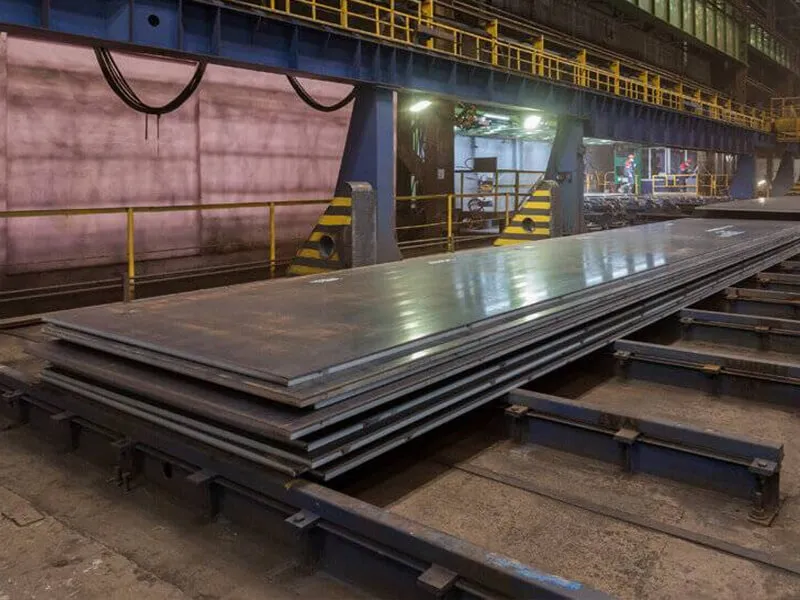
"Better" depends entirely on your design requirements. Using S355 allows you to use thinner plates and sections, saving weight. But it often comes at a higher cost and may have slightly different welding requirements.
A Detailed Comparison for Marine Structural Design
Let’s go beyond the yield strength number and look at the full picture for shipbuilding applications.
1. Mechanical Properties1: The Core Difference
- Yield Strength (ReH)2: This is the defining difference. S275 = 275 MPa minimum. S355 = 355 MPa minimum. This means a member made from S355 can carry about 29% more load before it starts to deform permanently, compared to the same sized member in S275.
- Tensile Strength (Rm): S275: 410-560 MPa. S355: 470-630 MPa. S355 is also stronger in ultimate tensile strength.
- Impact Toughness: Both grades have sub-grades (JR, JO, J2, K2) for different service temperatures. For the same toughness designation (e.g., S355J2 vs S275J2), the S355 grade typically meets the impact energy requirements at the same low temperature. You do not sacrifice toughness for strength.
2. Design and Economic Implications
This is where the choice becomes practical for a naval architect or shipyard.
- Weight Savings3: This is the main reason to choose S355. If a plate in S275 needs to be 20mm thick to handle a load, a plate in S355 might only need to be about 16mm thick (exact calculation required). This reduces the steel weight significantly. For a large container ship, saving hundreds of tons of steel weight means more cargo capacity.
- Cost Trade-off4: S355 steel is more expensive per ton than S275. However, you use fewer tons. The total project cost must be calculated: (Price per ton x Number of tons) + fabrication cost. Sometimes S355 gives a lower total cost due to less welding and handling.
- Fabrication Considerations5: S355, with its higher strength, generally has a slightly higher Carbon Equivalent (Ceq). This might require more careful welding procedures, like pre-heating for thicker sections, to avoid hydrogen-induced cracking. This is manageable but must be planned.
3. Application in Shipbuilding6
- Use S355 (or equivalent AH36/DH36) for:
- Hull plating of large merchant vessels (tankers, bulk carriers, container ships).
- Primary structural members where reducing scantlings (sizes) is a priority.
- Areas subject to very high local stresses.
- Use S275 (or equivalent Grade A/B) for:
- Smaller vessels like tugs, fishing boats, and barges.
- Internal structures, secondary bulkheads, and non-critical parts of larger ships.
- Projects where material cost is the dominant factor and weight is not a major concern.
For our clients, this choice is made at the design stage. When Gulf Metal Solutions in Saudi Arabia orders steel, they specify the grade required by their project’s drawings. Our role is to supply that exact grade—whether it’s S275J2 plate for a barge or S355J2N L-shaped steel for a ship’s frame—with the correct certification and guaranteed properties. Providing this certainty is how we address the "stable quality" need, regardless of the grade chosen.
Which is stronger, SS or MS?
"SS" means Stainless Steel1. "MS" usually means Mild Steel (carbon steel). This is a common but oversimplified question. People think "stainless" means it is automatically stronger. This is not true. Strength and corrosion resistance2 are two separate properties.
Mild Steel (MS)3 is generally stronger in terms of yield and tensile strength4 than common austenitic Stainless Steel1 (like 304/316). However, Stainless Steel1 is much stronger in terms of corrosion resistance2. For structural applications, high-strength carbon steels5 (like S355, AH36) are used for their strength, while stainless is chosen for its durability in corrosive environments.
It is a classic case of comparing apples and oranges. Each material has a primary purpose. Let’s clarify the confusion by comparing them directly on key parameters.
A Direct Comparison of Strength, Corrosion, and Use Cases
We will compare generic mild steel (e.g., S235) with generic 304 stainless steel, as they are common references.
1. Mechanical Strength: The Numbers
- Yield Strength (ReH):
- Mild Steel (S235): 235 MPa minimum.
- 304 Stainless Steel1: Typically around 205-215 MPa (Annealed condition). So, standard mild steel actually has a higher yield strength6 than standard 304 stainless.
- Important Note: There are high-strength stainless steels (like duplex grades 2205) with yield strength6s over 450 MPa, but they are specialty products and not what people usually mean by "SS."
- Tensile Strength (Rm):
- Mild Steel (S235): 360-510 MPa.
- 304 Stainless Steel1: 515-690 MPa. Here, stainless can show a higher ultimate strength.
- Conclusion on Strength: For structural design, yield strength6 is usually the limiting factor. Therefore, for a beam or column of the same size, a mild steel member will typically carry a higher load before it starts to bend permanently compared to a 304 stainless member.
2. Corrosion Resistance: The Defining Difference
This is where stainless steel wins completely.
- Mild Steel: It has very little inherent corrosion resistance2. It will rust quickly in the presence of water and oxygen, especially saltwater. It must be protected by paint, coatings, or cathodic protection (zinc anodes).
- Stainless Steel1: It contains chromium (min. 10.5%), which forms a self-healing, invisible passive oxide layer. This layer prevents rust. In marine environments, grades like 316 are needed for sufficient resistance.
3. Other Factors: Cost, Fabrication, and Application
- Cost: Stainless steel is typically 3 to 5 times more expensive per kilogram than mild steel. This is the biggest reason it is not used for the entire hull of a ship.
- Fabrication: Stainless steel has different welding characteristics and thermal expansion rates. It requires more skill and specific procedures.
- Structural Applications in Marine:
- Mild Steel (and HSLA Steel): This is the default choice for 99% of a ship’s hull and primary structure. Plates, bulb flats, L-angles, I-beams—all are made from marine-grade carbon steel7. Its strength, toughness, weldability, and lower cost make it ideal. This is our core business.
- Stainless Steel1: Used selectively where corrosion resistance2 is paramount and strength is secondary, or where maintenance is impossible.
- Examples: Railings, cleats, fasteners, propeller shafts, exhaust manifolds, chemical tank linings, specialty piping.
The table below makes the distinction clear:
| Property / Material | Mild Steel (e.g., S235) | Austenitic Stainless (e.g., 304) | Primary Reason for Choice in Marine |
|---|---|---|---|
| Yield Strength | Higher (235+ MPa) | Lower (~205 MPa) | Structural load-bearing capacity. |
| Corrosion Resistance | Very Low (rusts) | Very High (passive layer) | Long-term durability in wet/corrosive areas. |
| Cost | Low | Very High | Economic feasibility for large structures. |
| Primary Marine Use | Hull, decks, frames, stiffeners (the entire skeleton). | Fittings, hardware, specific tanks/pipes. | Function dictates material. |
For a shipbuilder in Mexico or a wholesaler in Malaysia, this means ordering the correct material for the job. They will order tons of our certified S355JR L-shaped steel for the ship’s frames. They might also order a small batch of 316 stainless flat bar for specific custom fittings. Understanding that "stronger" depends on the context—strength under load versus strength against corrosion—prevents costly mistakes and ensures the right material is in the right place.
Conclusion
Selecting the best marine steel profile requires analyzing the load case: use I-beams for major bending, bulb flats for efficient stiffening, and L-angles for versatile framing. Always choose the material grade (316 over 304 for saltwater, S355 over S275 for strength) based on the specific environmental and structural demands of your project.
-
Learn about the advantages of Stainless Steel, especially its corrosion resistance and durability in harsh environments. ↩ ↩ ↩ ↩ ↩ ↩ ↩ ↩ ↩ ↩ ↩ ↩ ↩ ↩ ↩ ↩ ↩ ↩
-
Explore the factors influencing corrosion resistance to make informed choices in material selection. ↩ ↩ ↩ ↩ ↩ ↩ ↩ ↩ ↩ ↩ ↩
-
Explore the properties of Mild Steel to understand its strength and applications in various industries. ↩ ↩ ↩ ↩ ↩ ↩ ↩ ↩
-
Discover the significance of tensile strength in material performance and safety in construction. ↩ ↩ ↩ ↩ ↩ ↩ ↩ ↩
-
Find out about high-strength carbon steels and their critical role in structural applications. ↩ ↩ ↩ ↩
-
Understanding yield strength is crucial for structural design and material selection in engineering. ↩ ↩ ↩ ↩ ↩ ↩
-
Learn about marine-grade carbon steel and its importance in shipbuilding and marine applications. ↩ ↩