
Your steel plates are ready for export. The vessel is waiting. But how you load them decides if they arrive straight and clean or bent and scratched.
For marine steel plate export projects, choose the loading method based on plate dimensions and weight: standard containers for plates under 2 tons per unit, flat racks for oversized plates up to 45 tons, and breakbulk for very long or heavy plates. Then use proper stacking with dunnage, secure with steel straps and lashings, and distribute weight evenly to meet vessel stability and port crane limits.
I am Zora Guo from cnmarinesteel.com. I have shipped thousands of tons of marine steel plates to shipyards across Asia, the Middle East, and Europe. The loading method you choose makes all the difference. Get it wrong, and your steel arrives damaged. Get it right, and your customer receives exactly what they ordered. Let me walk you through the three main loading methods and how to use them correctly.
How to Choose Between Container, Flat Rack, and Breakbulk Loading Based on Plate Dimensions and Weight?
You have a shipment of steel plates. Do you put them in a standard container, on a flat rack, or send them breakbulk? The wrong choice can mean refused cargo or damaged steel.
Choose standard dry containers for plates under 2 tons per unit that fit within standard container dimensions (width ≤2.35m, length ≤5.9m for 20ft). Choose flat racks for plates exceeding standard container dimensions or weighing up to 45 tons per unit. Choose breakbulk for very long plates (over 12m) or very heavy plates (over 45 tons) that cannot fit on any container equipment. Also consider port infrastructure – if your destination port lacks container cranes, breakbulk may be your only option.
Let me break down each method.
Standard Dry Containers (20ft and 40ft)
Standard containers are the most common and cost‑effective option for smaller plates. But they have strict limits.
Container specifications:
- 20ft container internal dimensions: length 5.9m, width 2.35m, height 2.39m
- 40ft container internal dimensions: length 12.0m, width 2.35m, height 2.39m
- Maximum payload: 28 tons for 20ft, 28‑30 tons for 40ft
When to use standard containers:
- Each plate or bundle weighs under 2 tons (this is a key rule from major carriers)
- Plate dimensions fit easily inside the container without bending
- Your total shipment volume is under 28 tons (fits in one container)
Important carrier rules (Maersk example):
- Steel plates over 2.0 mt per plate or bundle must be booked as special cargo
- Bedding timber under all steel plates is required regardless of weight
- Dunnage bags are NOT accepted
- Forces toward the door‑end must be arrested by a bulkhead anchored in the corner posts
- The floor of a standard container is not designed to withstand point loads from heavy steel plates. You must spread the weight using dunnage.
Pros: Lowest cost per ton for small shipments, widely available containers, easy to transship, good protection from weather.
Cons: Low weight limit for heavy plates, you cannot inspect the cargo during transit (container is sealed), weight distribution must be very carefully planned.
Flat Racks
Flat racks are containers without side walls or a roof. They have a heavy‑duty steel base and are designed for oversized and overweight cargo.
Flat rack specifications:
- 20ft flat rack: max payload ~31 tons
- 40ft flat rack: max payload 40‑45 tons
- No side walls or roof – you can load plates wider or taller than standard containers
When to use flat racks:
- Plates are too wide for a standard container (over 2.35m)
- Plates are too heavy for a standard container’s floor loading (over 2 tons per unit)
- You need to inspect or secure the cargo during loading (open access)
- The plate length is less than 12m
Critical flat rack loading rules:
- Cargo weight must be spread to the side girders. The main strength of a flat rack lies in the two bottom rails, not the wooden floor.
- The maximum payload can only be used when cargo weight is spread over the entire length of the bottom rails.
- Do not place heavy weights solely on the wooden floor.
- Cargo must not obscure the top corner castings. For underdeck stowage in cell guides, cargo must be within 30cm of the corner posts.
- Welding on flat racks or drilling holes is strictly prohibited.
- Use anti‑slip material (rubber mats or wood dunnage) between cargo and the flat rack bottom rails.
Pros: Can carry much heavier and wider plates than standard containers, open access for better securing, fits in container vessel cells.
Cons: More expensive than standard containers, requires careful lashing, more weather exposure.
Breakbulk (Conventional Vessel)
Breakbulk means cargo loaded individually onto a vessel, not in containers or flat racks. This is the traditional method for very large steel shipments.
When to use breakbulk:
- Plates exceed flat rack dimensions (over 12m long or over 45 tons per piece)
- You are shipping very large quantities (hundreds or thousands of tons)
- Destination port lacks container handling infrastructure
- The plates are extremely heavy (e.g., 50mm+ thick armor plate)
Pros: No practical size or weight limits (within vessel capacity), can load directly into the ship’s hold, lower cost per ton for very large volumes.
Cons: Longer port times (each piece is handled individually), more complex logistics coordination, higher risk of weather exposure, requires specialized stevedores.
Decision Matrix
| Factor | Standard Container | Flat Rack | Breakbulk |
|---|---|---|---|
| Max plate length | 5.9m (20ft) or 12.0m (40ft) | 12m | Unlimited |
| Max plate width | 2.35m | Up to 5m (depends on rack) | Unlimited |
| Max weight per unit | ~2 tons (container floor limit) | 45 tons | Unlimited (vessel crane limit) |
| Cost per ton (small volume, 500 tons) | Medium | Medium | Low |
| Best for | Standard plates, small orders | Oversized plates, 2‑45 tons per unit | Very large or heavy plates, bulk shipments |
| Weather protection | Good (enclosed) | Poor (open) | Poor (open) |
A Real Example
A shipyard in Vietnam needed to import 200 tons of 12mm plates. The plates were standard size (2m x 6m) and each bundle weighed 1.8 tons. I shipped them in eight 20ft standard containers. Cost was $3,200 per container – total $25,600. The plates arrived clean and dry.
A different order had 25mm plates that were 3m wide. Those would not fit in any standard container. I shipped them on three 40ft flat racks at $1,800 per flat rack – total $5,400 for 75 tons. The flat racks were more expensive per ton, but they were the only option. The customer accepted the extra cost because the plates would not fit any other way.
What Stacking Order and Dunnage Placement Prevent Plate Bending and Surface Damage During Ocean Transit?
You stack plates on top of each other. The weight of the top plates bends the bottom plates. Steel on steel rubs off the protective mill scale. Rust starts.
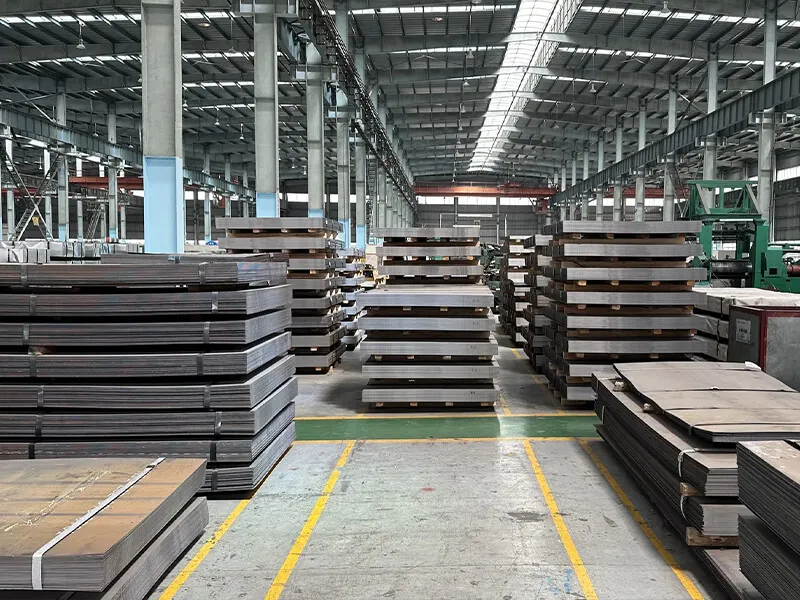
To prevent bending, always load thickest plates at the bottom of the stack and thinnest on top. Thick plates (over 20mm) are stiff enough to support several layers above. For dunnage, place hardwood timbers (minimum 100mm x 100mm) between every layer. The dunnage must be aligned vertically – each piece directly above the one below – and spaced close enough (every 1‑1.5m) to stop the plates from bending between supports. Maersk’s standard requires 5 pieces of 100mm x 100mm wood per layer, extending 30cm beyond the plate at each end.
Let me explain the two most critical factors for safe stacking.
Stacking Order – Thickest Plates at Bottom
The bending stiffness of a steel plate is proportional to the cube of its thickness. A 20mm plate is 8 times stiffer than a 10mm plate. That means thin plates bend easily under weight, while thick plates can support heavy stacks.
Loading order rules:
- Bottom layer: Thickest plates (20mm and above). These plates will carry the weight of the entire stack.
- Middle layers: Medium thickness (12‑20mm). They should not be placed at the bottom unless no thicker plates exist.
- Top layers: Thinnest plates (under 12mm). They are light and will not damage the plates below.
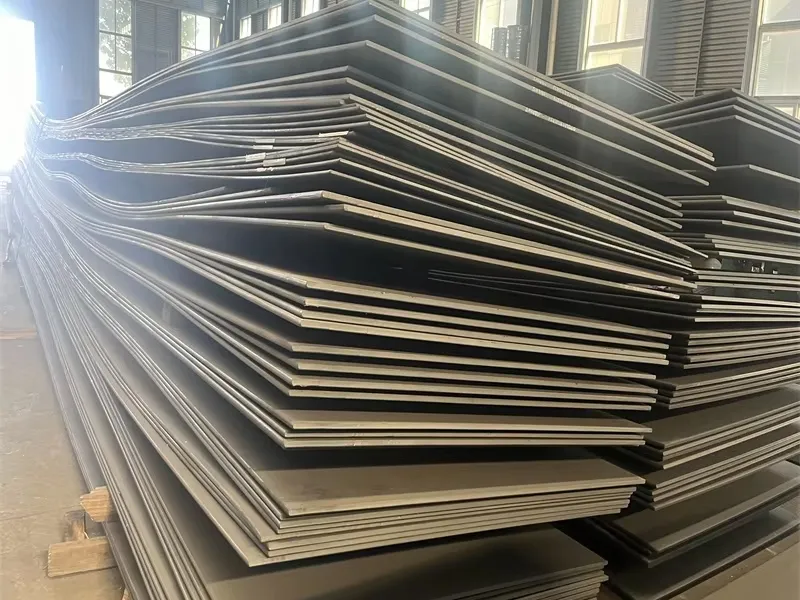
Do not stack more than 5‑6 layers of plates. The risk of permanent deformation increases with stack height. A stack of plates viewed from the side often looks wavy due to wrong placing of dunnage. When plates are not adequately supported, the weight of the stack can cause them to deform permanently. Once a plate develops a transverse kink, it requires a re‑rolling operation to flatten it again – which is very expensive.
Dunnage – The Layer Separator
Dunnage is wooden timbers placed between layers of plates. It serves three purposes:
- Prevents metal‑to‑metal contact that causes scratching and rust
- Creates air gaps to reduce moisture buildup and allow air circulation
- Distributes weight evenly across the layer below
Dunnage specifications:
- Material: Hardwood (oak, beech, or quality pine). Do not use softwood that crushes under weight.
- Size: Minimum 100mm x 100mm. For heavier stacks, use 150mm x 150mm.
- Number of pieces: Maersk requires at least 5 pieces of 100mm x 100mm dunnage per layer (or 4 pieces of 150mm x 150mm).
- Length: Must extend at least 30cm beyond the plate on both ends.
- Spacing: Close enough together to stop the plates from bending where there are gaps. Typical spacing is 1‑1.5 meters.
- Alignment: Dunnage must be kept in line vertically – each piece directly above the one below. This transfers loads straight down.
- Coverage: For bulk carriers, dunnage should be laid in athwartships lines across the tank top plating, spaced about 3m apart.
Common Stacking Mistakes to Avoid
| Mistake | Consequence | Prevention |
|---|---|---|
| Thin plates at the bottom | Thin plates bend permanently under weight of thicker plates above | Always place thickest plates at bottom |
| Dunnage not aligned vertically | Uneven loading and local bending | Ensure vertical alignment of dunnage columns |
| Dunnage spaced too far apart | Plates sag between supports and take a permanent wave | Space dunnage every 1‑1.5m |
| No dunnage between layers | Metal‑on‑metal contact causes rust and scratching | Always use dunnage, never stack plates directly |
| Stack too high (more than 6 layers) | Bottom plates may yield under excessive weight | Limit stack height to 5‑6 layers |
| Dunnage too small (50x50mm) | Crushes under weight, allows metal contact | Use minimum 100x100mm hardwood |
A Real Example
A customer in Saudi Arabia once received a shipment where the supplier had stacked 20mm plates on top of 10mm plates. The 10mm plates at the bottom bent permanently. The buyer rejected the entire shipment. The supplier had to replace 40 tons at a cost of $32,000. After that, they implemented a strict loading order: thickest plates at the bottom, dunnage between every layer, aligned vertically. No more bending issues.
How to Secure Plates with Steel Straps, Lashing Belts, and Edge Protectors for Heavy‑Sea Conditions?
You have the plates stacked and dunnaged. Now you need to keep them from shifting during a storm. A 30‑ton stack moving sideways in a container can punch through the wall.
For heavy‑sea conditions, secure steel plates with a combination of steel straps and lashing belts. Use steel straps (32mm wide, 0.8mm thick) around the stack to hold the layers together. Then use nylon lashing belts with ratchets to secure the stack to the container or flat rack. Edge protectors (plastic or metal corners) must be placed wherever straps or lashings touch plate edges – otherwise vibration will cut through the steel like a saw. In flat racks, weld stop bars or use wooden wedges to prevent sliding. The total lashing force must exceed the cargo’s inertial force during ship motion – roughly 0.5g acceleration, or half the cargo weight.
Let me detail the securing requirements for each loading method.
Securing for Standard Containers
When loading steel plates in standard containers, the cargo must be secured against tipping and sliding in both longitudinal and transverse directions.
Requirements per best practice:
- Forces toward side walls and end walls must be distributed evenly throughout the full length and width of the stack.
- Forces toward the door‑end must be arrested by a bulkhead or barrier anchored in the corner posts. The container doors themselves are not strong enough to stop a shifting load.
- Bedding timber (dunnage) under the cargo is mandatory. Plates must not rest directly on the container floor.
- The container floor is not designed for point loads. Heavy plates can punch through the floor if not properly supported.
Securing steps for a container:
- Place dunnage on the container floor.
- Stack plates as described above.
- Place steel straps around the entire stack (both vertical and horizontal). Use at least 2 vertical straps and 2 horizontal straps.
- Use nylon lashing belts with ratchets to secure the stack to the container’s lashing rings.
- Fill gaps between the stack and the container walls with wooden wedges or inflatable dunnage bags (check carrier rules – Maersk does not accept bags).
- Place a bulkhead at the door end (wooden beams wedged against the door frame).
Securing for Flat Racks
Flat racks require more extensive securing because there are no side walls to contain the cargo.
Critical requirements for flat rack securing:
- Cargo weight must be spread to the side girders. The main strength of a flat rack lies in the two bottom rails.
- Heavy weights cannot be placed solely on the wooden floor.
- Anti‑slip material (rubber mats or wood dunnage) must be placed between metal cargo surfaces and the flat rack bottom rails to increase friction.
- The center of gravity must be as close as possible to the center of the flat rack lengthwise and widthwise.
- Welding on flat racks or drilling holes is strictly prohibited.
Securing steps for a flat rack:
- Place rubber mats or coarse wood dunnage on the flat rack bottom rails to increase friction.
- Stack plates as described above.
- Use steel straps around the stack (vertical and horizontal).
- Use nylon lashing belts with ratchets to secure the stack to the flat rack’s lashing points. Use at least 4 lashings per stack.
- For extra security, weld temporary stop bars at the lower edge of the stack (on the flat rack side rails) to prevent sliding.
- Cover the stack with a tarp to protect from salt spray if the vessel will be at sea for more than a few days.
Edge Protectors – Why They Are Critical
Steel straps and lashing belts are under high tension. When the vessel rolls in heavy seas, the straps vibrate against the sharp edges of the steel plates. Over a long voyage, this vibration can cut several millimeters into the plate.
How edge protectors work:
Edge protectors are small L‑shaped pieces of plastic or galvanized steel that go between the strap and the plate edge. They distribute the strap pressure over a wider area and prevent the strap from cutting into the steel.
Where to place them:
- At every point where a strap touches a plate edge (corners and along the sides).
- Under every steel strap, and under every nylon lashing belt.
- For flat racks, also at points where lashings cross over sharp plate corners.
One customer learned this the hard way: A shipment of 200 tons of plates arrived in Qatar with deep grooves cut into the edges. The supplier had used steel straps without edge protectors. The 10,000 km journey by sea and truck had sawed into the plates. The grooves were 3mm deep. The plates were rejected. The supplier paid $12,000 for replacements. Now we use edge protectors on every strap.
Lashing Force Requirements
The total lashing force must exceed the inertial forces during ship motion. For a vessel at sea, the cargo experiences accelerations of approximately:
- Longitudinal: 0.5g (half the cargo weight) in rough conditions
- Transverse: 0.7g in rolling seas
- Vertical: 1.0g in heavy pitching
This means a 10‑ton stack needs lashings capable of resisting 5‑7 tons of lateral force. A standard nylon lashing belt with a ratchet has a breaking strength of about 5‑8 tons. Use multiple lashings and ensure they are tensioned properly. A loose lashing is useless.
How to Distribute Load Evenly Across Containers or Holds to Meet Vessel Stability and Port Crane Limits?
You load the containers or the vessel. If the weight is not distributed correctly, the ship can list, the truck can tip, or the port crane can exceed its safe working load.
To distribute load evenly, follow vessel stability guidelines: place heavier containers in the bottom rows and over the centerline, lighter containers higher and toward the ends. For truck transport, place the center of gravity of each container over the axles. For port cranes, ensure that the weight of each lift does not exceed the crane’s safe working load (SWL). Spread heavy plates across multiple containers instead of concentrating them in one. Use load planning software or consult the vessel’s loading computer. Port crane operators will refuse to lift any bundle that exceeds their crane’s SWL – and they are right to do so.
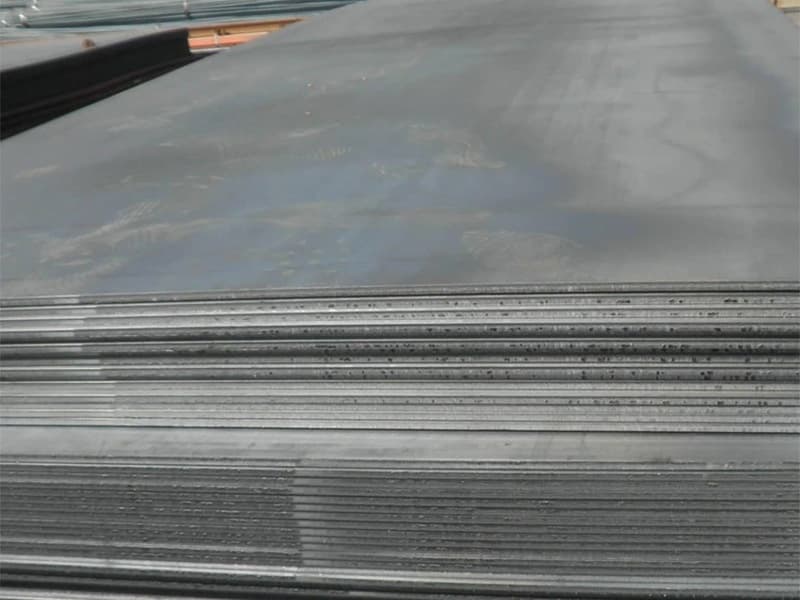
Let me explain the three levels of load distribution.
Level 1 – Container Weight Distribution for Vessel Loading
When containers are loaded onto a vessel, the ship’s stability depends on the vertical and horizontal distribution of weight.
Basic rules for vessel loading:
- Heavy containers go in the bottom rows (near the keel). This lowers the center of gravity and improves stability.
- Light containers go in higher rows.
- Weight should be balanced port vs. starboard (left vs. right) to avoid a list.
- Weight should be distributed along the length to avoid excessive bending stress on the hull (trim and shear force).
For a group of containers on the same vessel:
- Give the vessel planner a list of container weights.
- Let the planner decide the stowage positions. Do not ask for a specific position unless you have special requirements (e.g., cold storage).
Level 2 – Load Distribution Inside Each Container
Inside a container, the weight must be spread evenly across the floor. The container floor is not designed to support heavy point loads.
Rules for inside container:
- Use dunnage (timber) to spread the weight of steel plates.
- The combined weight of the stack must not exceed the container’s payload (28‑30 tons).
- The weight should be centered over the container’s axles when on a truck. For a 20ft container, place the center of the stack 1‑2 meters from the front wall (closer to the truck’s axles).
- Do not put all the weight at the very back or very front – that will lift the truck’s front wheels or overload the rear axle.
Level 3 – Port Crane Limits
Every port crane has a safe working load (SWL). For example, a typical mobile harbor crane might have SWL of 45 tons. A gantry crane at a container terminal might have SWL of 40‑50 tons.
What you must do:
- Ensure that no single lift (bundle, flat rack, or plate) exceeds the crane’s SWL.
- If your plates are heavy, split them into smaller bundles.
- Ask the port ahead of time what the crane limits are.
- If your cargo exceeds the crane limit, you will need a heavier crane (more expensive) or a different loading method.
Example: A 50‑ton plate cannot be lifted by a crane with SWL 45 tons. You must either find a crane with higher capacity (e.g., 100 tons) or split the plate (not possible) or use a different port.
Load Distribution Checklist for Export Projects
| Check | Action |
|---|---|
| Container weight distribution | Heavier containers in bottom rows, over centerline of vessel |
| Inside container load distribution | Center weight over axles, use dunnage to spread point loads |
| Stack height | Maximum 5‑6 layers, thickest plates at bottom |
| Port crane SWL | Verify each lift is under the crane limit. If not, split bundles or use heavier crane |
| Vessel stability plan | Send container weights to vessel planner before loading |
A Real Example
A supplier in China loaded 30 tons of heavy plates into a single 20ft container. The container floor was overloaded in one area (point load). During transport, the floor punctured. The plates fell out of the container on the truck. The damage was total – $25,000 lost. The supplier learned: always use dunnage to spread the load, and do not exceed the container’s floor load rating. Now they calculate floor pressure in PSI before loading any heavy plates.
Conclusion
Choose the right loading method (container, flat rack, or breakbulk) based on plate size and weight. Stack thickest plates at the bottom with aligned hardwood dunnage between layers. Secure with steel straps, lashing belts, and edge protectors. Distribute weight evenly to meet vessel stability and port crane limits. These steps deliver your steel undamaged.