
Ordering angle steel for one hull section is simple. Ordering for three or four sections at once turns a small mistake into a twenty-tonne error. I will walk you through the take-off method our repeat buyers use, step by step.
To calculate marine angle steel requirements for multiple ship sections, build a take-off per section: list every frame, stiffener, and deck beam from the drawings, multiply bar count by cut length to get total meters, apply the kg/m weight for each profile, add 3–7% cutting waste, then sum all sections and round up to standard bar lengths.
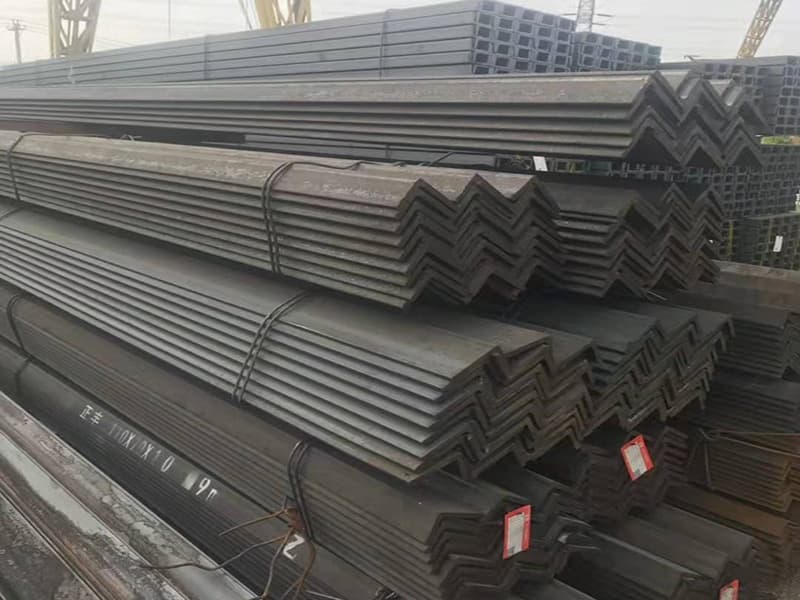
When a buyer sends me drawings for a complete vessel split into sections — stern block, midbody cargo hold, deckhouse — my first question is always the same: is this quote based on a real take-off, or on a guess from an old order? The difference decides whether the steel arrives complete or two weeks late. The method below is the one I use on every multi-section quote at Yichen Steel, and it works whether you buy from us or from any other mill.
How Do You Turn Multiple Ship Section Drawings Into an Angle Steel Take-off?
Skipping the drawing-level take-off is the fastest way to underorder. Miss one stiffener line across four sections and you are short by tonnes. Here is how to read the drawings so nothing is left out.
A take-off converts each ship section drawing into a list of angle profiles: mark every transverse frame, longitudinal stiffener, and deck beam, note its size and cut length, then multiply by the number of positions from the frame spacing. Every section gets its own list before you merge them into one order.
Mark Every Angle Job in the Section First
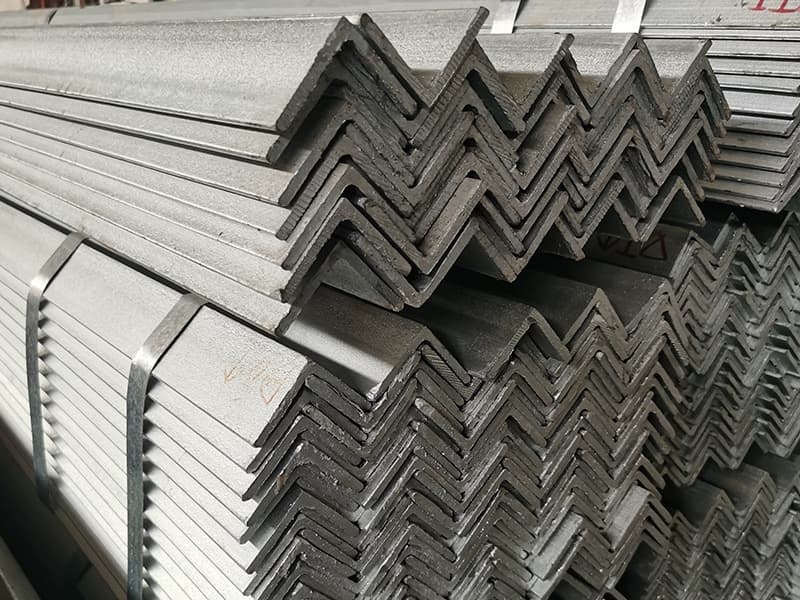
Start with the midship section plan and the profile drawings of each block. In a typical merchant hull, marine angle steel does three jobs. Transverse frames run up the sides like ribs — on smaller vessels and in the ends of large ships, these are the main support, usually unequal-leg angles like 150×90×12 at 600–900 mm spacing, with the long leg welded to the shell plate. Longitudinal stiffeners run the length of the ship inside the double bottom, along the sides, and under the deck — usually equal-leg angles like 100×100×10 or 120×120×10. Deck beams support the deck plating from below, often equal-leg angles around 75×75×8 to 130×130×11. Mark each of these on the drawing with a color, because they will become separate lines in your take-off table.
Do not forget the small stuff. Brackets at frame ends, floors in the double bottom, bulkhead stiffeners, and ladders and platforms all consume angle steel, and together they often add 10–15% to the frame count. I have watched a Vietnamese yard redo a material list because the estimator counted frames but not brackets. The vessel did not stop construction — but the second order paid second freight.
Read the Spacing, Then Count the Positions
Frame spacing is printed on the drawings, typically 600 mm for transverse frames, around 800 mm for longitudinal spacing, and 700–750 mm for deck beams. Divide the section length by the spacing to get the number of positions. A 24 m stern block at 600 mm spacing gives 40 frame positions per side, or 80 pieces once you count both sides. Write that number down per line item. This simple division is where most take-off errors hide, because people round down instead of up. Forty and a half positions is forty-one frames — the steel does not care that the drawing shows a half space at the bulkhead.
Build One Table Per Section, Then Merge
For each section, make a table with these columns: item, profile size, cut length, pieces per side or position count, total pieces, total meters. Merge the section tables at the end. Keep the section tables separate until then, because fabrication schedules deliveries block by block. When Gulf Metal Solutions in Saudi Arabia ordered plate and angle from us, they wanted steel released section by section so their fabrication line never ran dry — that only works if your take-off preserves the section breakdown. If you want the full per-line method, see our guide to estimating angle steel quantities from drawings.
How Do You Convert Frame Counts Into Meters, Weight, and Bar Quantities?
Counting pieces is not enough. Your supplier quotes in kilograms and tons, and your mill rolls bars in standard lengths. The conversion from pieces to an order is where the math gets technical.
Convert pieces to meters by multiplying piece count by cut length, then meters to weight using the profile’s kg/m value — for an angle, kg/m ≈ [(leg1 + leg2 − thickness) × thickness × 0.00785]. Add 3–7% cutting waste and round the total up to standard bar lengths of 6, 9, or 12 m.
The Two Formulas You Actually Need
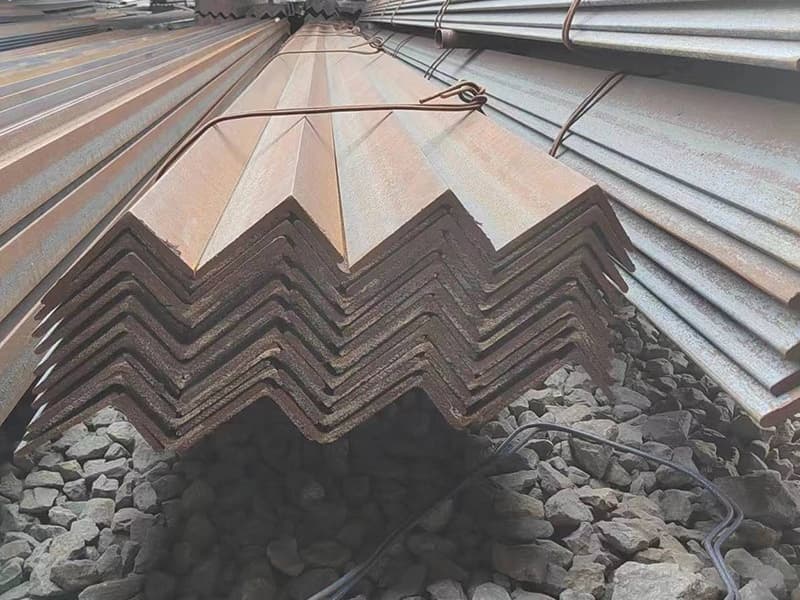
For quick estimates at the desk, use the theoretical weight formula: kg/m = [(A + B) − t] × t × 0.00785, where A and B are the leg lengths in millimeters and t is the thickness. For 100×100×10: (100 + 100 − 10) × 10 × 0.00785 = 14.88 kg/m, which matches the standard table value of about 14.9. Ship repair estimators use an even simpler shortcut with steel specific gravity 8: weight in kg = L × (W1 + W2) × Th(m) × 8, measuring legs and length in meters. Both formulas ignore the root radius at the heel, so they run about 1% heavy on mid-size angles — good news when you are budgeting freight.
Better yet, use the mill’s own table. A few values worth keeping in your head: 100×100×10 is about 14.9 kg/m, 120×120×10 is about 18.2, 150×90×12 is about 21.5, 150×150×10 is about 23, and 75×75×8 is about 9.0 kg/m. When a buyer quotes from the table rather than from a rounded guess, the quotation and the invoice agree, and nobody argues about a half tonne at payment.
A Worked Example Across Three Sections
Here is a real-shaped example using the structure from the previous section. Take a small cargo vessel split into three blocks:
| Section | Angle item | Profile | Spacing | Pieces | Cut length | Total meters | kg/m | Weight |
|---|---|---|---|---|---|---|---|---|
| A — Stern block (24 m) | Transverse frames, both sides | L150×90×12 | 600 mm | 80 | 5.0 m | 400 m | 21.5 | 8,600 kg |
| A — Stern block | Frame brackets (+10%) | L150×90×12 | — | — | mixed | 40 m | 21.5 | 860 kg |
| B — Midbody (30 m) | Longitudinals, 12 lines, both sides | L100×100×10 | 800 mm | 24 lines × 30 m | 30.0 m | 720 m | 14.9 | 10,728 kg |
| C — Deckhouse (15 m) | Deck beams | L75×75×8 | 750 mm | 20 | 10.0 m | 200 m | 9.0 | 1,800 kg |
| Total | 1,360 m | ≈ 21,990 kg |
Add cutting waste — I plan 5% on frames and brackets, 3% on long straight longitudinals — and the order lands near 23 tonnes. Round up to 12 m bars: 1,360 m plus waste needs about 117 bars, so order 120. That is the number that goes on the purchase order, not the 21.99 theoretical figure.
Choose Bar Lengths Before You Finalize the Count
Bar length choice decides how much steel ends up as offcuts. This is the comparison that saves or wastes the most money on a multi-section order:
| Standard length | Typical offcut on 5 m frame cuts | Typical offcut on 10 m deck beams | Best for | Watch out for |
|---|---|---|---|---|
| 6 m bars | Low — one cut per bar, 1 m offcut | One beam per bar, clean | Sections with short pieces and brackets | More weld joints in long runs |
| 9 m bars | Moderate — 4 m offcut per bar unless shared | One beam plus 1 m spare | Mixed blocks | Offcut pile grows fast |
| 12 m bars | Good if two 5 m cuts share one bar | One beam plus 2 m, or shared | Longitudinals and long frames | Needs longer trucks and yard space |
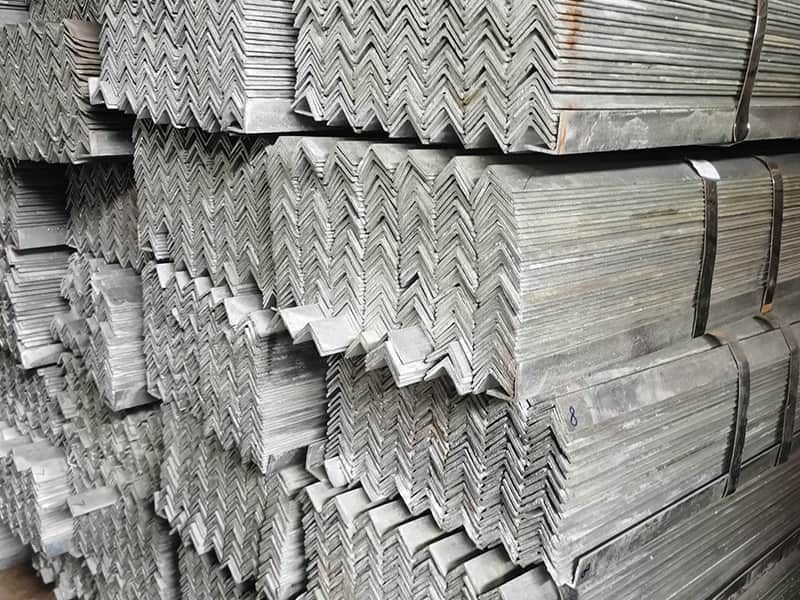
On the midbody, 12 m bars let each bar feed two 30 m longitudinals with a plan for end-to-end butt welds. On the stern block, 6 m bars match the 5 m frame cuts with almost nothing left over. Ordering everything in 12 m because the freight rate per tonne looks better is a classic false economy — I have seen the offcut skip at a Philippine yard filled with usable 4 m ends that nobody had planned to use. Cutting your bars is also worth a quote: ask whether the mill can supply cut-to-length angle steel so offcuts never leave the rolling plant.
Check the Weight, Then Check It Again
Before the order leaves your desk, do the two-way check. Convert your total meters back to weight per profile group, and compare the sum against your section-by-section estimate. They should agree within a percent or two. Then, when the steel arrives, weigh a few sample bars: actual weight per meter within about ±5% of theoretical is normal mill tolerance, but a consistent shortfall means thinner legs than specified and a section modulus below the drawing. Our own quality checklist ties weight deviation straight back to strength, because weight is not only a freight number — it is a proof of structure. For the certification paperwork that must accompany the steel, see the angle steel documentation checklist.
Which Order Mistakes Cost the Most When Buying for Several Ship Sections?
The take-off math is only half the job. Multi-section orders fail in coordination, not in arithmetic — and each mistake below has cost one of our buyers real time.
The costliest multi-section mistakes are merging sections too early, forgetting grade differences between blocks, ignoring mill minimum heat quantities per grade, and rounding down positions. Each one delays fabrication or forces a second order with second freight and second inspection.
Merging Sections Too Early
I covered this above, but it earns repeating because it is the most common. When you merge four section tables into one line item of “L100×100×10, 2,000 m”, you lose the ability to release steel per section, and you lose the ability to check each block’s material against its own drawing. Keep the tables separate, merge only for the purchase order, and attach the section breakdown as an annex. Fabricators downstream will thank you.
Forgetting That Different Blocks Need Different Grades
Not every section uses the same steel. Ice-class bows, and any block facing low design temperatures, need D, E, DH, or EH grades, while a mild deckhouse can run grade A or AH36 at most. Mixed-grade orders also mean mixed mill heats — a mill will not roll 400 kg of EH36 as a leftover; they batch by grade. Ask early whether your small-grade quantities can ride on an existing heat or must trigger a minimum. Our reference cross-walk of classification society grade designations shows how the same steel carries different marks from ABS, DNV, LR, BV, KR, and CCS.
| Mistake | What it costs | How to prevent it |
|---|---|---|
| Merging sections too early | Cannot release steel per block; errors invisible | Keep section tables separate until the PO |
| One grade assumed everywhere | Classification rejection on cold-region blocks | Mark grade per section from the drawings |
| Ignoring heat minimums | Forced over-order or second rolling run | Ask the mill about grade batching at RFQ stage |
| Rounding positions down | Short shipment, crane idle | Always round positions up |
| No waste allowance | 3–7% shortfall discovered at fabrication | Plan 5% frames, 3% long runs |
| Ordering 12 m bars for short cuts | Offcut scrap pile, wasted tonnage | Match bar length to cut length per section |
Ordering Without a Release Schedule
A 23-tonne order is not one delivery — it is a sequence. Sections get assembled in a yard order, so steel should arrive in that order. Tell your supplier which section goes first and agree a release plan, even for a single shipment: bundle labels per section, brackets packed with their frames, and the deckhouse angles loaded last so they come off first. One of the reasons Gulf Metal Solutions kept reordering from us was packaging and loading order — their crew unloaded section by section without re-sorting bundles on the quay. Steel that arrives sorted is steel that starts fabrication the same morning.
Skipping the Joint Inspection Point
Last one, and it is the cheapest insurance on the list. Before the angle steel ships, agree who checks what: surface defects like scabs, cracks, slivers, and laps; length tolerance within ±50 mm; and the mill test certificate against your ordered grades. On multi-section orders, inspect per section batch, not per vessel, so one bad bundle never contaminates four blocks. We support third-party inspection such as SGS before shipment, and I always push buyers to use it on their first order with any new supplier — including us. Trust is good, but a surveyor’s stamp is faster.
Conclusion
Build the take-off per section, convert with real table weights, add honest waste, and order in bar lengths that match your cuts — then multi-section angle steel orders run like one big easy order.