
Book the wrong box and marine angle steel either will not fit or cannot legally move. One miscalculation on length or payload, and the container sits at the gate.
A 40 ft container carries about 26.5 t of marine angle steel, which is 1,700–2,900 m depending on size. A 20 ft container carries 21.6–27 t but cannot take 6 m bars. Weight, not volume, always limits the load.
I watched a 40 ft box get rejected at a gate in Qingdao because the declared weight was 1.4 t light and the axle scale disagreed. Nothing was wrong with the steel. The planning was wrong. Container capacity for marine angle steel is three numbers, not one: length fit, payload, and the legal road weight at destination. Miss any one of them and the cheapest quotation in your inbox turns into the most expensive shipment of the quarter.
Which Container Type Can Actually Take Marine Angle Steel Bars?
Most capacity mistakes start with a tape measure, not a scale. A 6 m bar will not enter a 20 ft box, and a 12 m bar barely enters a 40 ft one.
A 20 ft container has 5.898 m of internal length, so 6 m bars do not fit. A 40 ft container has 12.032 m, so 12 m bars fit with only 32 mm to spare. Cut to 5.8 m if you need 20 ft boxes.
The Internal Length Is Shorter Than You Think
Container sizes are sold as nominal 20 ft and 40 ft, but the steel sits inside the box, not on the outside. A 20 ft general purpose container measures 5.898 m internally. A standard 6 m angle bar is 102 mm too long, and no amount of pushing changes that. We cut to 5.8 m for 20 ft shipments, or we move the order into a 40 ft box. Those are the two honest options.
Loading 6 m bars diagonally does work in theory. The diagonal of a 20 ft floor is about 6.35 m, so the bar goes in. Then it burns floor area, blocks the door end, and puts a permanent bend in the bundle that the yard has to straighten before it can be used. I have never seen a buyer accept that trade twice.
| Container | Internal L × W × H (m) | Nominal volume | Typical tare | Structural payload |
|---|---|---|---|---|
| 20GP | 5.898 × 2.352 × 2.393 | 33.2 m³ | 2.2–2.4 t | ~28 t |
| 40GP | 12.032 × 2.352 × 2.393 | 67.7 m³ | 3.7–3.8 t | ~26.7 t |
| 40HC | 12.032 × 2.352 × 2.698 | 76.3 m³ | 3.9 t | ~26.5 t |
| 40OT | 12.032 × 2.352 × 2.350 | ~76 m³ | 3.9 t | ~28.5 t |
| 40FR | 12.032 × 2.438 × 2.000 | open | 5.0 t | ~30.5 t |
The 40 ft box is the workhorse for a reason. 12.032 m of internal length takes a 12 m bar with 32 mm total slack, which is 16 mm at each end. That is thinner than a strap buckle. In practice we plan 11.8 m as the safe maximum for a standard 40 ft and quote true 12 m only when the buyer accepts that the last 200 mm gets threaded in by hand, with two men on the door and a soft sling.
The Door Opening Steals the Last 100 mm
The door opening is smaller than the internal section on every dry container: 2.340 m wide and 2.280 m high on a 40 ft GP. A bundle that measures 2.30 m across will not pass, even though the box is 2.352 m wide inside. This is where loading plans fail on paper and get fixed with a knife on the floor.
Bundle width has to be designed against the door first, then against the internal width, and the tighter of the two wins. That single line prevents most of the cutting, re-strapping and re-marking that shows up as a labour charge on the loading invoice.
When Open Top or Flat Rack Is the Honest Answer
Above 12 m, or above roughly 28 t in a single unit, a standard box is the wrong tool. A 40 ft open top loads from above with a crane and accepts profiles that will not thread through a door. A 40 ft flat rack takes over-length cargo and about 30 t, at a freight premium that only makes sense when nothing else fits.
For a single 13 m trial order the flat rack is correct. For 20 t of 12 m angle it is money burnt, because the steel would have gone into a standard 40 ft for less. We quote both and let the buyer see the difference, rather than quietly upselling the expensive option. A buyer who understands why the flat rack costs more comes back for the next order; a buyer who feels pushed does not.
Why Does Weight Run Out Before Volume in an Angle Steel Container?
Everyone checks the cubic metres first. For steel sections the cubic metres never bind. Weight binds, and it hides three tonnes of trouble.
Marine angle steel has a stowage factor near 0.7–1.0 m³ per tonne, so 26.5 t fills only 30–40% of a 40 ft container. Payload, the destination road limit and the verified gross mass stop the load, not volume.
The Arithmetic Behind One Container
Every angle quotation starts from the same line: kg/m = [(A + B) − t] × t × 0.00785, where A and B are the legs and t is the thickness in millimetres. From that one formula you get the tonnage that fits.
Take L100×100×10 at 15.1 kg/m. A 12 m bar weighs 181 kg. A 40 ft container with 26.5 t of usable payload takes 146 bars, or 1,752 m of angle. The same box takes 585 bars of L50×50×5 and only 98 bars of L125×125×12. The container does not change. The meterage changes by a factor of six.
| Section | kg/m | 12 m bars in 26.5 t | Total metres |
|---|---|---|---|
| L50×50×5 | 3.77 | 585 | 7,029 |
| L75×75×8 | 9.03 | 244 | 2,935 |
| L100×100×10 | 15.1 | 146 | 1,753 |
| L125×125×12 | 22.5 | 98 | 1,178 |
| L150×150×12 | 27.3 | 80 | 971 |
Two things go wrong with this arithmetic once it reaches the yard. First, buyers quote the structural payload and forget the tare. A 40 ft box weighs 3.7–3.9 t empty, and that weight already sits inside the 30,480 kg gross limit, so the cargo allowance is not 30 t. Second, they plan at 100% of payload and leave nothing for dunnage, matting, straps and timber bulkheads. On a 26.5 t load, blocking material runs 150–300 kg. It looks trivial until the weighbridge reads 200 kg over.
Where the Volume Actually Goes
Angle steel looks bulky because of the V. The section is mostly air. L100×100×10 carries 19 cm² of steel inside a 100 × 100 mm envelope, so even a perfectly nested stack is about one-fifth steel by cross-section. Nesting improves the ratio. It never fixes it.
Work the numbers the other way and the picture is clear. 26.5 t of L100 angle at a stowage factor of about 0.85 m³/t occupies 22.5 m³. A 40 ft GP holds 67.7 m³. The load uses a third of the box and the remaining two-thirds is air above the stack. A 40 ft high cube adds 8.6 m³ of that air and not one kilogram of legal payload. That is why we almost never quote a high cube for a full-container angle order. It is a taller empty space, and the buyer pays freight on it.
This is also why mixing sizes helps. A container built from one size of angle leaves a predictable air gap. A container built from two sizes of different leg length and one short cut length fills part of that gap and can add 1–2 t of loadable steel without touching the weight limit. On a route where freight is the biggest line item, that is the cheapest tonnage a buyer will ever find.
The Road Limit Sits Below the Box Rating
A 20 ft container is rated for about 28 t of cargo. On most trade lanes it will not move at 28 t. Road law at destination, chassis limits and carrier acceptance rules set a lower ceiling, often between 21.6 and 27 t, and overweight surcharges begin well before the structural limit. The box is rarely the constraint. The truck under it is.
I check three numbers before quoting a full container: the payload on the CSC plate, the carrier’s accepted weight for that lane, and the destination axle limit. When they disagree, the smallest one wins. Saudi Arabia and Vietnam do not apply the same number, so a quotation built on the Chinese export limit can fail at Dammam [Zora will replace].
How Should Bundles Be Built for the Container, Not the Crane?
A bundle built for the yard crane is often too wide for the door. Then the loader cuts the straps, and your heat numbers walk away.
Build angle bundles 1.0–1.15 m wide and 2–3 t each, so two fit across the 2.352 m floor and the crane still lifts them. Nest open side down, mat between layers, and strap at 1.2–1.5 m centres.
Bundle Width Is a Container Number
The internal width is 2.352 m and the door is 2.340 m. Split that in two and you get 1.17 m per bundle if you want two rows side by side. A bundle of L100 bars laid flat is 100 mm per bar plus nesting, so 10 bars measure about 1.05 m, a clean fit for two rows. A bundle of 17 bars measures 1.7 m, and the second one will not go in.
Bundle weight has a second ceiling: the crane at the loading bay and the forklift at the destination. Two to three tonnes is the range most yards can handle with standard gear. A 5 t bundle needs a bigger hook and a bigger forklift, and the buyer may not have either. We default to 2.5 t [Zora will replace] for that reason, and we say so on the quotation so nobody plans a lift the site cannot make.
Nesting, Matting and the 5–8 mm Rule
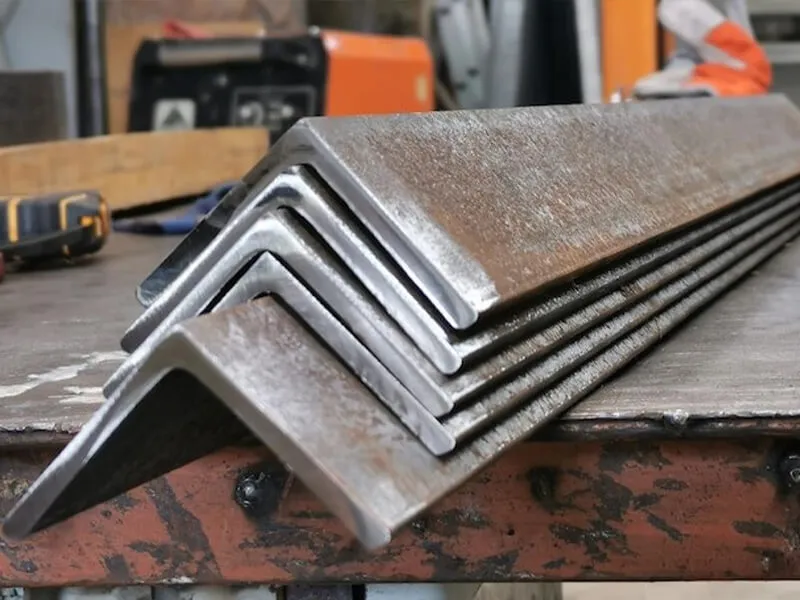
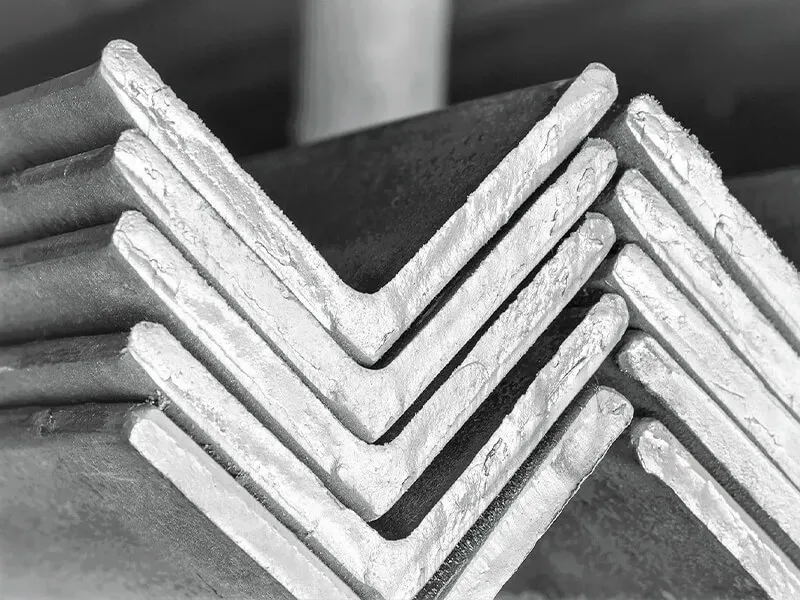
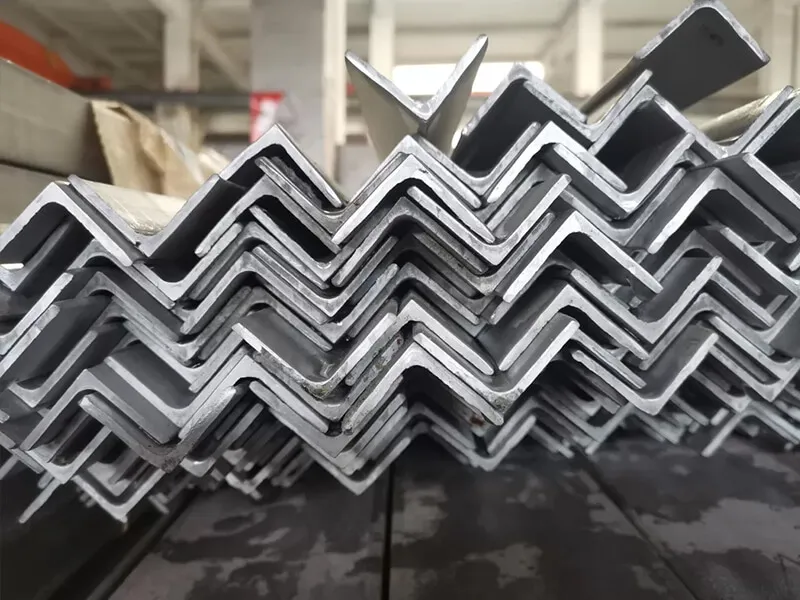
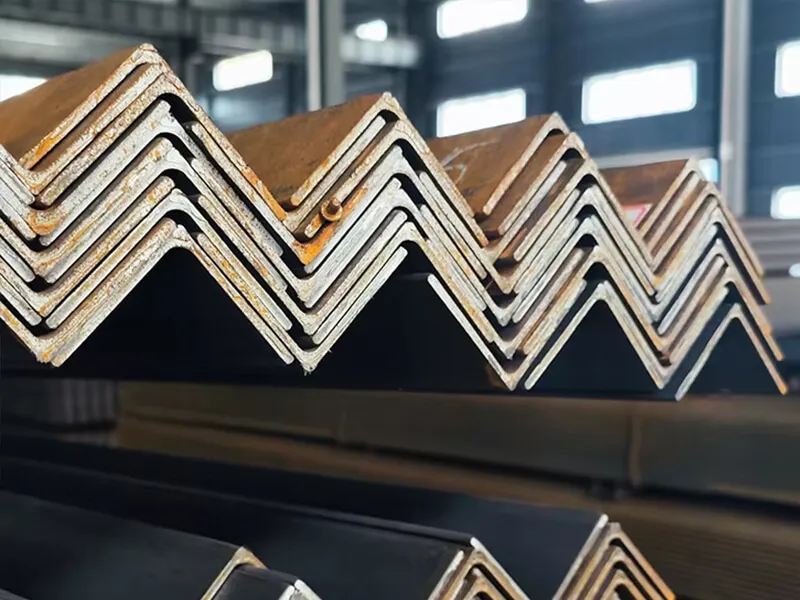
Nesting keeps a stack from walking. Angles nest open side down, one inside the next, and the stack becomes a shallow V-shaped block. Above that block, alternate the open side left and right on every layer. If every angle faces the same way, the whole stack leans one direction under vibration and the straps take the load instead of the steel.
Between layers we lay 5–8 mm rubber matting or old conveyor belt. It does two jobs. It stops the edge of one bar imprinting into the bar below, which is a surface defect a surveyor will write up on arrival. It also raises the friction coefficient enough that the stack does not slide as a block when the vessel rolls. Bare steel on bare steel is about 0.2 friction. With matting it roughly doubles, and that difference is the whole lashing calculation.
| Section | kg/m | Max layers flat in 40 ft | Main risk |
|---|---|---|---|
| L40×40×4 | 2.42 | 8–10 | Deformation, strap slip |
| L50×50×5 | 3.77 | 7–8 | Bowing, end damage |
| L63×63×6 | 5.72 | 6–7 | Imprinting, sliding |
| L75×75×8 | 9.03 | 5–6 | Layer shift |
| L100×100×10 | 15.1 | 3–4 | Single-bar weight, strapping |
| L125×125×12 | 22.5 | 2–3 | Forklift room, lifting gear |
These layer counts are field numbers for a 40 ft floor, not a calculation from a code. They assume flat stacking, matting between layers and a strapped bundle. Small sections take more layers because they bend instead of crushing. L100 and above take three or four, because a single bar at 181 kg is already awkward to handle and the bottom layer carries the whole stack.
Lashing That Survives the First Swell
A dry container has no cargo lashing points worth the name. The D-rings in the side rail are rated far below a 2.5 t bundle, and relying on them is how cargo ends up against the door on arrival. The real securing is blocking: timber across the full width at 1.5–2 m intervals, wedges driven against the side walls, and a bulkhead at the door end so nothing can reach the doors.
Then cross-lash with polyester straps in an X pattern at each end of the stack. Straps stop the bundle lifting and shifting. They do not stop it sliding, so the timber does that job. Every strap gets a protector where it crosses a cut edge, because a sharp corner cuts webbing at about 40% of its rating and a strap that fails at sea is worse than no strap at all.
I have opened a container in Dammam with the timber still standing and the straps slack, and that is exactly what you want. The steel had not moved a millimetre in 22 days, so the straps had nothing to hold. Slack straps on arrival are a good sign. Tight straps and a bent bulkhead mean the load was moving the whole way.
What Must the Loading Plan Prove Before the Doors Close?
The last hour on the floor decides the claim. Distribution, lashing and the VGM are all signed by the shipper, not the carrier.
A workable loading plan keeps roughly 60% of the weight in the front half, spreads point loads over dunnage, reserves 5–8% of payload for blocking, and closes with a weighed VGM before the doors are sealed.
The 60/40 Distribution Rule
The CTU Code asks for the centre of gravity near the middle of the box. The working rule is about 60% of the weight in the front half and 40% in the rear. Angle steel makes that easy to miss, because bundles are long and the heavy end is not obvious once the stack is four layers deep.
Spread the load by bundle weight, not bundle count. Two 2.5 t bundles at the front with three 2.5 t bundles behind them is 5 t against 7.5 t, which is rear-heavy but still inside the band for a 12 m stack that sits mostly forward of centre. The reverse layout, all the heavy bundles at the door, is what breaks a chassis on the road leg and what makes the doors spring open at the destination.
Point loads matter just as much. A 2.5 t bundle sitting on two narrow skids concentrates weight on a few floor boards, and container floors are built for distributed load, not for a steel edge. We put 100 mm dunnage under every bundle at 1.5 m centres and keep the heaviest bundles over the cross-members rather than between them.
VGM Is the Number You Sign
Since July 2016, SOLAS has required a verified gross mass for every packed container, and the shipper named on the bill of lading signs it. There are two legal methods: weigh the whole packed box on calibrated equipment, or add cargo, packing, securing material and tare. Method two is arithmetic, and arithmetic is where the mistakes live.
The tolerance is tight. Many jurisdictions accept ±5% or ±1 t, whichever is smaller, and a container without a valid VGM is not loaded at all. On a 26.5 t cargo that 1 t allowance is 3.8%, so a payload planned at 100% of the carrier limit has no room for a weighing error. I plan at 95–97% and leave the rest for matting, timber and the scale.
Method two also needs the tare from the CSC plate of the actual container, not from a data sheet. Two boxes of the same nominal size can differ by 200–300 kg. Use the plate, photograph the plate, and keep the photo with the shipping documents.
The Photo Record That Wins Claims
Before the doors close, photograph the loaded box from the door end, both long sides, the stack height against a tape, the timber bulkhead, and the strap pattern. Then photograph the seal number. Six photos take two minutes and settle most cargo claims before they start.
We do this on every Gulf Metal Solutions shipment into Dammam, together with an SGS attendance before sealing. Their comment after the first container was that our packaging was the best they had received from a Chinese supplier. The photos were part of why they could say that with confidence. A claim needs evidence, and the loading bay is the only place to collect it.
The table below is the comparison I use when a buyer asks which container is cheapest. The honest answer depends on the bar length first, the payload second, and the road limit third.
| Option | Takes 6 m bars | Takes 12 m bars | Realistic angle payload | Best for | Main risk |
|---|---|---|---|---|---|
| 20GP | No (5.898 m) | No | 21.6–27 t | Cut lengths up to 5.8 m, mixed sizes | Payload rejection at the gate |
| 40GP | Yes | Yes, 32 mm total slack | 24–26.5 t | Standard 6 m and 11.8 m orders | Door-end blocking overlooked |
| 40HC | Yes | Yes | 24–26 t | Nothing, for dense angle | Paying freight on air |
| 40OT | Yes, crane loaded | Yes | ~28 t | Over-length bars, crane-only ports | Higher freight, weather exposure |
| 40FR | Yes | Yes, over-length allowed | Up to ~30 t | 13 m+ bars or 28 t+ units | Freight premium, no side walls |
Conclusion
Count length, payload and road weight before you count cubic metres. On angle steel the smallest of the three decides the shipment, and the VGM confirms it.