
A bundle that shifts at sea arrives bent and rejected. Lashings loosen, bars bend, and your shipment becomes a claim instead of a delivery. The fixes are cheaper than the loss.
Marine angle steel bundles stay put at sea when three layers work together: timber dunnage and cradles that raise friction, direct lashings sized to the CSS Code rule of thumb, and welded stoppers or timber wedges that block the remaining gaps. Photograph every layer before the hatch closes.

Most buyers think cargo securing starts with rope and wire. It starts earlier, with how the bundle itself is built. In my eleven years shipping marine steel out of Liaocheng, I have seen claims traced back to a missing timber skid far more often than to a weak turnbuckle. This article walks through the forces that actually move a bundle at sea, the packing and blocking that comes before any lashing, the lashing methods that hold best on breakbulk vessels, and the paperwork that protects you when the discharge surveyor climbs aboard. I will also link you to two companion pieces on container loading capacity and choosing between container and breakbulk shipping, because the securing method depends on the transport mode you picked at the quotation stage.
What Forces Actually Move a Steel Bundle in a Rolling Sea?
Bundles do not move because the sea is rough. They move because transverse acceleration peaks at the exact moment friction drops, and the lashing plan never accounted for both at once.
A rolling ship applies roughly 0.8 g transverse and 0.3 g longitudinal acceleration to deck cargo, while vertical acceleration cuts the normal force and starves friction at the worst moment. The CSS Code rule of thumb answers this by demanding securing capacity equal to the full cargo weight on each side.
The Acceleration Numbers Behind the Calculation
The advanced calculation method in Annex 13 of the IMO Code of Safe Practice for Cargo Stowage and Securing starts with acceleration tables, not with rope. For deck stowage the basic figures work out near 0.8 g transverse and 0.3 g longitudinal, before the allowances for wind pressure and sea sloshing are added. Under deck, in the tween or the lower hold, the transverse numbers fall, which is why breakbulk stowage under hatch is inherently friendlier to steel sections. The transverse figure already includes the gravity component acting parallel to a heeled deck. So picture the bundle at the top of a roll: the ship leans, gravity pulls the bundle sideways along the deck, and the horizontal inertia of several tonnes of steel joins in.
The cruel part is vertical. The same tables carry a vertical acceleration term that, when the ship heaves downward, reduces the normal force pressing the bundle against the deck. Friction is a product of normal force and coefficient. Drop the normal force by half, and your friction drops by half, at the exact instant the transverse force is peaking. This is why a bundle that survived loading without a creak can slide forty minutes into a gale.
Why Friction Never Carries the Load Alone
Friction depends entirely on the surface pair, and steel is the worst partner in the book. The Annex 13 tables put the coefficient at about 0.1 for steel on steel and about 0.3 for steel on timber. Run the arithmetic on a working bundle. Seventeen bars of L100×100×10 at 15.12 kg/m and 12 m make roughly 3 tonnes. At 0.8 g, the transverse force on that bundle is about 24 kN. On bare steel deck, friction resists a measly 3 kN. On dry timber dunnage it resists about 9 kN. The remaining 15 kN belongs to the lashings, and the numbers get worse when rain, mill scale, or a film of primer grease sits between the surfaces. I once watched a stevedore in [Zora will replace] spray water to settle dust around stowed bundles, and I made them re-dry the dunnage before we closed the hold. Nobody plans for water, but water is exactly what the North Sea supplies.
What the Rule-of-Thumb Actually Demands
The rule-of-thumb method is deliberately conservative, and that is why I like it. It requires the total MSL, the maximum securing load, of all securing devices on each side of the item to equal the weight of the item itself. It assumes a transverse acceleration of 1 g, ignores friction completely, and ignores lashing angle losses. When the standard pretends friction does not exist, a buyer who counts on friction is stacking hope against physics. For balance calculations, each device’s calculated strength is its MSL divided by a safety factor of 1.5. Two more clauses matter for angle steel. Transverse lashings should run to the deck at angles not greater than 60 degrees; steeper lashings help against tipping but cannot be counted against sliding. And lashings that simply run over the top of the bundle, called top-over lashings, only add pretension and friction, so they cannot be credited in the balance calculation at all. Also remember the MSL of a lashing is set by its weakest link, the wire, the shackle, the turnbuckle, or the deck lashing point.
| Surface pair under the bundle | Typical coefficient μ | Friction on a 3 t bundle | What it means at 0.8 g |
|---|---|---|---|
| Steel on steel (bare deck) | about 0.1 | about 3 kN | Lashings carry over 87% of the load |
| Steel on timber dunnage | about 0.3 | about 9 kN | Lashings still carry about 15 kN |
| Steel on timber plus anti-slip mat | higher, type-dependent [Zora will replace] | needs a mat datasheet | Never assume; verify from the supplier |

How Should You Pack and Block Bundles Before the Lashings Go On?
Securing starts in the yard, not on the quay. A badly built bundle fights every lashing you throw at it, and no wire can save a package that is already falling apart inside.
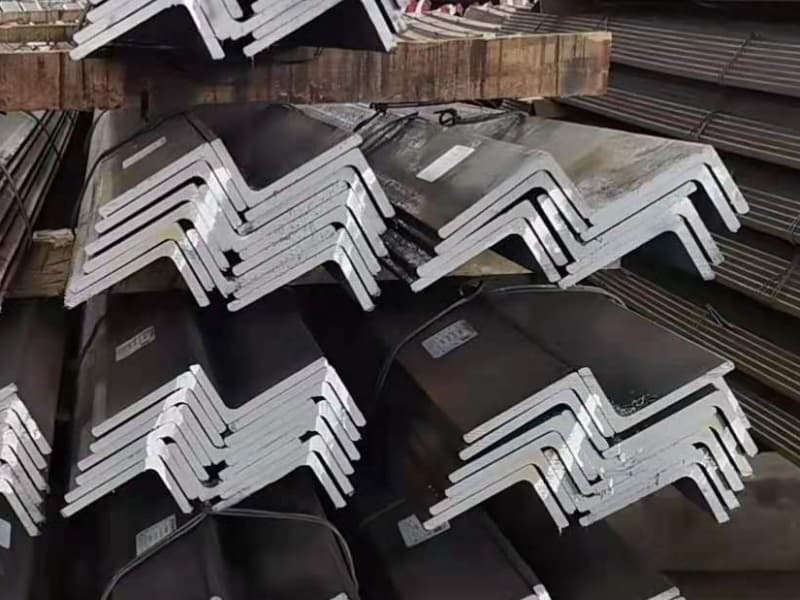
Build each bundle as one rigid unit: aligned bars, steel strapping with edge protectors, and timber cradles under the profile. Then raise it on dunnage, wedge every gap, and fill every void, because a bundle that cannot start moving never needs stopping.
Build the Bundle So It Behaves Like One Piece
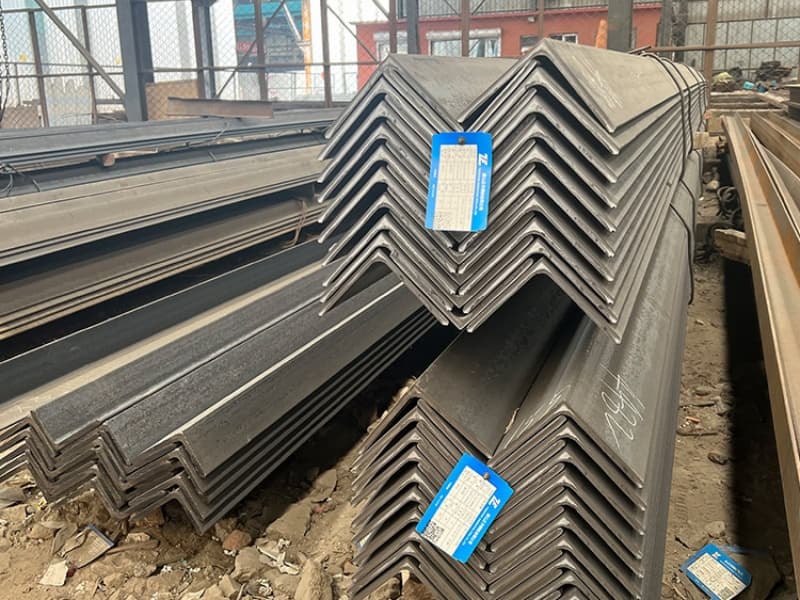
A bundle of marine angle steel is not naturally one object. Each bar inside can slide against its neighbours, and once the outer bars walk a few centimetres, the strapping loses tension and the bundle breathes. We strap our export bundles with steel banding fitted with edge protectors at every corner, so the banding bites the pack without cutting into the paint or the bar edges. Equal-leg bundles stack neatly; unequal-leg bundles want timber cradles that hold the profile upright, because an unequal angle laid flat will roll on its heel at the first heavy roll. Keep bundle weights in the 2 to 5 tonne range so yard cranes and vessel stevedores handle them with standard gear [Zora will replace]. And align the bars before strapping, flush at both ends. An unaligned bundle presents a ragged face to the lashing wire, and the wire finds the protruding bar first.
Dunnage and Blocking Come Before Any Wire
Dunnage is the cheapest insurance in the whole chain. Use dry hardwood bearers, 100 by 100 mm is the common size, laid in rows so the bundles sit level and air can move underneath on the voyage. The timber raises friction from steel-steel to steel-timber, keeps salt water off the bars, and gives the lashings something to bite against. Keep the timber dry during loading, and keep spare bearers on the quay, because a bundle set directly onto a wet deck has already lost the argument. After the bundles are landed, the blocking starts. Drive timber wedges into the gaps along the sides, nail battens across the ends, and fill the voids between bundle rows, because the void is the runway the bundle uses to accelerate. In breakbulk stow under hatch, we land bundles in tiers aligned fore and aft, plank between tiers, and for the top tiers we ask the vessel crew for welded steel stoppers, which Annex 13 treats as a first-class securing device. Inside containers the same logic applies with different tools: lashing bars, anti-slip mats under skids, and timber bracing packed hard against the door end. A gap you leave empty at the loading port is a dent you find at the discharge port.
Which Lashing Methods Hold Best for Breakbulk Angle Steel?
There are two schools of lashing, and only one of them survives a proper survey. Top-over straps are fast, direct lashings are tedious, and the difference shows up at sea.
Direct lashings, wire rope or chain running from the bundle to fixed deck securing points at angles under 60 degrees, carry real calculated strength. Top-over straps only add friction, welded stoppers block sliding outright, and the strongest plan combines all three.
Direct Lashings Beat Top-Over Straps
A direct lashing is a continuous load path: wire rope or chain, a turnbuckle or bottle screw for tension, shackles at each end, and a fixed lashing point on the deck structure. The force path runs from bundle to lashing to ship, and the balance calculation can count every newton of it. We prefer direct wire lashings with turnbuckles for breakbulk angle steel, tensioned hand-tight plus a bar turn, and a chain lashing for the heavier plate parcels that ride in the same hold. Two habits make them work. First, fit softeners, timber corner pieces or rubber sleeves, wherever the wire crosses a sharp corner, because angle steel edges are exactly the kind of chafe point that quietly cuts a lashing to half strength over a two-week voyage. Second, re-tension after the first day. Timber dunnage compresses, and a lashing tensioned at the quay is a slack lashing by the time the ship clears the pilot station. Mark each turnbuckle with paint after final tension, so any mid-voyage check, at a port call or by the crew, can see at a glance whether a lashing has worked loose. I learned this from a chief mate in [Zora will replace] who walked the hold every morning at sea and clicked every turnbuckle a quarter turn. His cargo never moved. Mine, before I copied him, once shifted 60 millimetres, which is nothing on paper and a full claim at discharge.
Stoppers, Wedges and Filling the Voids
Direct lashings stretch a little, even steel wire. That is why the strongest securing plans block the bundle geometrically, so the lashings never have to work at full stretch. Welded steel stoppers, small steel blocks welded to the deck against the bundle sides, convert sliding into a static stop, and the Annex 13 amendments treat them explicitly in the balance calculation. Timber chocks nailed against the bundle ends do the same job in the fore-and-aft direction. Between tiers, planks and wedges stop the upper bundle using the lower one as a slide. For stowage in the lower hold, where accelerations are lower but access for re-tensioning is nil, geometric blocking carries even more of the job. The comparison below is how I explain the options to buyers planning their first breakbulk parcel.
| Lashing method | Best use | Strengths | Limits |
|---|---|---|---|
| Top-over webbing strap | Light bundles, quick deck work | Fast, cheap, tool-free | Not creditable against sliding; pretension decays |
| Direct wire lashing with turnbuckle | Standard breakbulk angle bundles | Calculable strength, re-tensionable | Needs deck lashing points; chafe protection essential |
| Chain lashing | Heavy parcels, plate and thick sections | High MSL, minimal stretch | Rigid; needs rated hooks and points |
| Welded stoppers plus timber wedges | Lower hold, long voyages | Geometric stop, no reliance on elasticity | Needs vessel crew approval and welding work |
How Do You Prove the Bundles Stayed Secured Until Discharge?
When a bundle shifts, the argument starts at discharge and the evidence has to come from loading. Everything the receiver will accept, the insurer will accept, and the court will accept is photographed before the hatch closes.
A lashing plan agreed before sailing, third-party lashing survey reports, and a photo pack of every tier, dunnage row and stopper taken at the load port form the evidence chain that decides any shift claim.
The Lashing Plan and the Photo Pack
The lashing plan is a drawing, one page per stow position, showing bundle arrangement, dunnage rows, lashing points, angles and the MSL of each device. We prepare it before vessel nomination, because the master needs to approve it and the port captain needs to check it against the ship’s securing arrangements. At loading, the photo pack follows a fixed script: dunnage before the bundles land, each tier as it is completed, wedges and battens in place, stoppers welded, lashings tensioned, and a last frame of the whole stow before the hatch cover comes down. Timestamps on those photos do more work in a claim than any letter ever drafted. When we ship for Gulf Metal Solutions to Dammam, they ask for SGS lashing inspection before shipment, and their feedback has been that our packaging is the best they have received for ship steel. That is not luck; that is the photo script and the lashing plan doing their quiet job. One habit I would force on every exporter: walk the stow one last time after the surveyor leaves. Surveyors sample. Ship owners sail with what is actually in the hold.
What to Agree Before the Steel Leaves the Mill
Securing fails on contract gaps as often as on wire. Agree in writing who supplies the dunnage and timber, who pays the lashing labour, and who re-inspects at any port call where the vessel works other cargo. Ask for the CSS Code rule-of-thumb compliance to be stated on the lashing plan, and keep the MSL certificates for the wire, shackles and turnbuckles with the shipping documents, because a lashing without a rated capacity is just rope with an opinion. Define the notification window for shift damage at discharge, and require the receiver to photograph before restow. These clauses cost nothing at signing and settle arguments that would otherwise eat the margin of the whole parcel. Our export documents pack already carries the mill certificates, and we simply file the securing evidence beside them. Buyers who skip this step learn the hard way that the carrier’s liability starts and ends with the word “properly” in a sentence nobody can prove. And one last practical note: keep a named person on each side, your lashing contact and the vessel’s officer, who can reach each other by phone during loading. Half the securing failures I have witnessed were really communication failures. The crew welded stoppers where the plan showed chocks, the plan showed chocks because nobody asked, and the parcel sailed with a compromise nobody had calculated.
| Evidence item | Taken by | When | Why it decides claims |
|---|---|---|---|
| Lashing plan | Shipper | Before vessel nomination | Sets the standard the stow must meet |
| Dunnage and blocking photos | Shipper or surveyor | As stow progresses | Proves friction and blocking layers |
| Third-party lashing survey | SGS or equivalent | Before hatch closure | Independent confirmation of the plan |
| Full-stow final photo | Shipper | Last frame before closing | Baseline for any discharge survey |
| MSL certificates for devices | Shipper | With shipping documents | Proves the lashings were rated, not guessed |
Conclusion
Prevent shifting with friction, direct lashings and stoppers, in that order. Size everything to the CSS Code rule of thumb, photograph the stow before the hatch closes, and your cargo arrives as cargo.