
Bent or distorted marine angle steel stalls fit-up, burns welding hours, and can fail classification survey. I will show you how to judge, straighten, or reject each piece before it ever reaches the assembly line.
Inspect every angle on arrival against EN 10056-1 straightness limits (0.15% of length), sort defects into bow, twist, and leg-angle distortion, then cold-straighten minor damage, hot-straighten moderate damage within temperature limits, and reject kinked or cracked pieces outright.
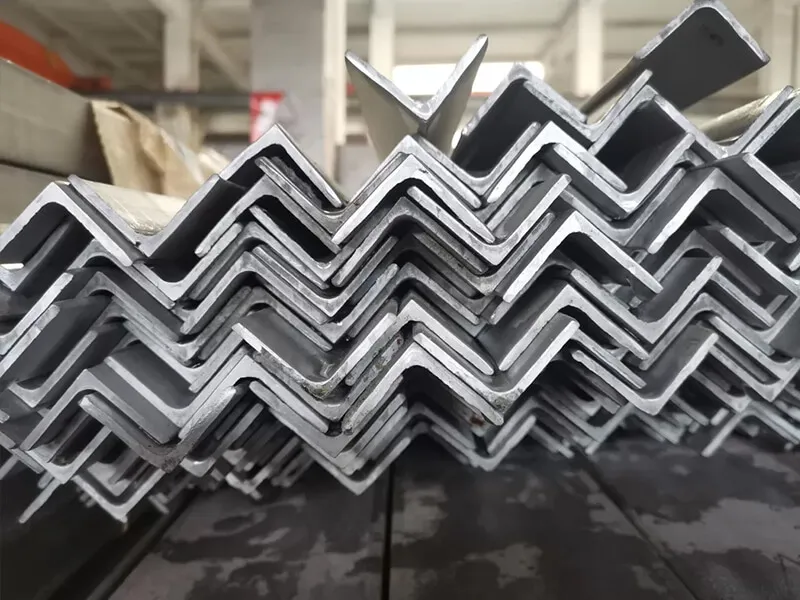
I have been selling marine angle steel from Liaocheng for years, and the calls I dread most are not about price. They start like this: the vessel discharged yesterday, the yard opened the bundles, and three meters of 100×100×10 are visibly bowed. Nobody photographs the bundle before unloading, so nobody can prove whether the bend happened at the mill, in transit, or on the yard’s own forklift. That argument is avoidable, and so is most of the damage itself. In this article I will walk you through where the distortion comes from, how to decide whether a piece can be saved, how to straighten it properly when it can, and how to stop the problem from repeating on the next shipment.
Why Does Marine Angle Steel Arrive Bent or Distorted in the First Place?
A bowed or twisted angle is almost never a rolling defect alone. It is the result of stress accumulating through the supply chain, and each handover adds a little more.
Angle steel distortion builds up in three stages: residual stress locked in during hot rolling, mishandling during loading and transport such as single-point lifting or misaligned dunnage, and poor yard storage where supports are not vertically aligned. Knowing the source tells you who pays for the fix.
What the Mill Puts In
Hot rolling leaves residual stress behind by design of the process, not by negligence. The legs of an angle cool at different rates, the flange tips cool faster than the root, and that uneven contraction locks a pattern of internal stress into every bar. A well-run mill controls this with roller straightening after rolling, and a compliant bar leaves the mill within the straightness tolerance of EN 10056-1: 0.15% of length, with a minimum allowance of 3 mm for pieces up to 5 m and 5 mm above that. JIS G 3192 uses a very similar rule, and ASTM A6 works from weight-per-foot tables instead. So a bar that arrives within 15 mm of bow over a 10 m length is technically in tolerance, even if it looks crooked laid on the ground. The real trouble starts when handling forces add to that baseline.
What Transport Adds
Sea freight is hard on open sections. I watched a bundle of unequal angles being unloaded at [Zora will replace] with a single sling around the middle, and the two overhanging ends sagged under their own weight before the bundle even touched the quay. A two-leg balanced lift with slings placed at the quarter points keeps the bar straight; a single-point lift guarantees a bow. Misaligned dunnage does the same damage more slowly. When the timber bearers under a stack are not vertically aligned, the weight of the upper layers bends the lower bars between supports. Dunnage spaced 3 to 4 m apart is standard practice, and supports must line up through the stack so the load passes through the wood, not through the steel. Sharp strap tension across an unsupported edge can also kink a thin leg, and forklift tines prying between bars leave local dents that are worse than a smooth bow because they create a sharp stress raiser.
What the Yard Does to Itself
Some of the worst distortion I see was created after delivery. Angles dragged off a stack by hooking the top piece stress the legs. Bundles pushed off a truck rather than lifted land on one end and take a set. Outdoor storage with the open side of the angle facing up traps water between bars, and while that is mainly a corrosion problem, standing water plus stack pressure also marks the surface. Our own packaging earned a compliment from Gulf Metal Solutions in Saudi Arabia partly for this reason: they told us our bundling was the best they had received for ship steel, because every bearer was aligned and every bundle survived the road from Dammam port without a single new bow. That is not luck. It is a packing standard.
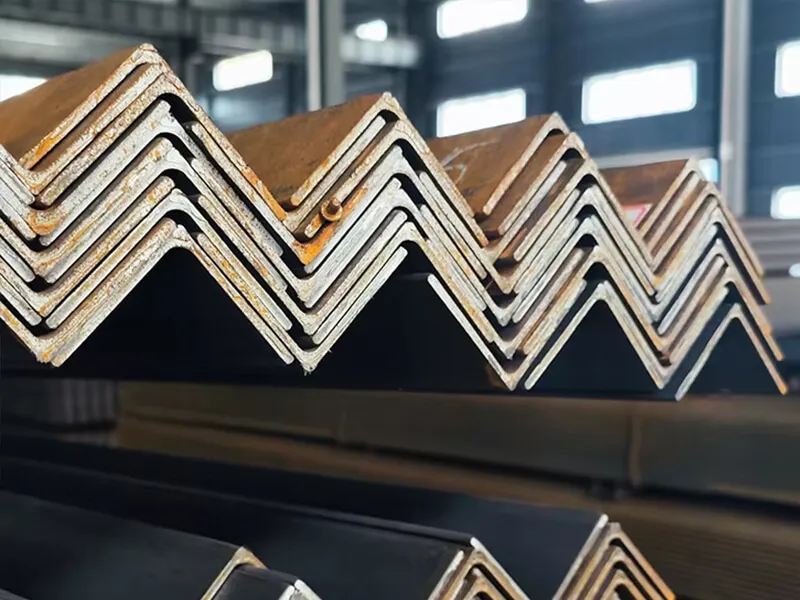
| Distortion type | What it looks like | Usual trigger | How to detect it fast |
|---|---|---|---|
| Bow (sweep) | Smooth curve along the length | Single-point lifting, unsupported overhang, misaligned dunnage | String line along the leg edge; measure max gap |
| Twist | One leg rotated out of plane relative to the other | Torsion during rolling, clamping only one end during handling | Lay on a flat plate; one leg rocks while the other sits flat |
| Leg-angle (open or closed) | Included angle more or less than 90° | Uneven cooling at the mill, prying with tools | Square or protractor against the inside face |
| Local dent or kink | Sharp, short-radius deformation | Forklift tines, strap edges, impact during discharge | Visual plus straightedge over the damaged zone |
When Can You Straighten a Distorted Angle and When Must You Reject It?
Not every crooked bar is scrap, and not every crooked bar is saveable. The decision needs a rule, not a mood, because a surveyor will ask for one.
Judge each piece against the standard, not the eye. A bar within 0.15% of length straightness needs no correction. Smooth bows and mild twists can be straightened cold or hot. Kinks, cracks, and dents with sharp radii must be rejected, because straightening cannot restore the section’s integrity.
Start With the Numbers, Not the Eye
Before anyone lifts a hammer, measure. Stretch a taut string along the leg edge and measure the maximum gap with a ruler or feeler gauge. For a 12 m angle the EN 10056-1 allowance is 18 mm; anything at or under that is compliant stock, and “straightening” it is optional, not required. I would still note it on the receiving report, because a bar sitting near the tolerance edge will fight you during fit-up. If the measurement exceeds tolerance, check whether the deformation is smooth or sharp. Smooth curvature spreads plastic strain over a long radius and responds well to correction. A kink concentrates strain in a few centimetres, and no straightening process reliably restores a kinked section without risking a crack. Classification surveyors treat it the same way: smooth, documented correction is acceptable; uncontrolled repair of sharp damage is not.
Match the Method to the Damage
Cold straightening suits minor and moderate damage on ordinary-strength grades. A hydraulic press or roller straightener works the bar back with incremental force, and good practice keeps each correction pass to roughly a third of the remaining deformation, repeating three to five passes rather than forcing it in one go. Hand hammering works for short pieces and light bows, and the hammer should strike the convex side while the bar sits on firm supports, never the concave inner face. Flame straightening handles what cold methods cannot: heavier bows, stiff sections, and twists. The bar’s yield strength drops dramatically in the 600 to 800 °C range, so controlled local heating followed by restraint reshapes the steel with far less force. Normal and higher-strength shipbuilding grades (A, B, D, E, AH32/36, DH32/36) tolerate heating up to about 900 °C, but TMCP and extra high-strength material needs the steelmaker’s confirmation and a lower ceiling, and the heated zone should not be repeatedly cycled. Repeated heating coarsens the grain, and the same spot should not see more than about three thermal straightening cycles.
Know the Reject Signs
Some conditions end the discussion immediately. Reject a piece that shows a crack of any length, whether visible or confirmed by dye penetrant or magnetic particle inspection. Reject kinks and sharp dents, because the local strain has already exceeded what the steel can absorb. Reject any bar that has been straightened so many times the surface shows scaling, hammer marks, or signs of overheating such as a bluish or iridescent tint beyond the accepted range. And reject pieces whose identity has been lost: if the heat number can no longer be traced to a mill test certificate, the bar is structurally fine but commercially dead, because a classification surveyor cannot accept untraceable material into a hull structure. I keep one rule taped above my desk from an old quality manager: steel you cannot prove is steel you cannot ship.
| Condition found on arrival | Verdict | Correct action |
|---|---|---|
| Straightness within 0.15% of length | Accept | Use as-is; note near-limit pieces on the receiving report |
| Smooth bow slightly over tolerance, ordinary grade | Correctable | Cold press or roller straightening in incremental passes |
| Mild twist, no kink | Correctable | Clamp one end, over-rotate slightly past true, repeat; or flame straighten |
| Bow or twist beyond cold capacity | Correctable with care | Flame straightening 600–800 °C, pyrometer monitored, max 3 cycles |
| Kink, sharp dent, or visible crack | Reject | Cut out as demo piece, claim against the supplier with photos |
| Heat number illegible or trace lost | Reject commercially | Do not install in classed structure; negotiate replacement |
How Do You Straighten Bent or Twisted Marine Angle Steel Without Damaging It?
The mechanics matter more than the force. A crew that understands sequence, temperature, and verification will save bars a careless crew would ruin.
Fix twist first, then leg angle, then bow. Use incremental cold force for minor damage, and flame straightening at 600–800 °C for the rest, monitored with a pyrometer and verified afterward with a string line plus dye penetrant or magnetic particle inspection on higher-strength grades.
Set the Sequence Before Any Force Is Applied
An angle with both twist and bow will never come straight if you attack the bow first. Correct the twist, then the leg-angle deviation, then the longitudinal bow. Twisting correction is simple in principle: clamp one end rigidly in a vise or press fixture, grip the other end with a wrench or twist bar, and rotate against the deformation slightly past the true position, then release and repeat. Slight over-correction compensates for elastic spring-back. If both legs of the section are worked in isolation the piece will never come right, because the two legs share one root; always treat the section as a single body. For leg-angle deviation, an open angle (more than 90°) is corrected in a V-block by striking the inclined leg edge, and a closed angle is corrected by placing one leg flat on the platform and working the inner face with a flat tool. Once the section geometry is true, the bow can be addressed by supporting the bar on two blocks, convex side up, and pressing or striking midway between the supports.
Control the Heat Like a Welder, Not a Wrecker
Flame straightening in shipyards is essentially controlled welding in reverse. The torch applies line, wedge, or point heating patterns depending on the defect: line heating along the convex side for longitudinal bow, wedge heating for angular distortion. The target zone reaches 600 to 800 °C, glowing dark red to cherry red, and a calibrated pyrometer must sit within about 100 mm of the heated zone, read by a second person rather than the torch operator. Above roughly 850 °C you risk grain coarsening in carbon and low-alloy steel, so the discipline is real, not bureaucratic. Cooling matters too: ordinary carbon grades can be cooled faster, but low-alloy shipbuilding grades should air-cool slowly, and sudden water quenching on higher-strength material can harden the heated zone. After cooling to ambient temperature, verify. Re-run the string line check, and on high-strength or TMCP material apply dye penetrant or magnetic particle inspection to every straightened zone before sign-off, because a crack introduced by over-temperature work hides until the welder finds it the hard way.
Record What You Did
A straightened bar with no record is a bar a surveyor can refuse. Log the piece identification, the heat number, the defect type and measured magnitude before correction, the method used, the maximum temperature reached for any heated work, and the post-correction measurement. Attach the NDT result if one was performed. This takes five minutes per bar and it converts “we fixed it” into evidence the classification society will accept. In my experience the yards that skip the paperwork are the ones repeating the same corrections on the next shipment, because nothing forces the root cause upstream to be fixed.
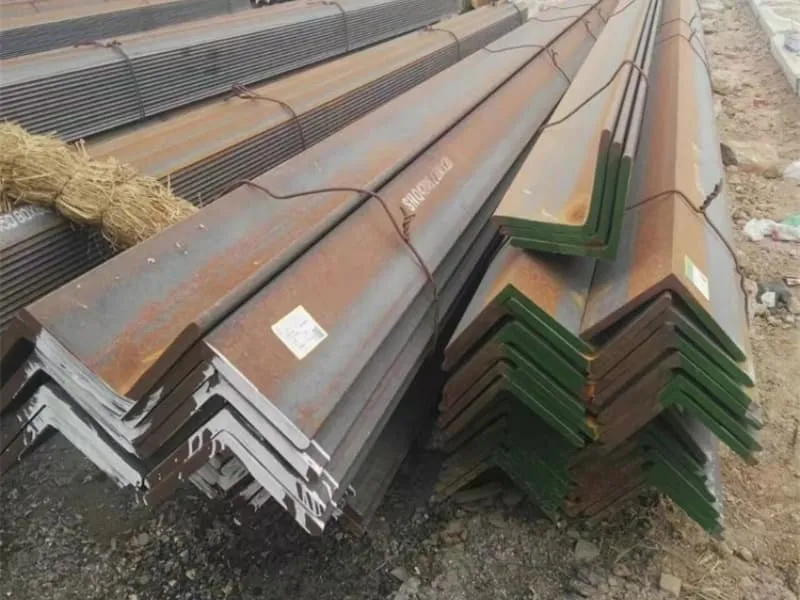
| Aspect | Cold straightening | Flame (hot) straightening |
|---|---|---|
| Best for | Smooth minor bows, mild leg-angle deviation | Heavy bows, stiff sections, twist, localized hard set |
| Equipment | Hydraulic press, roller straightener, hammer and supports | Oxy-fuel torch or induction, pyrometer, restraint fixtures |
| Temperature | Ambient | 600–800 °C (max about 900 °C for A/B/D/E, AH/DH grades) |
| Skill risk | Low; damage limited to over-force marks | High; grain coarsening and cracking if overheated or over-cycled |
| Verification | Re-measure straightness | Re-measure plus MPI/DPI on high-strength and TMCP material |
| Cycle limit | 3–5 incremental passes per defect | Maximum about 3 heating cycles per location |
How Do You Stop the Next Shipment from Bending Before It Reaches Your Yard?
Straightening is a cost you pay twice: once in labour and once in delay. Prevention at the ordering and receiving stage is cheaper than every fix in this article.
Put straightness tolerance and packing requirements in the purchase order, verify bundles on arrival with a string line before unloading is signed off, store angles on vertically aligned dunnage with the open side down, and lift with two balanced slings. These four habits eliminate most transport-induced distortion.
Write the Requirement Into the Purchase Order
A purchase order that says only “marine angle steel, 100×100×10, grade A” invites the minimum effort. Add the tolerance clause explicitly: straightness to EN 10056-1 (0.15% of length), out-of-square within the standard’s limit, and any project-specific rule from your classification society stated over the top. Ask the supplier to confirm the tolerance class in writing before production starts. The same applies to packing: aligned dunnage, bundle strapping that protects the leg edges, and lifting points marked for quarter-point slings. When we ship to wholesale buyers, this kind of clause costs us nothing because it matches our standard packing, but it filters out suppliers who bundle steel loosely and let the road do the bending. I tell buyers the blunt version: the supplier who argues about a packing clause is the supplier who packs badly.
Build Receiving Inspection Into the Delivery Routine
Make the string line check part of discharge, not something done “later in the week”. Photograph each bundle while still secured on the truck or under the vessel’s lifting gear, before anyone cuts the straps. Measure straightness on a sample of bars from each bundle, log the numbers, and compare against the purchase-order clause. If a discrepancy appears, the photographs plus measurements are your claim file, and a supplier with a proper quality culture will replace the pieces without a fight. Gulf Metal Solutions built exactly this routine after their first order with us, and their receiving disputes dropped to zero across subsequent shipments. The check takes one crew member twenty minutes per truck, and it is the cheapest inspection your yard will ever run.
Store and Lift Like the Steel Is Still Warm
Storage discipline costs nothing and pays constantly. Stack on timber dunnage raised 0.3 to 0.7 m off the ground depending on surface, keep bearers vertically aligned through the stack, limit manual-handling stack heights to about 1.2 m, and lay outdoor angles open side down so water cannot sit in the channel. Heavier sections go low, lighter sizes on top. Withdraw stock FIFO so no bundle sits under a pile for a season. For lifting, two slings at the quarter points, load low, no dragging. One personal observation from our own yard in Liaocheng: the bundles that came back to us as “bent on arrival” complaints were, more often than either side wanted to admit, bent between the truck and the stack by a forklift driver in a hurry. Slow the last ten meters down and half the problem disappears.
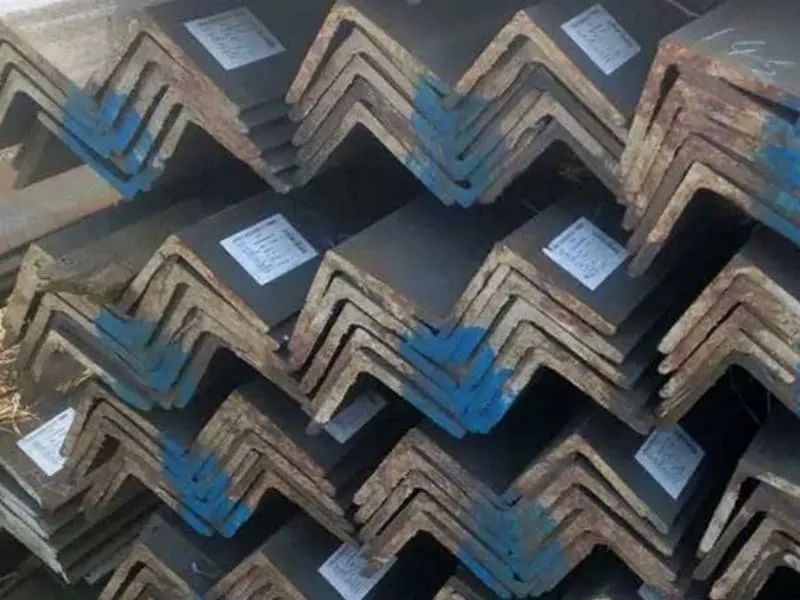
| Practice | Reactive yard (fix after damage) | Disciplined yard (prevent the damage) |
|---|---|---|
| Purchase order | Grade and size only | Tolerance clause + packing standard confirmed in writing |
| Receiving | Unload first, inspect when convenient | Photograph secured bundles, string-line sample before sign-off |
| Lifting | Single-point lift, fastest method | Two slings at quarter points, load kept low |
| Storage | Ground contact, random bearers | Aligned dunnage, raised base, open side down, FIFO |
| Documentation | Verbal “we fixed it” | Correction log with heat numbers, methods, NDT results |
| Dispute outcome | Arguments, partial credit at best | Photo + measurement claim file, fast replacement |
Conclusion
Straightness is a purchase-order clause, a receiving check, and a storage habit long before it is a repair job. Handle the steel gently, judge defects by the standard, and document every correction you make.