
Too much steel costs you money. Too little steel stops your work. You need a smart plan.
Good inventory planning means you keep enough marine angle steel for your next 4 to 6 weeks of work. You also need a safety stock for delays. And you must track your usage every week. This balance saves you from high storage costs and missed deadlines.

I have helped many shipyards in Vietnam, Qatar, and Saudi Arabia fix their steel stock problems. Let me share what works and what does not.
How to Calculate the Right Marine Angle Steel Stock Levels for Your Shipyard?
You do not want empty racks. But you also do not want steel sitting outside for a year. So how do you find the right number?
You calculate your stock level by using three numbers: your average weekly usage1, your supplier’s lead time2 in weeks, and a safety factor3 of 1.5 for unexpected delays. Multiply these three together. That is your minimum stock4 in tons. I have used this formula with shipyards5 in Malaysia and Pakistan with great results.
[^6] stock levels shipyard](https://cnmarinesteel.com/wp-content/uploads/2026/01/Marine-angle-steel-53.webp)
Let me break down the formula and show you a real example.
I am Zora Guo. I export marine angle steel to shipbuilders all over the world. One of my buyers in Romania had a big problem. He kept running out of 100x100x10mm angle steel. Every time he ran out, he paid for air freight. That cost him three times the normal price. He asked me: "How much should I keep in stock?"
I sat down with him and built a simple calculation. Here is how it works.
Step 1 – Find your average weekly usage
Look at your last three months of production. Add up the total tons of marine angle steel you used. Divide by 12 weeks. That is your average weekly usage.
For example, let us say you used 240 tons in 12 weeks. Your average is 20 tons per week.
Step 2 – Know your supplier’s lead time
Lead time is the time from when you place an order to when the steel arrives at your shipyard. This includes production time, shipping time, and customs clearance.
For me, shipping from Liaocheng to Dammam port takes about 35 days. That is 5 weeks. But I always add one extra week for possible delays at the port or in customs. So my lead time is 6 weeks.
Step 3 – Add a safety factor
Things go wrong. A mill stops production. A ship gets delayed. Your supplier misses a batch. So you need extra steel to cover these surprises.
For most shipyards, I recommend a safety factor of 1.5. That means you keep 50% more than your normal usage during lead time.
Step 4 – Do the math
Here is the formula:
Minimum stock (tons) = Average weekly usage × Lead time (weeks) × Safety factor
Using our numbers:
20 tons/week × 6 weeks × 1.5 = 180 tons
This means you should never let your stock fall below 180 tons. When you hit 180 tons, you place a new order for 120 tons (which is 20 tons × 6 weeks). By the time that new order arrives, your stock will be low but not empty.
Real example from my buyer in Romania
He used 15 tons per week. His lead time from my factory to his yard in Constanta was 5 weeks. Safety factor 1.5. His minimum stock was 15 × 5 × 1.5 = 112.5 tons. He started ordering 75 tons (15 × 5) every time his stock hit 112 tons. He never ran out again. And he stopped paying for expensive air freight.
Here is a table you can use for your own shipyard:
| Your weekly usage (tons) | Lead time (weeks) | Safety factor | Minimum stock (tons) |
|---|---|---|---|
| 10 | 5 | 1.5 | 75 |
| 20 | 5 | 1.5 | 150 |
| 30 | 6 | 1.5 | 270 |
| 50 | 6 | 1.5 | 450 |
Adjust the safety factor based on how reliable your supplier is. For a new supplier, use 2.0. For a trusted supplier like my company, you can use 1.3.
What Are the Hidden Costs of Overstocking or Understocking Angle Steel?
Most buyers only think about the price of the steel. But the real costs are hiding in your yard and in your delays.
Overstocking costs you storage space, rust damage, and tied-up cash. Understocking costs you rushed air freight, idle workers, and late delivery penalties. Both are expensive. I have seen shipyards lose 15% of their steel value to rust just because they stored too much for too long.
Let me show you the numbers behind these hidden costs.
I remember a buyer from Mexico. He had a big warehouse full of marine angle steel. He thought he was smart because he bought a lot at a low price. But when I visited his yard, I saw the problem. The steel had been sitting outside for 18 months. The surface was covered in thick rust. Some pieces had pitting so deep that they could not be used for shipbuilding. He had to scrap 40 tons. That was $32,000 gone.
Then there was another buyer from Thailand. He kept very low stock. He ordered only when he ran out. One time, his supplier delayed a shipment by three weeks. His workers had no steel. They stood around doing nothing for 10 days. He paid them anyway. Then he paid for air freight to rush a small batch. That cost him $18,000 extra.
So let me break down the hidden costs for you.
Hidden costs of overstocking1
Cost 1 – Storage space
Steel takes up space. That space could be used for other things. If you rent a yard, you pay per square meter. If you own the yard, you lose the opportunity to use it for something else.
Cost 2 – Rust and corrosion2
Marine angle steel is not stainless steel. It rusts. Even with good storage, surface rust starts after 3 to 4 months. After 12 months, the rust can become pitting. Pitting means the steel loses thickness. You cannot use it for critical parts. I have seen rust damage reduce steel value by 10-20%.
Cost 3 – Tied-up cash3
Steel is expensive. If you have 500 tons sitting in your yard, that is $300,000 to $400,000 of cash that you cannot use for other things. You could have used that money to buy other materials or pay your workers.
Cost 4 – Inventory management cost
You need people to count, move, and organize the steel. More steel means more labor. You also need cranes and forklifts. These have operating costs.
Hidden costs of understocking
Cost 1 – Idle workers4
Your welders and fitters get paid by the hour or by the day. If they have no steel to work on, you still pay them. One week of idle time for a team of 10 workers can cost $5,000 to $10,000.
Cost 2 – Rush freight5
Normal sea freight from China to Vietnam costs about $50 per ton. Air freight costs $500 to $800 per ton. That is 10 to 15 times more. I have seen buyers pay $20,000 in air freight just because they ran out of one size of angle steel.
Cost 3 – Late delivery penalties6
Your customer expects the ship or the foundation on a certain date. If you deliver late because you had no steel, you pay a penalty. Some contracts have penalties of 0.5% of the project value per week. That can be huge.
Cost 4 – Lost trust
This is hard to measure but very real. If you delay your customer once, they might still work with you. If you delay them twice, they find another supplier. That lost business can cost you millions over time.
Here is a simple comparison table:
| Situation | Hidden cost per year (example for 200 tons/year usage) |
|---|---|
| Overstock by 100 tons (held for 12 months) | Storage $2,000 + Rust damage $8,000 + Tied cash $15,000 = $25,000 |
| Understock (two rush orders per year) | Air freight $6,000 + Idle workers $4,000 + Penalty risk $10,000 = $20,000 |
The best place is in the middle. Not too much. Not too little.
How to Organize Your Steel Yard for Fast Access and Damage Prevention?
A messy steel yard costs you time and ruins your steel. Good organization saves you money every single day.
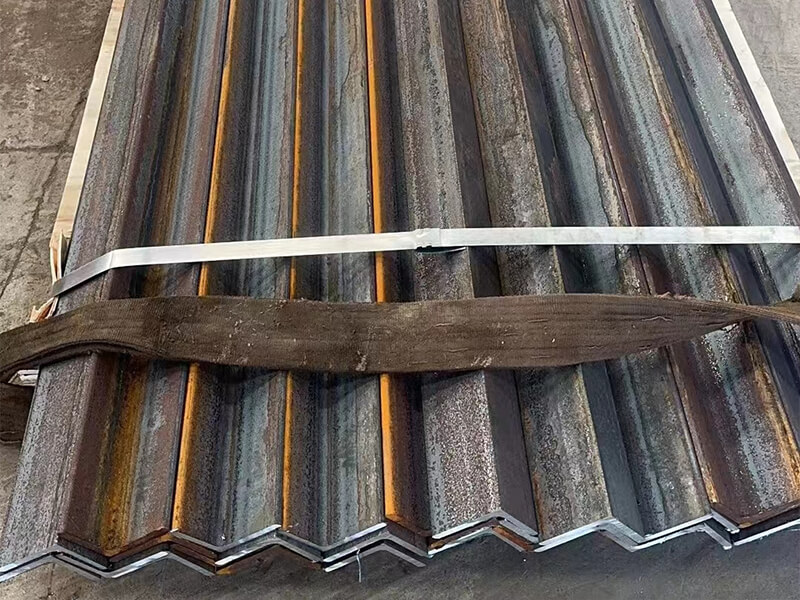
You organize your yard by separating steel by size and grade. Use concrete blocks or steel racks to keep the steel off the ground. Cover the stack with a waterproof tarp. And label every pile with a clear sign. I have visited shipyards in the Philippines and Pakistan. The ones with good organization find steel three times faster and have less rust damage.
[^1] yard damage prevention](https://cnmarinesteel.com/wp-content/uploads/2026/01/Marine-angle-steel-47.jpg)
Let me share the exact system I recommend to my buyers.
I am Zora Guo. I ship marine angle steel to shipyards and wholesalers in more than 15 countries. Over the years, I have seen every type of storage setup. Some are excellent. Most are terrible. Let me tell you about a buyer in Saudi Arabia. His yard was a mess. Angle steel of different sizes was piled on top of each other. To get a 150x150mm piece from the bottom, his workers had to move 10 tons of other steel. That took half a day. After I suggested a simple organization system, he cut his retrieval time from 4 hours to 30 minutes.
Here is my step-by-step system.
1. Keep steel off the ground
Never put marine angle steel directly on dirt or gravel. Moisture from the ground causes rust on the bottom pieces. Use concrete blocks, wooden sleepers, or steel racks. Raise the steel at least 150mm (6 inches) off the ground. This allows air to flow underneath.
2. Separate by size and grade
Do not mix different sizes in one pile. Make a separate pile for each:
- Leg length (e.g., 100x100mm, 150x150mm, 200x200mm)
- Thickness (e.g., 10mm, 12mm, 15mm)
- Steel grade (e.g., A36, AH36, DH36)
Mix them up, and your workers will waste time searching. They will also grab the wrong grade by mistake. That can cause a safety problem later.
3. Use racks for long-term storage
If you plan to keep steel for more than 3 months, put it on A-frame racks. These racks hold the angle steel on its side. The steel does not touch other pieces. Air circulates around every bar. This stops rust and makes it easy to count your stock.
4. Cover with waterproof tarps2
Use heavy-duty PVC tarps. Cover the top and the sides. Leave a small gap at the bottom for air to flow. Do not wrap it tight like a package. Trapped moisture makes rust worse. A loose cover is better.
For extra protection in humid climates (like Malaysia or the Philippines), put silica gel bags under the tarp. Change them every two months.
5. Label every pile clearly
Put a sign on each pile. The sign should show:
- Size (leg x leg x thickness)
- Grade (A36, AH36, etc.)
- Quantity in pieces and tons
- Date of arrival
Use a waterproof marker or a laminated card. I have seen yards use color codes. For example, red tag for AH36, blue tag for A36. That works very well.
6. Set up a first-in-first-out (FIFO) system3
Use the oldest steel first. When new steel arrives, put it behind the older steel. This way, no steel sits for more than 6 months. I tell my buyers: "If a piece of angle steel stays in your yard for more than 8 months, you are losing money."
Here is a simple checklist for your yard manager:
| Task | How often | Who does it |
|---|---|---|
| Check tarps for holes | Every week | Yard worker |
| Check for rust on bottom pieces | Every month | Supervisor |
| Re-stack piles that have shifted | After each storm | Yard worker |
| Update pile labels | When new steel arrives | Storekeeper |
| Move oldest steel to front | Every week | Yard worker |
A buyer from Qatar followed this system. He told me: "Before, we lost about 5% of our angle steel to rust every year. Now we lose less than 1%. That saves us $50,000 per year."
How to Build a Reliable Replenishment Plan with Your Steel Supplier?
You can have the best stock formula and the best yard organization. But if your supplier is slow or unreliable, you will still run out of steel.
A reliable replenishment plan needs three things: a blanket order1 for the whole year, fixed delivery dates2 every month, and a dedicated contact person3 at the supplier. You also need a penalty clause for late deliveries4. I use this plan with my biggest buyers in Vietnam and Mexico. They never run out of steel.
[^5] supplier](https://cnmarinesteel.com/wp-content/uploads/2026/01/Marine-angle-steel-43.jpg)
Here is how to set up a plan that works for both you and your supplier.
I remember a buyer from Pakistan. He used to order steel every time he needed it. Each order was small. Each order took the same amount of paperwork. His supplier got tired of the small orders. They started delaying his shipments. He waited 8 weeks for steel that should take 4 weeks. Then he came to me.
I suggested a different approach. A blanket order for the whole year. Here is how it works.
Step 1 – Forecast your yearly usage
Look at your usage from last year. Add 10% for growth. That is your forecast. For example, if you used 1,000 tons last year, plan for 1,100 tons this year.
Step 2 – Sign a blanket order with your supplier
A blanket order is one big contract for the whole year. It says: "I will buy 1,100 tons of marine angle steel from you this year. You will deliver it in 12 equal monthly shipments of 92 tons each."
Benefits for you:
- Fixed price for the whole year (no surprises)
- Guaranteed delivery every month
- You do not have to make a new contract every time
Benefits for your supplier:
- They know how much to produce
- They can plan their mill schedule
- They can give you a better price
Step 3 – Set fixed delivery dates
Agree on a specific day each month. For example, "Shipment leaves China on the 5th of every month." Put this in the contract. Then mark these dates on your calendar. You will know exactly when to expect each delivery.
Step 4 – Assign a dedicated contact person
Ask your supplier for one person who handles your account. This person knows your sizes, your grades, and your delivery dates. You do not have to explain everything every time. You just send a quick message: "Shipment for May is confirmed?" And they reply.
At my company, I assign a dedicated export sales rep to every big buyer. Gulf Metal Solutions in Saudi Arabia works with one of my team members. That person knows their order history, their preferred packing, and their shipping documents. They told me: "Your response time is the fastest among all our Chinese suppliers."
Step 5 – Add a penalty clause for late deliveries
Write this in your blanket order: "If any monthly shipment is delayed by more than 7 days, the supplier pays a penalty of 1% of that shipment’s value per week of delay."
This clause protects you. It also motivates your supplier to ship on time. I accept this clause in my contracts because I know I can deliver on time.
Step 6 – Review and adjust every quarter
Once every three months, look at your actual usage. If you used more than planned, increase the next monthly shipments. If you used less, decrease them. A good supplier will allow small adjustments.
Here is a sample replenishment schedule:
| Month | Planned tons | Delivery date (at your port) |
|---|---|---|
| January | 90 | Jan 25 |
| February | 90 | Feb 22 |
| March | 90 | Mar 25 |
| April | 100 | Apr 22 |
| May | 100 | May 25 |
| June | 90 | Jun 22 |
| July | 90 | Jul 25 |
| August | 90 | Aug 22 |
| September | 90 | Sep 25 |
| October | 90 | Oct 22 |
| November | 90 | Nov 25 |
| December | 90 | Dec 20 |
This plan gives you a steady flow of steel. No big surprises. No last-minute rush orders. And your supplier loves you because you are predictable.
Conclusion
Calculate your stock needs. Avoid hidden costs. Organize your yard. Then build a steady replenishment plan with a reliable supplier.
My Personal Insights (from 10+ years in marine steel export)
I am Zora Guo. My team in Liaocheng works only with certified mills. We offer flexible monthly deliveries for shipyards and wholesalers. Whether you need marine angle steel, bulb flat steel, or L-shaped sections, we can set up a blanket order that fits your usage. Send me an email at sales@chinaexhaustfan.com or visit cnmarinesteel.com. Tell me your monthly usage and your size range. I will send you a yearly delivery plan with a fixed price.
-
Understanding blanket orders can help you streamline your procurement process and ensure consistent supply. ↩ ↩ ↩
-
Learn how to set fixed delivery dates to improve your supply chain efficiency and predictability. ↩ ↩ ↩ ↩
-
Discover the benefits of having a dedicated contact for smoother communication and better service. ↩ ↩ ↩ ↩
-
Explore how penalty clauses can protect your interests and ensure timely deliveries from suppliers. ↩ ↩ ↩
-
Learn about marine angle steel to understand its uses and benefits in construction and manufacturing. ↩ ↩
-
Learn about the risks of late deliveries to protect your business from financial losses. ↩