
You are building a ship. You order steel plates. But they fail inspection. Now what? That nightmare stops here.
A marine steel plate compliance guide helps global shipyards avoid costly mistakes. It covers classification rules, material properties, paperwork checks, and coating standards. Following these steps ensures your steel passes tests and your project stays on schedule.
You might think buying steel is simple. You order, you pay, it arrives. But with marine steel, the rules are strict. One wrong grade, one missing certificate, and your plates get rejected. Let me walk you through what really matters.
What Are the Key Classification Society Rules (ABS, DNV, LR, CCS)?
You see these letters on every spec sheet. But which ones apply to your order? Getting it wrong means your steel is useless for the project.
Classification societies1 set the rules for marine steel. ABS (American Bureau of Shipping), DNV (Det Norske Veritas), LR (Lloyd’s Register), and CCS (China Classification Society) are the main ones. Each has its own grade names and testing requirements. Your steel must meet the rules of the society that will class your vessel.
Why Different Societies Exist
You might wonder why we have so many classification societies. Each country started its own to ensure ships built there were safe. Over time, they became global. Today, most societies recognize each other’s standards through International Association of Classification Societies (IACS) agreements. But a plate certified by CCS for a Chinese-built ship may not automatically be accepted by ABS for a US-flagged vessel. You need to check with your client and the flag state.
Key Differences Between Societies
The good news? The underlying steel grades2 are similar. They all refer to standards like ASTM, EN, or JIS. But the naming and additional tests vary. For example:
| Society | Common Grade for Hull | Equivalent | Special Requirement |
|---|---|---|---|
| ABS | Grade A, B, D, E | Similar to ASTM A131 | Impact tests for higher grades |
| DNV | NV A, NV B, NV D, NV E | Based on EN 10025 | Stricter tolerance on sulfur content |
| LR | LR Grade A, B, D, E | Similar to ABS | Requires mill to be approved by LR |
| CCS | CCS Grade A, B, D, E | Based on GB standards | Accepts domestic Chinese mills |
From my experience, many shipyards specify one society but accept equivalent grades from another if the certificate shows the correct stamp. But you cannot assume. I had a client in Mexico who ordered plates to ABS. We offered plates made to CCS with an ABS certificate from the mill. The client checked with their surveyor first and got approval. That saved weeks of waiting for a special mill run.
How to Confirm Correct Rules
The safest way is to ask for the "approved manufacturer3" list from the classification society. Big mills like Baosteel, POSCO, or JFE are approved by all major societies. But smaller mills might only have approval from one or two. Before you order, ask your supplier for the mill’s approval certificates. Then send them to your client’s surveyor for pre-approval. This small step avoids the pain of plates arriving and being rejected because the mill isn’t approved.
What Are the Essential Mechanical Properties for Hull and Offshore Structures?
You pick up a plate. It looks strong. But will it crack in freezing water? Will it bend under wave pressure? You need numbers, not guesses.
Mechanical properties tell you how the steel behaves under stress. For hull and offshore structures, the key ones are yield strength, tensile strength1, elongation, and impact toughness2. These are tested and printed on the mill certificate3. If they don’t match the class rule, the plate fails.
Understanding Each Property
Let’s break down what these numbers mean for your project.
Yield Strength – This is the stress at which the steel starts to deform permanently. For common hull steel grades like A, B, D, E, the minimum yield strength4 is usually 235 MPa. For higher strength steels (AH32, DH36, etc.), it goes up to 315-355 MPa. Offshore structures often require higher yield strength to handle heavy loads.
Tensile Strength – This is the maximum stress the steel can take before breaking. It is always higher than yield strength. The ratio between tensile and yield gives you an idea of safety margin. Typical marine steel has tensile strength of 400-520 MPa for mild grades, and 490-620 MPa for high strength.
Elongation – This measures ductility. A longer elongation means the steel can stretch more before breaking. It is important for forming and for absorbing energy in a collision. Minimum elongation for marine steel is usually around 21-22% for a 200mm gauge length.
Impact Toughness – This is critical for ships sailing in cold waters. It measures how much energy the steel can absorb when struck at low temperatures. Grades like D and E require impact testing at -20°C and -40°C respectively. Offshore structures in Arctic regions may need even lower temperatures.
Common Mistakes in Specifying Properties
I often see buyers focus only on grade name. They order "Grade A" and think it’s done. But Grade A has no impact requirement. If the ship will trade in cold areas, you need Grade D or E. Another mistake is confusing thickness effects. A 50mm thick plate may have lower yield strength than a 10mm plate from the same grade. The mill certificate must show values for the actual thickness you buy.
How to Verify Properties on Mill Certificate
The mill certificate (also called EN 10204 3.1 or 3.2) lists all test results. Look for these items:
- Heat number
- Mechanical test values (yield, tensile, elongation)
- Impact test values (if required) with temperature and absorbed energy
- Chemical composition (especially carbon equivalent for weldability)
If any value is missing or borderline, ask the supplier. Borderline values might still pass if they are above minimum. But if they are below, the plate is non-conforming.
How to Verify Mill Certificates and Traceability?
Paperwork is boring until you need it. Then it is everything. Without correct certificates, your steel is just scrap.
Mill certificates1 are the birth certificates of your steel plates. They prove the material meets the grade and class rules. Traceability means you can link each plate back to its heat and test results. Without traceability2, the surveyor will reject the plates.
What a Proper Mill Certificate Contains
A valid mill certificate (3.1 or 3.2) must have:
- Mill name and approval marks from classification societies
- Buyer name and order number
- Product description (grade, dimensions, quantity)
- Heat number and cast number
- Chemical analysis for each heat
- Mechanical test results (including impact if applicable)
- Date of testing and signature of mill inspector
For 3.2 certificates, an independent surveyor (like SGS or Bureau Veritas) also signs, confirming the tests were witnessed.
How to Ensure Traceability During Delivery
When plates arrive at your yard, you must be able to match each plate to its certificate. This is where many projects fail. Plates get unloaded, stacked, and mixed up. Then when the surveyor asks for the certificate for a specific plate, you cannot find it.
Here is a simple process I recommend to my clients:
| Step | Action | Responsibility |
|---|---|---|
| 1 | Mark each plate with heat number and plate number at the mill | Supplier |
| 2 | Provide a packing list that matches the marks | Supplier |
| 3 | Upon arrival, check marks against packing list | Buyer |
| 4 | Store plates by heat and grade, keep a log | Buyer |
| 5 | Give surveyor access to certificates and plates | Buyer |
We always stamp the heat number on each plate with metal stamps. Paint marks can wear off, but stamps stay. We also include a copy of the certificate inside the waterproof packaging. That way, even if the documents get lost, the buyer has a copy with the material.
What to Do If Certificates Are Lost or Incorrect
Mistakes happen. If you find a discrepancy, stop using the plates and contact the supplier immediately. We once had a client in Qatar who received plates with a certificate that had a wrong heat number. The mill had made a typo. We sent a corrected certificate within 24 hours and the surveyor accepted it. If the mistake is real (wrong grade), the supplier must replace the plates. That is why working with a reliable supplier matters. We have long-term relationships with mills, so we can fix problems fast.
What About Coating, Surface Preparation, and Pre-Fabrication Standards?
You have the right steel. But if the surface is rusty or the primer fails, your schedule slips. Coating is part of compliance too.
Marine steel plates usually come with a shop primer. This temporary coating protects the steel during transport and storage. But the primer must be compatible with the final coating system. Surface preparation standards1 like ISO 85012 define how clean the steel must be before coating. If you ignore these, the coating will peel and corrosion starts.
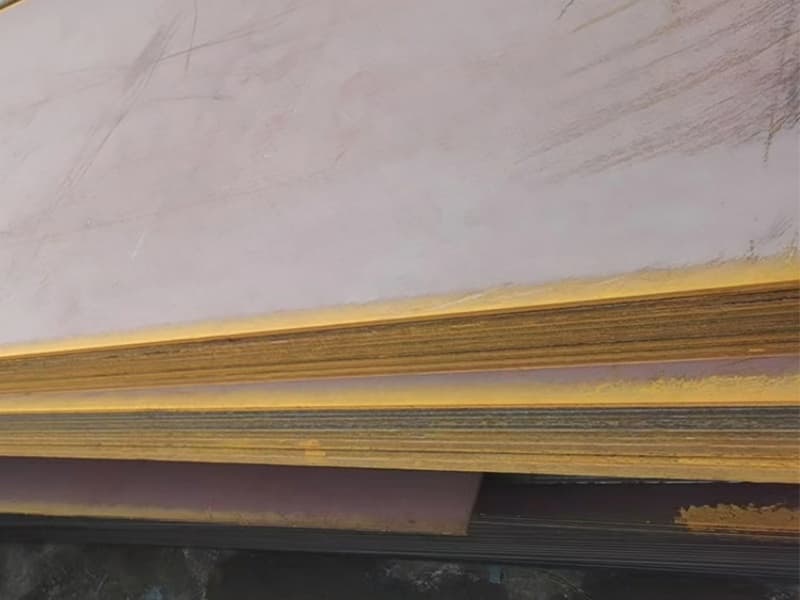
Shop Primer Types and Compatibility
Common shop primers are epoxy, zinc silicate, or alkyd based. Each has pros and cons. Epoxy is good for general protection but may not be compatible with all topcoats. Zinc silicate gives excellent corrosion resistance but requires careful surface preparation if you need to weld through it.
Before ordering, ask your coating supplier which primer they recommend. Then tell your steel supplier to use that primer. We have seen projects where the buyer ordered plates with a standard primer, but the final coating required a specific type. The primer had to be removed by blasting, costing time and money.
Surface Preparation Standards
Steel arrives with mill scale, rust, and oil. Before applying the shop primer, the mill prepares the surface according to standards like:
| Standard | Description | Typical Use |
|---|---|---|
| ISO 8501-1 | Visual standard for rust grades and preparation grades | Specifies Sa2, Sa2.5 blast cleaning |
| ISO 8502-3 | Assessment of dust on surface | Checks cleanliness after blasting |
| ISO 8502-6 | Analysis of soluble salts | Ensures no chlorides remain |
| ISO 8503-1 | Surface roughness profile | Measured by comparator |
If the surface is not clean enough, the primer will not stick. We had a client in the Philippines who complained about primer peeling. We investigated and found that the storage yard was near the sea, and salt spray had contaminated the plates before coating. The solution was to wash the plates with fresh water and reapply primer on site.
Pre-Fabrication and Weldability Concerns
Shop primer3 must also allow welding without producing excessive fumes or porosity. Some primers are "weld-through" approved. Check with your welding engineer. If the primer is too thick, it can cause welding defects. Usually, a dry film thickness of 15-25 microns is safe.
Also consider edge preparation. If you need beveled edges for welding, the supplier can do that before delivery. We offer edge preparation as an option. It saves the yard time and ensures consistent bevels.
Summary Checklist for Coating
Before you place an order, confirm these points:
- Primer type and dry film thickness
- Surface preparation standard (usually Sa2.5)
- Compatibility with final coating
- Weld-through approval
- Storage conditions to avoid contamination
If you cover these, your plates will arrive ready for fabrication.
Conclusion
Marine steel plate compliance is about following rules, checking paperwork, and controlling quality. Do it right, and your ship will sail with confidence.
-
Understanding surface preparation standards is crucial for ensuring proper adhesion and longevity of coatings on steel. ↩ ↩ ↩ ↩
-
ISO 8501 sets essential guidelines for rust and preparation grades, ensuring optimal surface conditions for coating. ↩ ↩ ↩ ↩
-
Exploring different shop primers helps in selecting the right one for your specific coating needs and compatibility. ↩ ↩ ↩
-
Understanding yield strength is crucial for ensuring the safety and durability of hull structures under stress. ↩