
One bad supplier can sink your entire project. I have seen it happen. A shipyard in the UK lost weeks because their steel mill ran out of money. A contractor in North America faced sudden price hikes because their supplier was struggling to survive.
Supplier stability affects marine steel plate projects through financial health and mill capacity, consistent quality and class approvals, long‑term agreements with inventory buffers, and reduced procurement risk for multi‑vessel builds. A financially solid, well‑managed supplier delivers on time, maintains quality, absorbs market shocks, and gives you confidence to plan ahead.
I am Zora Guo from cnmarinesteel.com. I have worked with shipyards that lost everything because they chose the cheapest supplier. I have also worked with shipyards that built long‑term success on stable supplier relationships. The difference is not luck. It is choosing a partner who can withstand storms — both at sea and in the market.
How a Supplier’s Financial Health and Mill Capacity Ensure Uninterrupted Production and On‑Time Delivery
Your supplier quotes a low price. You place a large order. Six months later, the supplier calls: "We cannot deliver. We ran out of money to buy raw materials."Your project stops.
A supplier’s financial health directly determines their ability to purchase raw materials, pay workers, and keep mills running. A financially unstable supplier may delay orders, deliver lower quality, or disappear entirely. Mill capacity matters too — a supplier that relies on a single mill with limited output cannot scale when you need more steel. Strong suppliers maintain diversified mill relationships and healthy balance sheets. They also keep cash reserves for raw material purchases and have access to credit during market downturns. Without financial stability, even the best production plan means nothing.
Let me show you what happens when a supplier loses financial stability.
The Real Cost of Supplier Financial Failure
The Royal Navy’s next‑generation Fleet Solid Support (FSS) project is a cautionary tale. Liberty Steel Dalzell, which had been selected to supply marine steel plates for the project, ran out of funds for raw material procurement and was unable to commence formal production. The plant relied on purchasing steel billets from British Steel for rolling and processing into marine plates, but an inability to pay for those billets forced an interruption of its billet supply chain. Small‑scale trial production in November 2025 yielded only about 1,000 tons of steel plates — equivalent to"roughly three days’output"by factory standards. Employees were receiving only 80% of their wages and remained on standby status. The production disruption was directly linked to the liquidity crisis at GFG Alliance, the parent company, following the 2021 bankruptcy of a core financing channel.
That is what supplier instability looks like. A project that was supposed to move forward is now stuck. No steel, no ships. Without steel, there are no ships.
Mill Capacity and Production Constraints
Financial problems are not the only risk. Even a financially healthy supplier may not have enough mill capacity.
A large Chinese marine engineering firm sources plate from a concentrated supplier base where the five largest mills control approximately 65% of the domestic high‑strength plate market. Only 15% of regional mills hold the necessary classification-society certifications acceptable to high‑end marine construction. This creates a high switching barrier — if your certified mill fails, you cannot simply call another mill. The certification process takes months.
Steel constitutes about 32% of total vessel construction expenditure. When the domestic marine‑grade steel price index rose by 12% in a single year, it directly compressed gross profit margins. The price hike was driven by raw material costs and supply concentration.
I experienced this myself with a customer in Malaysia. They had a single approved mill for their AH36 plates. When that mill had an unplanned 6‑week maintenance shutdown, the customer had no backup. They had to buy spot steel at 25% higher prices and still faced a 4‑week delivery delay. Their production line stopped for 10 days. That one event cost them over $100,000 in idle labor and late delivery penalties. A stable supplier would have had alternative mill relationships or buffer stock to absorb the disruption.
Steel mill lead times can stretch dramatically during market disruptions. At one point, lead times for sheet and plate products reached 10‑month highs, with an average increase of about 10% over just two weeks. When demand surges, stable suppliers with reserved capacity keep delivering. Unstable ones fall behind.
Why Consistent Quality, Class Approvals, and Traceability Prevent Rejection‑Related Delays and Rework Costs
You order steel. It arrives. The class surveyor rejects it because the mill certificate is missing. You cannot use the plates. You wait for replacements.
Quality failures cause the most expensive delays in shipbuilding. A rejected batch of steel means weeks of waiting for replacements, re‑booking crane time, rescheduling labor, and potentially missing delivery deadlines. Classification society approvals (ABS, DNV, LR, BV) are non‑negotiable — steel without proper certification cannot be used in classed vessels. Consistent quality across batches allows predictable welding behavior and reliable mechanical properties. Heat number traceability enables you to track every plate from the mill to the final weld, which is essential for both class audits and failure analysis. A supplier with strong quality systems reduces rejection risk, rework costs, and inspection delays.
Let me explain why quality consistency is so critical.
The Cost of Quality Failure
A single plate rejection can ripple through your entire project. If 5% of a 1,000‑ton order is rejected, that is 50 tons of steel you cannot use. Replacement plates take 4‑8 weeks to arrive. During that time, your fabrication line may run out of material. Workers stand idle. Cranes sit unused.
When buyers are asked to choose between attractive pricing, reliable lead times, stable mechanical performance, workable documentation, and practical processing support, the decision is rarely straightforward. But in marine fabrication, delays rarely begin at the moment a plate arrives. They begin much earlier, when those trade‑offs are not properly balanced.
A recent research study on shipbuilding supplier selection found that quality emerges as the most influential criterion, followed by risk‑related factors, underscoring the importance of compliance, reliability, and risk mitigation in shipbuilding procurement. Quality criteria had nearly twice the weight of price in the decision framework.
Class Approvals — The Legal Requirement
Every ship built for international trade must be certified by a classification society. The steel plates must come from mills approved by that society. If your supplier sources from a non‑approved mill, the plates cannot be used — no exceptions.
This is why only 15% of regional mills hold the necessary classification‑society certifications acceptable to major marine construction firms. Getting certified takes years and significant investment. A stable supplier maintains these approvals, renews them annually, and provides documented evidence.
Traceability — The Chain of Evidence
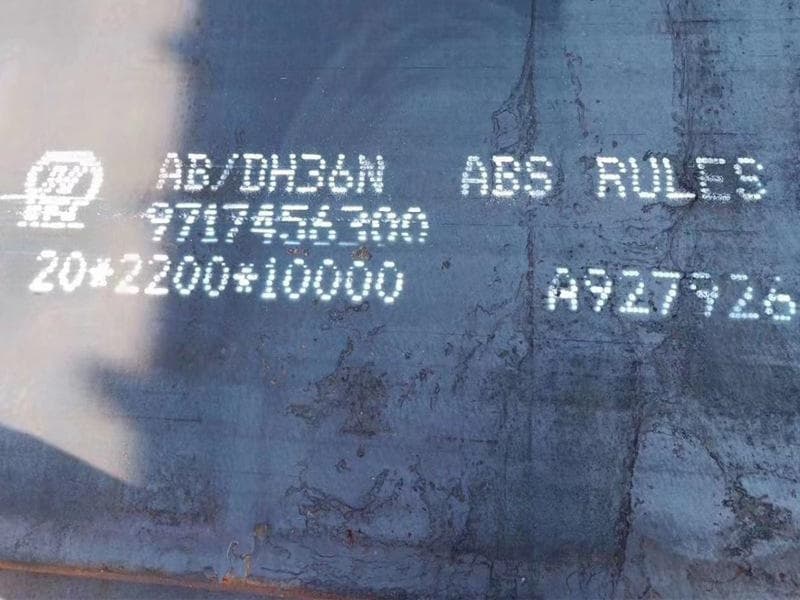
Heat number traceability means every plate is stamped with a unique heat number that links back to its mill certificate. That certificate shows the chemical composition and mechanical test results for that specific batch of steel.
In the event of a failure — a cracked weld, a structural problem — traceability allows you to identify exactly which plates were affected. Without traceability, you might have to scrap the entire project’s steel. With traceability, you replace only the affected batch.
A stable supplier has robust traceability systems. They can provide you with complete documentation for every plate in every shipment.
A Real Example
A shipyard in the Philippines received a shipment of 300 tons of DH36 plates. The mill certificates were complete and the class stamps were present. But when the yard’s quality team spot‑checked the plates, they found that the heat numbers on 15 plates did not match the certificates. The supplier had accidentally mixed plates from a different heat into the bundle. The entire 300‑ton shipment was quarantined for two weeks while each plate was individually tested. The rework cost was $25,000, and the project lost 18 days. A stable supplier with better quality control would never have mixed heats.
How Long‑Term Frame Agreements and Inventory Buffers from Stable Suppliers Absorb Market Volatility
Steel prices are unpredictable. A tariff is announced. Prices jump 34% in weeks. Your fixed‑price order is suddenly a bargain — or a burden.
Long‑term frame agreements (LTAs) lock in prices and secure mill capacity. When prices spike, your LTA protects you. When supply tightens, your LTA guarantees your allocation. A stable supplier uses inventory buffers — stock kept at their warehouse or at a nearby facility — to absorb demand fluctuations. Combined with phased deliveries, these buffers ensure you receive steel when you need it, not when the market allows it. During disruptions, stable suppliers prioritize LTA customers over spot buyers. In a constrained market, the best suppliers are not just the ones with parts on a shelf — they are the ones that can shorten lead times, stabilize quality, and absorb demand spikes.
Let me show you how this works in practice.
How LTAs Protect Against Price Spikes
Steel and shipbuilding industries negotiate thick plate prices twice a year. These negotiations are often prolonged due to opposing stances — heightened global uncertainties, conflicts, and tariff risks make it difficult for either side to concede. The steel industry argues that rising raw material costs, industrial electricity rates, and logistics make price increases unavoidable. Meanwhile, shipbuilders advocate for price freezes or reductions.
For the first half of 2026, Korean steel and shipbuilding industries settled on a supply price of thick plates in the mid‑800,000 won per ton range — a slight increase from the low 800,000s recorded in the fourth quarter of the previous year. Shipbuilders could not completely avoid rising cost pressures, but the LTA structure limited the impact.
If you buy spot, you pay whatever the market demands. If you have an LTA, you pay the agreed price. That difference can be hundreds of dollars per ton.
Capacity Allocation During Shortages
When the naval industrial base gets tight, buyers stop rewarding suppliers simply for being available and start rewarding them for reducing risk. The most attractive suppliers are not just the ones that can shorten lead times. They are the ones that can shorten lead times, stabilize quality, support alternate sourcing, and absorb demand spikes.
In a tight market, a supplier that reduces delay risk can become more valuable than a cheaper supplier whose execution is harder to trust.
Naval buyers put more weight on suppliers that shorten lead times, stabilize quality, widen sourcing options, and stay responsive when demand shifts. In a constrained market, capability that reduces uncertainty often becomes more valuable than simple catalog breadth.
Inventory Buffers — Your Safety Net
A stable supplier maintains inventory buffers — safety stock of common sizes and grades. When your project needs extra steel on short notice, the buffer is there. When a shipment is delayed, the buffer covers the gap.
If a stable supplier does not have a particular size or grade in stock, they should be able to produce it within a predictable lead time or provide a documented plan for sourcing an alternative that meets the same specifications.
A Real Example
BAE Systems Australia signed a Framework Agreement with BlueScope Distribution to secure the supply of Australian‑made steel plate for the construction of the Hunter Class Frigate Program. The agreement locks in local steel supply over the next five years. According to BAE Systems, the Framework Agreement provides long‑term stability and continuity for Australian steel plate to be supplied into the ship build. More than 5,000 tonnes of specialised, high‑strength steel will be delivered for each ship.
That is supplier stability. BAE Systems does not worry about price spikes or supply gaps. They have a partner who delivers.
How Supplier Stability Lowers Procurement Risk and Builds Confidence for Multi‑Vessel or Phased Projects
You have a contract for six vessels over three years. You need steel delivered in phases. A stable supplier lets you plan with confidence.
Supplier stability enables multi‑vessel planning. A stable supplier can commit to phased deliveries across multiple years, lock in pricing for the project duration, and maintain consistent quality across every batch. This reduces procurement risk — you are not re‑negotiating contracts, re‑qualifying mills, or re‑testing material for every vessel. Confidence comes from a track record of on‑time delivery, responsive communication, and transparent forecasting. In multi‑vessel projects, the cost of switching suppliers is enormous. A stable supplier becomes a strategic partner who shares your long‑term vision.
Let me break down the confidence factors.
Reduced Procurement Risk Across Multiple Vessels
Supplier selection in shipbuilding is a high‑stakes decision problem due to stringent quality requirements, compressed construction schedules, and elevated project risks. A systematic decision‑support framework for selecting shipbuilding material suppliers while enhancing supply‑chain resilience is essential.
When you build multiple vessels, you cannot afford to evaluate a new supplier for each one. A stable supplier with a proven track record eliminates that overhead.
The Power of Predictable Lead Times
When a supplier can deliver repeatedly without drama, that predictability protects planning assumptions across the rest of the program. A record of predictable lead times becomes a competitive advantage.
I have seen shipyards choose a slightly more expensive supplier simply because their lead times were consistent. That consistency allowed the yard to schedule labor, crane time, and downstream work with confidence. The cheaper supplier with variable lead times created chaos.
Technical Data and Documentation Maturity
Suppliers that maintain cleaner technical packages, configuration discipline, and usable product data become more valuable when engineering questions or sustainment transitions arise. The more complex the part and the tighter the schedule, the more useful clean data becomes.
For multi‑vessel projects, this is critical. The documentation from the first vessel should work for the second, third, and fourth. A stable supplier builds that consistency.
Fast Engineering Response
Buyers reward suppliers that do not vanish when a drawing issue, fit problem, or process question appears. The ability to respond quickly with engineering support can turn a potential stop‑work moment into a manageable disruption.
A Real Example
BAE Systems Australia uses a single‑source supply arrangement with BlueScope. The agreement provides not only materials but also warehousing, logistics, technical support, certification, and project management services. BlueScope’s General Manager said: "We have a shared vision and our partnership enables us to demonstrate the support offered to Australian manufacturers. We offer customers quality manufactured products, various steel processing capability, and robust project management delivery solutions."
That is a strategic partnership. BAE Systems does not worry about where the next shipment of steel will come from. They have a stable partner who delivers.
How I Apply This at cnmarinesteel.com
At cnmarinesteel.com, I have built my business on supplier stability. I work with long‑term partner mills that hold multiple class approvals. I maintain inventory buffers of common sizes at my warehouse. I offer phased deliveries and VMI arrangements for large shipyards. When a customer needs urgent steel, I can often pull from stock and ship within days, not weeks.
Our customer Gulf Metal Solutions switched to us because we were the first supplier to respond within two hours. They told us: "The product quality is stable. The packaging is the best among all the packaging for ship plates we have received so far. We plan to place an order for ship L‑shaped steel and spherical flat steel from them in the next quarter."That is what stability builds — trust and repeat business.
Conclusion
Supplier stability — financial health, consistent quality, long‑term agreements, inventory buffers — directly determines whether your marine steel plate project succeeds. Choose partners who can withstand storms, not just those who offer the lowest price.