
Vague order lines look harmless on a Monday morning. The mill fills every gap with its own default. Three weeks later a container of unusable angle steel sits on your quay and your frame line stops.
When a marine angle steel order contains ambiguous specifications, the mill rolls to its most common interpretation of the order, the yard receives steel that fails fit-up or class inspection, and the batch ends up sorted, reworked, rejected, or reordered — typically costing two to eight weeks and the full price of replacement material.
I am Zora Guo, export sales lead at Yichen Steel in Liaocheng, Shandong. I have quoted and shipped marine angle steel to yards and distributors in Vietnam, Qatar, Saudi Arabia, and the Philippines for years. I can tell you the orders that go wrong are almost never the difficult ones. They are the half-written ones — an order that names a grade but not the standard, or a thickness but not which leg it belongs to. In this article I want to walk through exactly where ambiguity hides, what it costs at each stage, and the specification block my team runs before we confirm any marine angle steel order.
Which Parts of a Marine Angle Steel Order Are Most Often Left Ambiguous?
An angle section is only four numbers deep, yet most purchase orders name two of them and stop. Every silent gap is a decision the mill has to make for you, and the mill will always choose its most common rolling program.
The most ambiguous fields in a marine angle steel order are leg dimensions and thickness interpretation, the dimensional standard, the grade sub-letter, the impact test temperature, the length type and tolerance, the class society, and the certificate class. Any one of them left blank lets the mill guess.
The Four Numbers and the Two Standards
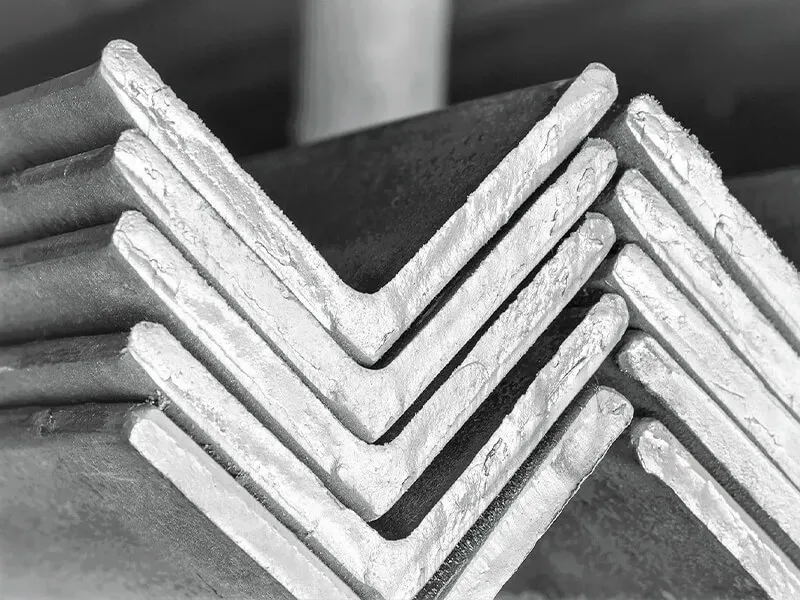
Every hot-rolled angle, equal-leg or unequal-leg, is fully described by long leg A, short leg B, thickness t, and delivery length. For equal angles you write 100 x 100 x 10 and nobody argues. For unequal angles, writing both legs in the right order matters, because L150x90 and L90x150 describe the same section but reverse the role each leg plays in the frame. The bigger trap is the thickness. When the rolling program carries both a 10 mm and a 12 mm variant of the same A x B profile, a shorthand like “L150x90x10” becomes a coin flip unless you repeat it in words: “thickness 10 mm on both legs.”
The second silent gap is the dimensional standard. JIS G3192 and EN 10056-1 both describe a “150x90x10” angle, but their tolerances are not identical, and a surveyor checks against the standard named on the class-approved drawing, not the one your purchase order happened to reference. Under EN 10056-1, leg width tolerance is about ±1.0 mm for legs up to 80 mm and ±1.5 mm up to 150 mm, while thickness tolerance sits near ±0.5 mm for sections up to 10 mm. JIS bands the same numbers differently. If your drawing dimensions to one standard and your purchase order names the other, the material can pass your tape check and still fail the surveyor’s.
Grade Shortcuts That Read Two Ways
“AH36 angle steel” is not a specification. It is a family. The sub-letter matters because the grade only exists if the Charpy V-Notch impact test ran at the temperature your design assumes — AH36 is tested at 0 °C, DH36 at -20 °C, EH36 at -40 °C. A certificate showing impact values at 0 °C does not satisfy a requirement the drawing wrote as DH36. I have watched a buyer discover this after delivery, when the MTC finally reached the surveyor. The steel was good steel. It was simply the wrong steel, and class rules gave us no path to rework it.
Then there is the certificate class. EN 10204 3.1 is our baseline for marine angle steel, and 3.2 is required when your class surveyor demands witnessed testing. If the order is silent, most mills issue 3.1 and consider the job done. Here is the field-by-field view of what goes ambiguous most often, from the inquiries that cross my desk:
| Ambiguous field | What the buyer wrote | What the mill assumed | Typical outcome |
|---|---|---|---|
| Thickness on unequal legs | “12mm AH36” | Leg thickness per section table | Wrong leg critical to design, steel unusable |
| Dimensional standard | None | Mill’s default (JIS or EN) | Tolerance dispute at class inspection |
| Grade sub-letter | “high-tensile angle” | AH36 (most common) | Impact test at 0 °C fails a DH36 requirement |
| Impact test temperature | None | Grade default temperature | MTC rejected by surveyor |
| Length | “6 meters” | Random mill length band | Bars near 5.9 m, cutting list comes up short |
| Certificate class | None | EN 10204 3.1 | Surveyor demands 3.2, re-test needed |
| Class society stamp | “with certification” | No third-party stamp | Material cleared for cutting without class approval |
| Marking | None | Bundle tag only | Mixed grades indistinguishable at receiving |
Eight fields, and buyers routinely leave six of them blank. The order still gets quoted, still gets rolled, still ships. Nothing about the process looks broken until the steel arrives somewhere it does not fit.
What Does Ambiguity Actually Cost at the Mill and on Your Quay?
The price of a half-written specification never shows up on the invoice. It shows up as idle welding crews, a bundle nobody can release, and a schedule hole you cannot fill from stock.
Ambiguity costs show up in three places: the mill rolls to the wrong interpretation and the batch is lost or re-rolled, receiving cannot verify grades without heat-number sorting that takes days, and fabrication stops while the dispute is documented. Grade-level ambiguity almost always ends in rejection, not rework.
At the Rolling Mill
From the mill’s side, an ambiguous order is not a problem to solve — it is a gap to fill with the default. When a purchase order says “12mm AH36 angle” without naming both legs, the mill reads its standard section table and rolls the most common interpretation of that description. Every document on that shipment will then be correct: the grade matches, the certificate matches, the nominal description matches. The steel still cannot be used, because the interpretation was wrong from the first minute. A yard in Vietnam ordered on exactly this kind of shorthand; the drawing needed the shorter leg to carry the critical thickness, the mill shipped the other reading, and the whole batch went back. The reorder cost the project roughly two months, and nobody at any stage had made a mistake you could point to.
That is the part I keep trying to explain to new buyers: ambiguity is not a supplier failure you can claim against. The mill rolled what was written. The conflict was born upstream, between the drawing and the purchase order, and so is the fix.
At the Receiving Quay
The second cost lands when the container opens. If the order never required heat numbers stamped on every piece and listed on the mill test certificate, your receiving team cannot verify that the material on the truck matches the paper in the envelope. This is a nuisance with a single-grade shipment. It is a crisis when two grades travel in the same consignment, because AH36 and Grade A look identical once rolled — the only honest difference is the stamped heat number. Sorting a mixed 200-tonne delivery by heat stamp can take two to three days, and during those days nothing goes to your cutting line. I once watched a receiving crew measure a container load of angles one by one with a tape, at the quay, in the rain, because the purchase order only said “6 m” and the bars sat near the bottom of the random-length band. Nobody was at fault. The order was just silent.
What It Does to Your Schedule
Stack the stages and the pattern is clear. Ambiguity found before quoting costs a phone call. Found at the mill, it costs a hold instruction and maybe a re-roll. Found at receiving uncut, it costs an inspection report, a non-conformance report, and an engineering disposition. Found after fabrication, it costs rework, scrapped pieces, and surveyor visits. The table below is how I size the damage when a buyer calls me with a problem batch:
| Where ambiguity is caught | Typical time impact | Typical cost impact | Who resolves it |
|---|---|---|---|
| Before order release | None | None — corrected PO | Procurement |
| During rolling at the mill | 1–2 weeks | Partial re-roll cost | Supplier + buyer |
| At receiving, uncut | 2–4 weeks | Sorting, inspection, freight back | Designer + surveyor |
| After fabrication | 4–8 weeks | Rework, scrap, schedule penalties | Designer + surveyor + owner’s rep |
| Grade mismatch at any stage | 4–8 weeks | Near-total batch loss | Surveyor, mandatory |
The bottom row is the one to fear. Dimension problems sometimes end in “use as is” or “rework,” because steel can be machined or re-cut into the drawing condition. Grade problems almost never do, because a substitution of marine-grade material touches class rules no fabricator can weld their way around. So the ambiguity that costs least to fix — one extra line on the purchase order — is the same ambiguity that costs most when left in.
How Do You Close Every Ambiguity Before the Purchase Order Is Signed?
None of this requires better suppliers. It requires a fixed specification block that every marine angle steel order repeats, line by line, before anyone signs. If a line is empty, the order is not ready to send.
Close ambiguity by writing the order as a specification block: section with both legs and thickness, named dimensional standard, grade with society prefix, impact test temperature, length type and tolerance, certificate class, marking requirements, and quantity by pieces and theoretical weight. No empty lines, no verbal add-ons.
The Specification Block, Line by Line
Here is the block my own team fills in with customers, and I recommend you take it outright. Every line maps to a failure mode we have actually seen. Section: A x B x t in millimetres, both legs stated, tied to the drawing revision number. Standard: name and edition, for example EN 10056-1 or JIS G3192. Grade: society prefix plus grade, so ABS AH36 or CCS DH36, never a bare “high-tensile.” Impact test: temperature and direction, because that is what makes the grade real. Delivery condition: as-rolled or normalized, stated, because your welding procedure was qualified for one of them. Length: exact, random, or cut-to-size, with the tolerance you actually need. Certificate: EN 10204 3.1 as baseline, 3.2 when your surveyor demands it. Marking: heat number, grade, and size on every piece, not just the bundle tag. Quantity: pieces and theoretical weight together.
The last pair of lines work as a team. Pieces tell your production planner what arrives. Theoretical weight tells your freight forwarder and your finance team what was paid for. When the order carries only tonnes, nobody can check the piece count at the gate, and a short container is discovered weeks later instead of in ten minutes.
Turn It into a Side-by-Side Habit
The block only works if you use it to interrogate your own order before sending it. Take every order line you are about to release and place it next to the complete version. Where the two differ, you have found an ambiguity — and it costs nothing to fix at that moment. This is the comparison I run with buyers on their first order with us:
| Order element | Ambiguous version | Complete version |
|---|---|---|
| Section | “12mm AH36 angle” | L150 x 90 x 12, thickness 12 mm both legs, dwg rev. C |
| Standard | Not stated | EN 10056-1:2017 |
| Grade | “high-tensile” | CCS DH36 |
| Impact test | Not stated | Charpy V-Notch at -20 °C, longitudinal |
| Length | “6 meters” | Exact 9,000 mm, plus 10 / minus 0 |
| Certificate | “with MTC” | EN 10204 3.2 with class surveyor witness |
| Marking | Not stated | Heat no., grade, size stamped on every piece |
| Quantity | “26 tonnes” | 180 pieces, about 26.5 tonnes theoretical |
One more habit sits behind the table, and it is the cheapest of all: make every purchase order state the drawing revision number on its face. Not in an attachment, not in an email chain. On the PO itself. When an inquiry reaches us without a revision number, I ask for it before I quote, because I know there is conflict risk sitting quietly in that file. Buyers who send the complete block get same-day confirmations from us. That speed is not a coincidence — a buyer we support in Saudi Arabia once told us we were the first supplier to respond within two hours, and part of that is simply that a complete specification leaves nothing to ask about. The complete version takes maybe five extra minutes to write. The ambiguous version has cost projects I know about [Zora will replace] weeks and a full replacement order. Between those two prices, five minutes is nothing.
Conclusion
Write the marine angle steel order as a complete specification block, compare it against the ambiguous version, and fix every gap before signing. Ambiguity found on paper is free; the same ambiguity found on the quay is not.