
A steel section arrives at your yard gate with markings that do not obviously match the drawing callout, so your inspector holds the delivery and your fabrication line sits idle. Read this guide before the next shipment lands.
To match steel section markings with shipbuilding drawings, read the drawing callout into its four parts (shape prefix, dimensions, grade, and classification society), find the same four fields stamped or stenciled on the steel, and verify each field against the mill test certificate by heat number. Any field that fails blocks that piece.
Every importer we serve has faced this moment at least once: the truck is at the gate, the fabricator wants his stiffeners, and the QC man is holding a drawing in one hand and a callout like “L 200×90×9×13, Grade A, DNV” in the other, staring at a bundle whose paint marking says something different. If you handle that moment with a fixed procedure, it costs you twenty minutes. If you handle it by guessing, it costs you a week, and in the worst case it costs you the class approval of the whole block. I have watched both versions play out at ports from Dammam to Ho Chi Minh City, and the difference between the two outcomes is never luck. It is whether the buyer understood, before the steel ever shipped, how a drawing callout, a physical marking, and a mill test certificate are supposed to connect into one unbroken chain. That chain is what this article walks through, field by field, from the drawing office to the warehouse gate.
What Does the Drawing Callout Tell You About a Steel Section?
Procurement teams often copy a callout into a purchase order without splitting it into its parts, so a missing grade or a swapped dimension slips through unnoticed. Then the mill rolls exactly what was written, and the drawing was not what anyone meant.
A shipbuilding drawing callout for a section has four parts: the shape prefix (L for angle, FB for flat bar, HP for bulb flat), the dimensions in a fixed order, the material grade with its strength and toughness letters, and the classification society whose rules the material must satisfy. Every part must be matched independently.
The Four Parts of a Standard Section Callout
When a naval architect draws a stiffener, the callout is not decoration. It is a compressed purchase specification. Take a typical hull frame note: “L 250×90×9×13, Grade AH36, ABS”. Here is how to split it:
| Callout part | Example | What it fixes | What to verify on delivery |
|---|---|---|---|
| Shape prefix | L | Angle section, not bulb flat or flat bar | The delivered profile is physically the right shape |
| Dimensions | 250×90×9×13 | Web height, flange width, web thickness, flange thickness in mm | Caliper check against ISO 657-18 tolerances |
| Grade | AH36 | 355 MPa minimum yield, impact tested at 0 °C | Grade mark on steel matches MTC grade field |
| Society | ABS | Material released under ABS Rules with ABS surveyor endorsement | Society stamp or endorsement code on the MTC |
Note the dimension order. Under ISO 657-18, the metric shipbuilding L sections are designated L H × B × t × T — web height, flange width, web thickness, flange thickness. A trading-house shorthand like “L150×100×12” only gives you two legs and one thickness, which is ambiguous for the heavier shipbuilding profiles where web and flange thicknesses differ. The four-number form removes that ambiguity, and it is the form I ask buyers to use in every purchase order they send us.
Why the Same Section Can Look Different on Two Drawings
The confusion usually starts with notation drift, not with wrong steel. Older drawings, especially from European design offices, may show a grade written as “A36” when the material is actually high-strength hull steel AH36 — the letter was simply placed in front of the number at some yards and behind it at others, and the meaning is identical. The same thing happens with society prefixes: a drawing might read “GL AH36” from an old Germanischer Lloyd specification, and the merged classification framework now carries the equivalent under the DNV mark. Neither of these is a mismatch in substance; they are notation variants.
But there is one variant that is never acceptable to wave through: a callout that omits the impact-test letter or the society entirely. “250×90 angle, 355 MPa” is not a specification — it is a strength number with no toughness requirement and no certifying body behind it, and no surveyor will accept it against a classed hull. When a client sends us an RFQ written that way, I always send back two questions: which impact temperature, and which society? If the buyer cannot answer, the answer has to come from the design office before we quote, because once the steel is rolled with the wrong toughness letter, no amount of paperwork will fix it.
This is also where a good supplier earns their keep. On one recent order for a Vietnamese yard, the drawing callout read “L 200×200×16, Grade D” — an equal angle at 355 MPa implied strength but only a normal-strength D grade letter. The design had been revised to high-strength structure, and the drawing note had never been updated. We flagged it, the yard confirmed AH36 was intended, and the purchase order was corrected before cutting. That one email probably saved the client a rejected lot.
The practical takeaway is to build a small callout dictionary for your own project before the first order goes out. One page is enough. List every section profile the design uses, the exact four-part callout, the grade, the society, and any notation variant that appears in the drawing set. Then make the purchase order quote that page line by line. When the delivery arrives, your inspector is no longer comparing a stamp against a memory of a drawing — he is comparing against the same one-page list the supplier rolled the steel from. In my experience, buyers who keep this page cut their receiving disputes to nearly zero, and the suppliers who receive it quote faster because nobody has to guess what “the usual angle” means this time.
How Do You Read the Markings on the Steel Itself?
Buyers who have never stood in a steel warehouse often assume the marking on the steel is a courtesy label. It is not — it is the physical half of the traceability chain, and if it is missing, faint, or mismatched, the certificate beside it is worthless to a surveyor.
Marine sections carry two kinds of marks: rolled or stamped marks applied at the mill (grade, heat number, manufacturer identity, society stamp, repeated at intervals along the length) and painted or stenciled marks applied before shipment (color code, bundle number, order reference). Stamped marks are the legal identity; paint marks are handling aids.
Where to Find the Marks on Bundles and Single Sections
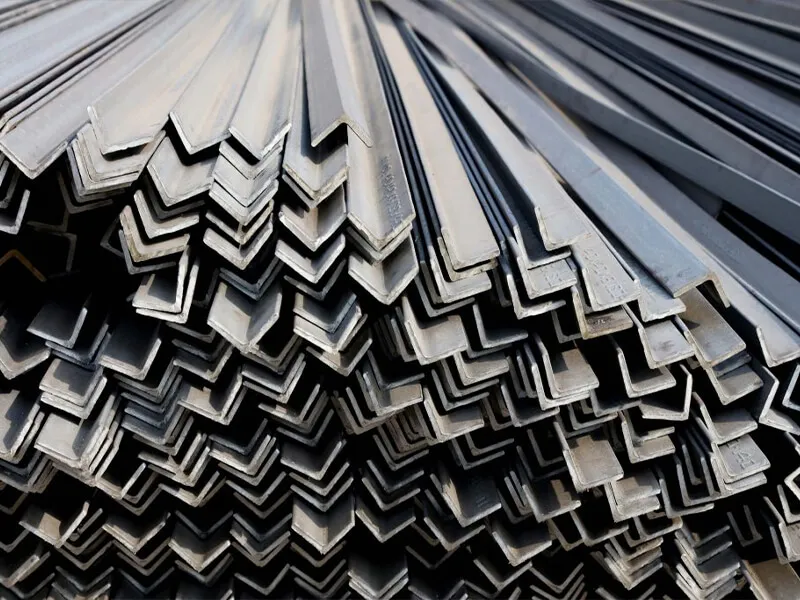
On a single length of marine angle steel, look for the rolled-in or stamped identity on the web at regular intervals — mills repeat the mark along the length precisely so that identity survives cutting the bar into stiffeners. If you cut a 12-meter bar into six two-meter pieces, each piece should still carry at least one stamped mark, or you must record which section carried the original mark before cutting. On bundles, the paint or stencil usually shows the grade, the heat or bundle number, the destination port, and sometimes a color code — some yards require an additional color band for high-strength grades like AH36 so that a fitter cannot grab an ordinary-strength bar from the wrong rack.
One thing I tell every new client: stickers and chalk do not count. The outdoor environment of a shipyard destroys adhesive tags in weeks, and chalk washes off in the first rain. Only stamped, indented, or durable paint marks survive, and only stamped marks satisfy a classification surveyor doing a random identity check.
What Each Mark Must Match
The physical mark never stands alone. It has to agree with the mill test certificate, and the certificate has to agree with the purchase order, and the purchase order has to agree with the drawing. Here is the matching map I use when a client asks us to pre-verify a shipment:
| Physical mark on steel | Must match on the MTC | Must match on the drawing / PO | Typical failure we see |
|---|---|---|---|
| Grade mark (e.g., AH36) | Grade field of the certificate | Grade in the callout | Paint grade readable, stamp grade different |
| Heat number | Heat number listed on the MTC | Heat numbers listed on the packing list | Heat number stamped too lightly to read |
| Manufacturer identity | Mill name on the MTC | Mill on the buyer’s approved list | Trader name used instead of mill name |
| Society stamp / endorsement code | Society endorsement on the MTC | Society named in the callout | Endorsement missing for part of the lot |
We learned the light-stamp lesson the hard way on the client side. A customer in Mexico once called us in a panic because their yard inspector could not read the heat number on a delivered lot — the stamping had come out faint, and the inspector would not accept marks he could not photograph legibly. The steel was fine; the identity was not provable. A technician had to re-mark every piece with a portable etcher before the lot was released. Since then, we photograph the stamp on every bundle before it leaves our warehouse in Liaocheng and email the photos ahead of the steel, so the buyer’s inspector can pre-check identity while the vessel is still at sea. That habit came from a client lesson, and it has since settled more than one anxious Friday afternoon.
What Is the Fastest Way to Match Markings Against the Drawing Without Stopping Production?
Inspectors who check piece by piece against the drawing slow the whole receiving operation down, and yards under schedule pressure start skipping checks. The fix is not fewer checks — it is a batch-level procedure that catches the fatal mismatches in minutes.
Match in three passes: first the certificate against the purchase order (paper must agree before steel is touched), then the physical marks on a random sample against the certificate, then the dimensions and grade of the sampled pieces against the drawing callout. Release the batch only when all three passes agree.
A Five-Step Cross-Check You Can Run at the Warehouse Gate
Here is the sequence I recommend to every buyer, and it is the same one our clients in Saudi Arabia and Romania run at Dammam and Constanța:
- Paper pass. Compare the MTC’s grade, dimensions, and heat numbers against the purchase order and the drawing callout. Do this in the office, before the truck is unloaded. If the paper is wrong, you have not yet paid for the demurrage.
- Stamp pass. Walk to the stack, pick pieces at random — I suggest one in every twenty, minimum three pieces per heat — and read the stamped grade, heat number, and society mark. Photograph each one.
- Certificate-to-steel pass. Every heat number found on the steel must appear on an MTC in the folder. One orphan heat number flags the batch.
- Dimension pass. Caliper the web thickness and flange thickness of the sampled pieces and check them against the ISO 657-18 tolerance for that profile size. A 9 mm web rolled at 8.4 mm is out of tolerance, not “close enough”.
- Release or hold. If all passes agree, sign the release and let fabrication start. If any pass fails, hold the affected heat only — not the whole delivery — pending the supplier’s response.
Step five matters more than people expect. A mismatched heat is a contained problem; a held delivery is a schedule problem. When we ship, our packing list links every bundle number to its heat numbers precisely so a buyer can hold one heat and work the rest. On a Gulf Metal Solutions shipment to Dammam, the yard’s inspector pulled ten pieces at random, checked every stamp against the certificate photos we had sent before loading, and released the lot in a single day — because the chain was already assembled before the steel arrived.
When a Mismatch Is Fatal and When It Is Just Paperwork
Not every mismatch should stop your line. Over the years I have sorted client calls into two piles, and the table below is the honest version of that sorting. The left column kills the steel; the right column costs you a day of paperwork.

| Mismatch found | Severity | Typical root cause | Correct action |
|---|---|---|---|
| Heat number on steel not on any MTC | Fatal | Mixed heats loaded at the mill or warehouse | Hold the heat, demand the missing certificate or reject |
| Grade letter differs (AH36 vs A on steel) | Fatal | Wrong stock pulled, or marking error at mill | Reject the piece, audit the whole heat |
| Society endorsement missing on MTC | Fatal | Steel supplied without surveyor release | Reject — it is ordinary structural steel, not hull steel |
| Notation variant (A36 written for AH36, old society prefix) | Paperwork | Drawing-office convention drift | Confirm with designer, record the equivalence in writing |
| Faint but legible stamp | Paperwork | Worn stamping die at the mill | Photograph, etch a supplementary mark, note in QC file |
| Dimension within tolerance band but at the limit | Acceptable | Normal rolling variation | Record the measurement, release |
The fatal pile shares one feature: the traceability chain is broken, so no surveyor can prove what the steel is. The paperwork pile is everything where the chain is intact and only the wording differs. My rule of thumb after years of port-side calls: if the question is “what is this steel?”, it is fatal until proven otherwise. If the question is “how is this steel written?”, it is paperwork.
I will leave you with the observation that started this whole procedure for me. Standing in our stockyard one summer morning, watching a loader stack bundles for a Philippine order, I noticed the paint marks on two bundles were the same color code but the stamps underneath were from different heats. Nothing about the paint was wrong — and everything about the stamps mattered. Paint tells the forklift driver where to go. Stamps tell the surveyor what the steel is. Never let the second be managed by the first.
Conclusion
Read the callout into its four parts, match the stamp to the certificate by heat number, and hold only the heat that fails. The chain, kept unbroken, keeps your line running.