
You ordered marine angle steel for a critical shipbuilding project. The material arrives. It looks acceptable at first glance. But then your welders start working. Problems appear. The angles are slightly twisted. The surface has scale that won’t clean off. The leg lengths vary. Your project slows down while you deal with substandard material. These quality issues are more common than you think.
Common quality issues in marine angle steel supply include dimensional inaccuracies (leg length and thickness variations), out-of-tolerance straightness or twist, poor surface condition with excessive rust or scale, incorrect steel grade markings, and non-compliant or missing Mill Test Certificates. These issues lead to fabrication delays, rework costs, and potential project rejection by classification societies.

Quality problems are not always visible to the untrained eye. They hide in the details of dimensions, material properties, and documentation. To protect your project, you need to know what to look for. Let’s start with the basics of the product itself.
What is angle steel1?
You are in the shipyard. A new shipment of steel has arrived. It is stacked in bundles. You see the familiar L-shape. It is angle steel1. But is it the right angle steel1 for the job? Knowing what angle steel1 is, and what it is supposed to do, helps you spot when something is wrong. A basic understanding is your first defense against quality issues.
Angle steel, also known as L-shaped section steel2, is a hot-rolled steel profile with two legs meeting at a 90-degree angle. It is used extensively in shipbuilding and marine structures for framing, stiffening, and creating structural connections. It is defined by its leg lengths (equal or unequal) and its thickness, and is produced to international standards with specified mechanical properties.
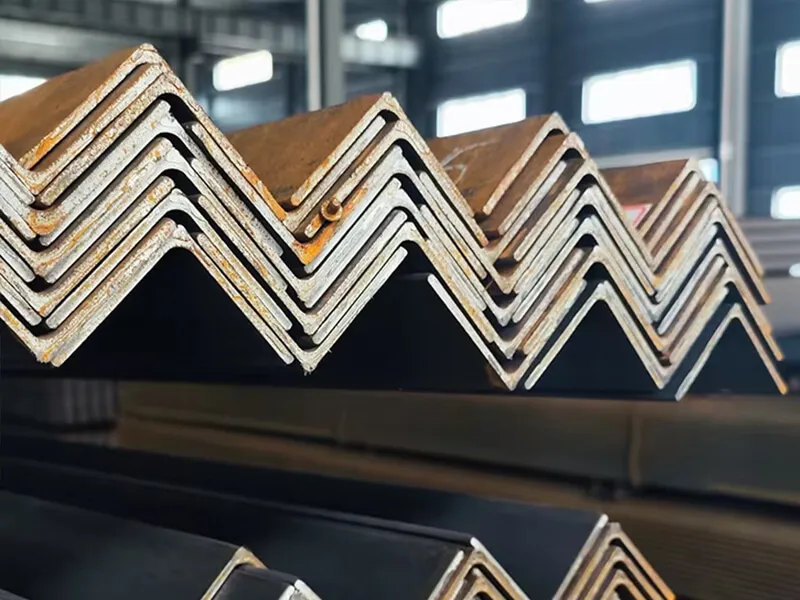
The Critical Characteristics of Marine Angle Steel
To understand quality issues, you must first understand the product’s critical characteristics.
1. Dimensional Precision.
Angle steel is not just any L-shape. Its dimensions are tightly controlled by standards like ASTM A6, EN 10056, or JIS G 3192.
- Leg Length (A and B): For an equal angle, both legs are the same length. For an unequal angle, they are different. The standard specifies tolerances on these lengths (e.g., +/- 2mm for a 100mm leg).
- Thickness (t): The thickness of the legs is also specified with a tolerance. This is critical because the structural strength depends on it.
- Root Radius: The inside corner has a specified radius. A too-sharp corner can be a stress concentration point.
- Straightness: The angle must be straight along its length. Twisted or bowed sections are difficult to work with.
2. Material Grade.
For marine use, the steel must be a specific marine grade3 (e.g., AH36, DH36). This is not the same as general structural steel (like A36). The grade guarantees:
- Yield and Tensile Strength: The material can handle the design loads.
- Impact Toughness: It will not become brittle in cold ocean water.
- Weldability: Its chemical composition allows for sound welds without cracking.
3. Surface Condition.
The surface should be relatively clean, with minimal scale and no deep pits, laminations, or cracks. Excessive rust before delivery is a sign of poor storage or handling.
4. Traceability.
Each piece should be marked with the grade, heat number, and manufacturer’s ID. This allows the material to be traced back to its Mill Test Certificate (MTC).
My Insight from the Field
A fabricator in Malaysia once received a shipment of what they thought was AH36 angle steel1. The pieces were marked "AH36." But during welding, they noticed the welds were behaving differently than usual. They had the material tested. It turned out to be plain carbon steel (A36) with fake markings. The supplier had stamped the wrong grade. The fabricator had to remove all the welded material from their structure, a costly and time-consuming rework. This story illustrates that "angle steel1" is not just a shape. It is a combination of shape, grade, and traceability4. All three must be correct. If one is wrong, the material is scrap.
What’s the weight of a 40x40x5 steel angle?
You are planning the crane lift for unloading. You need to know the weight per piece to rig safely. Your supplier’s documentation says the theoretical weight1 is 2.97 kg/m. But your pieces seem heavier. Is your crane at risk? Or is the steel lighter than expected, meaning your structure might be under-designed? Weight is not just a logistics number. It is a quality indicator2.
The theoretical weight1 of a 40x40x5mm steel angle3 (equal leg) is approximately 2.97 kilograms per meter. This is calculated using the formula: Weight (kg/m) = [(A+B) – t] t 0.00785, where A and B are the leg lengths (40mm) and t is the thickness (5mm). The actual weight may vary slightly due to manufacturing tolerances.
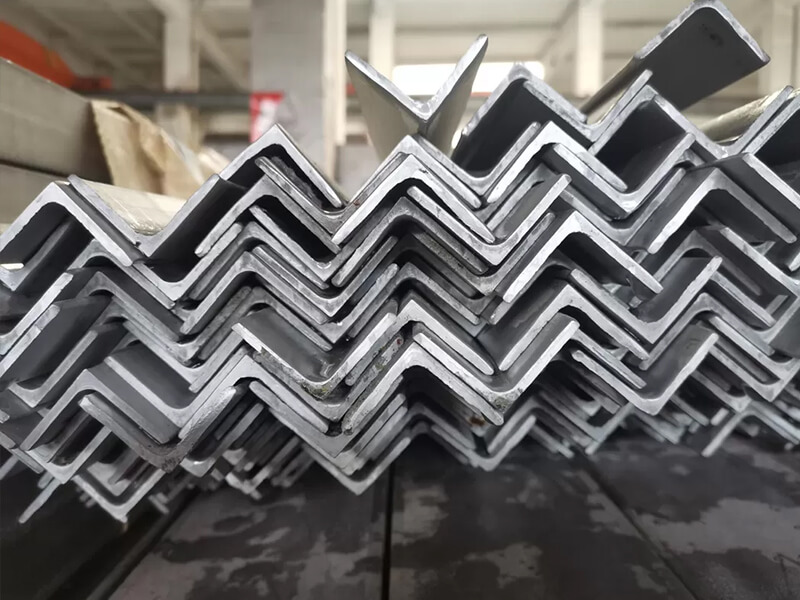
Weight as a Quality Check
Weight deviation is a powerful, simple indicator of potential quality problems.
1. The Calculation in Detail.
Let’s verify the number.
- Step 1: (A + B) – t = (40 + 40) – 5 = 75.
- Step 2: Multiply by thickness (t): 75 * 5 = 375.
- Step 3: Multiply by the density constant (0.00785): 375 * 0.00785 = 2.94375 kg/m. Rounded to 2.97 kg/m.
2. What Weight Deviations Can Tell You.
- If the Actual Weight is Consistently Higher than Theoretical: This could mean the legs are thicker than specified. While extra thickness might seem like a bonus, it adds weight to the vessel (reducing cargo capacity) and could indicate the mill is not controlling tolerances tightly. It may also mean you are paying for more steel than you need.
- If the Actual Weight is Consistently Lower than Theoretical: This is a red flag. It could mean the legs are thinner than specified, which compromises the structural strength4. The angle may not meet the required section modulus. This is a serious quality issue that could lead to failure.
- Variation Within a Bundle: If you weigh several pieces and the weights vary significantly, it suggests the mill’s process is inconsistent. This inconsistency can lead to fit-up problems in fabrication.
3. How to Use Weight for Incoming Inspection.
- Step 1: Calculate. Know the theoretical weight1 per meter for your ordered size.
- Step 2: Sample Weigh. Take a few random pieces from the shipment. Weigh them individually or in a small bundle. Measure their exact length.
- Step 3: Calculate Actual Weight per Meter. Divide the total weight by the total length.
- Step 4: Compare. Compare the actual weight per meter to the theoretical weight1. A deviation of more than +/- 5% (or the tolerance allowed by the standard) is cause for concern and should trigger a more detailed investigation.
My Insight from the Field
A client in the Philippines once complained that our 40x40x5 angles seemed "light." They were concerned the steel was under-strength. We asked them to weigh a sample and send us the data. Their calculated actual weight was 2.95 kg/m, well within the standard tolerance. We explained that the slight difference from the theoretical 2.97 kg/m was normal and acceptable. This simple check reassured them. It also showed them a practical way to verify quality themselves. Now, they routinely weigh samples from every shipment as a quick first check. It has helped them identify one shipment from another supplier that was significantly underweight, which they rejected.
What are four types of steel?
Your quality inspector notes that the steel has poor weldability. It cracks near the weld zone. This might not be a dimensional issue. It could be a material issue. Steel is not one thing. It is a family of materials. Understanding the basic types helps you understand why some steel is suitable for marine use and why some is not. This knowledge is key to preventing material-related quality failures.
Steel can be classified into four main types based on chemical composition: 1) Carbon Steel1, where carbon is the primary alloying element. 2) Alloy Steel2, which contains significant amounts of other elements like chromium, nickel, or molybdenum. 3) Stainless Steel3, which has at least 10.5% chromium for corrosion resistance. 4) Tool Steel4, which is hardened for cutting and drilling tools. Marine structural steel is typically low-carbon or high-strength low-alloy (HSLA) steel.
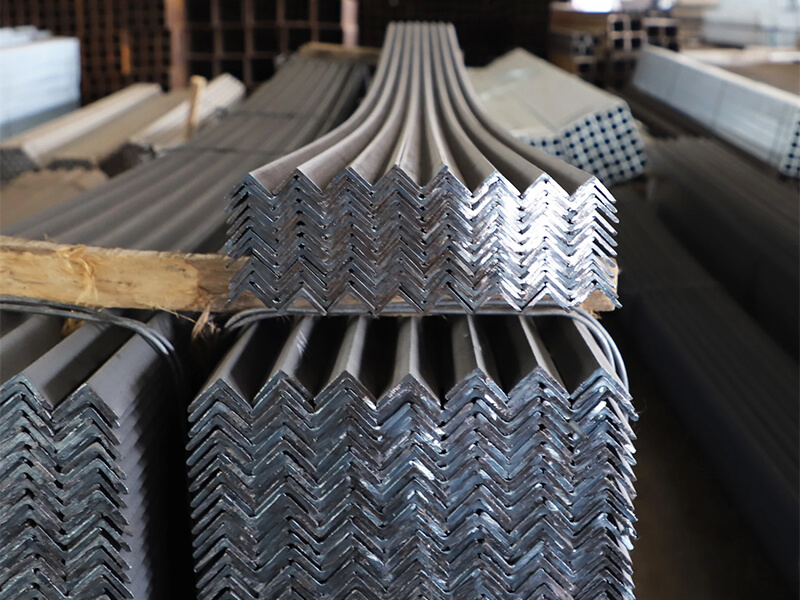
Connecting Steel Type to Marine Quality Issues
Each type has different properties. Using the wrong type, or receiving the wrong type, is a catastrophic quality failure.
1. Carbon Steel1.
- Description: Iron with carbon content up to 2.1%. The most common type.
- Low-Carbon Steel1 (Mild Steel): Contains up to 0.3% carbon. It is weldable, formable, and cheap. But it lacks high strength and toughness. Example: ASTM A36.
- High-Carbon Steel1: Contains more carbon for hardness. It is difficult to weld and brittle. Not used for marine structures.
- Marine Relevance: Basic marine grades (like ABS Grade A) are low-carbon steels. They are suitable for less critical areas.
2. Alloy Steel2.
- Description: Contains additional alloying elements to improve properties like strength, hardness, toughness, or corrosion resistance.
- High-Strength Low-Alloy (HSLA) Steel5: This is the key type for marine applications. Grades like AH36, DH36, and EH36 are HSLA steels. They contain small amounts of elements like manganese, chromium, nickel, and vanadium to increase strength and toughness without sacrificing weldability.
- Quality Issue: If you order AH36 but receive plain carbon steel (A36), the material will have lower strength and toughness. It may fail under load or become brittle in cold water.
3. Stainless Steel3.
- Description: Contains at least 10.5% chromium, which forms a protective oxide layer for corrosion resistance.
- Common Grades: 304 and 316. 316 has molybdenum for better corrosion resistance in saltwater.
- Marine Relevance: Used for specific components like fittings, railings, and chemical tanks. It is expensive and not used for primary hull structure.
4. Tool Steel4.
- Description: Hardened and tempered for cutting tools and dies.
- Marine Relevance: Not relevant for structural applications. If you receive this, it is a clear error.
5. Table: Steel Types and Their Marine Applications.
| Steel Type | Key Alloying Elements | Typical Grade | Marine Application | Common Quality Issue |
|---|---|---|---|---|
| Low-Carbon Steel1 | Carbon (10.5%), Ni | 304, 316 | Fittings, railings, tanks. | Wrong alloy (e.g., 304 instead of 316 for saltwater). |
| Weathering Steel | Cu, Cr, Ni | COR-TEN | Certain architectural structures. | Rarely used in primary marine structures. |
My Insight from the Field
A client in Qatar ordered a large quantity of AH36 angle steel. The material arrived with Mill Test Certificates6 that looked authentic. But during fabrication, their welding engineer noticed the welds were solidifying too quickly, indicating a different carbon content. They sent samples for independent testing. The results showed the steel was actually A36, not AH36. The supplier had substituted a cheaper grade. The client rejected the entire shipment and had to find emergency replacement material. The delay cost them weeks. This reinforced for me that verifying the steel type is not just about checking the MTC. Sometimes, independent testing is necessary, especially when dealing with a new or untrusted supplier. This is why we offer third-party inspection support.
What is the weight of 75 75 6mm ms angle?
You are checking the packing list against the delivered material. The total weight seems off. You need to calculate what the weight should be to see if the shipment is short. Or maybe you are designing a lifting beam and need to know the load. Accurate weight calculation is a basic but essential skill. It helps you catch quantity discrepancies and verify supplier data.
The theoretical weight1 of a 75mm x 75mm x 6mm mild steel (MS) angle2 is approximately 6.8 kilograms per meter. The precise calculation using the standard formula [(A+B)-t] t 0.00785 gives: [(75+75)-6] 6 0.00785 = 144 6 0.00785 = 864 * 0.00785 = 6.7824 kg/m.
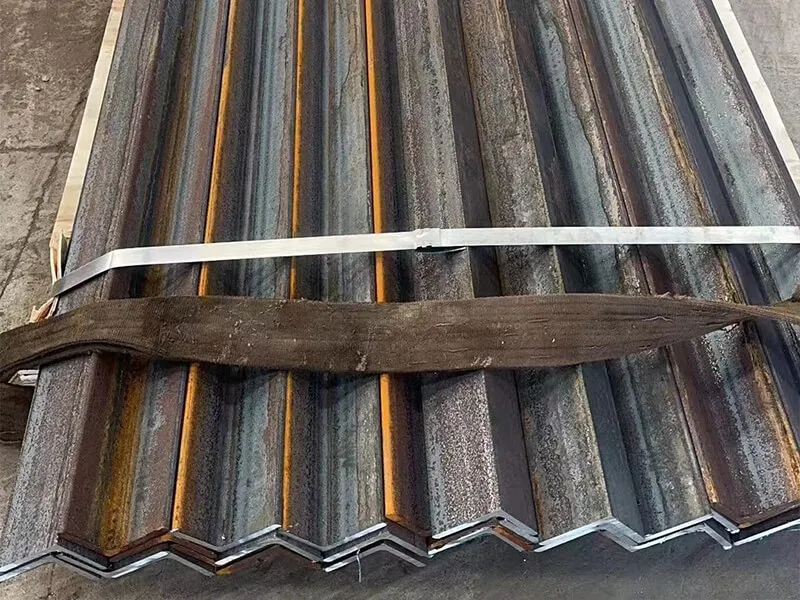
Weight Calculation as a Quality and Logistics Tool
This calculation is useful in several practical scenarios.
1. Verifying Shipment Quantities.
- The Problem: You ordered 100 pieces of 75x75x6 angle, each 12 meters long. The total theoretical weight1 is 100 pieces 12 m/piece 6.78 kg/m = 8,136 kg (8.14 tons). The truck scale says the shipment weighs 7.8 tons. There is a discrepancy.
- The Investigation: Is the shipment short? Are the pieces lighter than theoretical? Or is the truck scale inaccurate?
- The Solution: You can use the theoretical weight1 as a baseline. If the actual weight is significantly lower, it could mean fewer pieces were delivered. Your first action is to count the pieces. If the count is correct, then you need to investigate the weight per meter, as discussed earlier.
2. Planning Lifting and Transport.
- The Need: Your crane has a safe working load of 5 tons. You need to lift a bundle of 20 pieces of 75x75x6 angle, each 12m long.
- The Calculation: 20 pieces 12 m 6.78 kg/m = 1,627 kg (1.63 tons). Well within the crane’s capacity. You proceed safely.
- The Risk: If you underestimate the weight, you could overload the crane. If you overestimate, you might waste time using a larger crane than necessary.
3. Comparing Supplier Quotes.
- The Scenario: Supplier A quotes $700 per ton. Supplier B quotes $650 per ton. But Supplier B’s material is consistently lighter (e.g., 6.5 kg/m actual vs. 6.78 theoretical). You need to compare the cost per meter, not just cost per ton.
- The Calculation:
- Supplier A: $700/ton * (6.78 kg/m / 1000) = $4.75 per meter.
- Supplier B: $650/ton * (6.5 kg/m / 1000) = $4.23 per meter.
- The Insight: Supplier B is still cheaper per meter, but the gap is smaller than the per-ton price suggested. More importantly, the lighter weight might indicate a thinner section, which could be a structural risk. You need to investigate why it is lighter.
My Insight from the Field
A client in Thailand ordered a large quantity of 75x75x6 angles from us. They received the shipment and did a quick weight check3 on a sample. The actual weight was 6.79 kg/m, almost exactly theoretical. This confirmed the mill’s quality and our accuracy. Later, they told us about a previous supplier whose material consistently weighed 6.5 kg/m. They had accepted it, assuming it was within tolerance. But when they started fabrication, they noticed the legs were visibly thinner. They checked with calipers and found the thickness was only 5.5mm in places, below the acceptable tolerance. They had been paying for 6mm angles but receiving 5.5mm. The cumulative cost of the missing steel across many orders was significant. This experience taught them that weight is a powerful, simple check that can uncover hidden quality issues.
Conclusion
Common quality issues in marine angle steel supply range from dimensional errors to material substitutions. By understanding the product, calculating weights, and verifying grades, buyers can protect their projects from costly defects.
-
Exploring theoretical weight calculations can help ensure accurate material assessments and prevent discrepancies. ↩ ↩ ↩ ↩ ↩ ↩ ↩ ↩ ↩ ↩ ↩ ↩ ↩ ↩ ↩ ↩ ↩ ↩
-
Understanding the weight of this specific angle is crucial for accurate shipping and construction planning. ↩ ↩ ↩ ↩ ↩
-
A weight check is a simple yet powerful tool for ensuring material quality and preventing costly errors. ↩ ↩ ↩ ↩ ↩
-
Find out how Tool Steel is utilized in manufacturing cutting tools and its importance in industrial applications. ↩ ↩ ↩ ↩
-
Understand the significance of HSLA Steel in marine construction and its advantages over other steel types. ↩
-
Discover the role of Mill Test Certificates in verifying steel quality and ensuring compliance with specifications. ↩