
Choosing the wrong grade of marine steel can lead to catastrophic failures or unnecessary costs. The codes AH36, DH36, and EH36 may look similar, but their differences are critical for your vessel’s safety and performance.
The primary difference between AH36, DH36, and EH36 steel plates lies in their toughness, specifically their minimum impact energy at different temperatures. AH36 is for general use, DH36 offers better low-temperature performance, and EH36 provides the highest level of toughness for the most demanding environments.
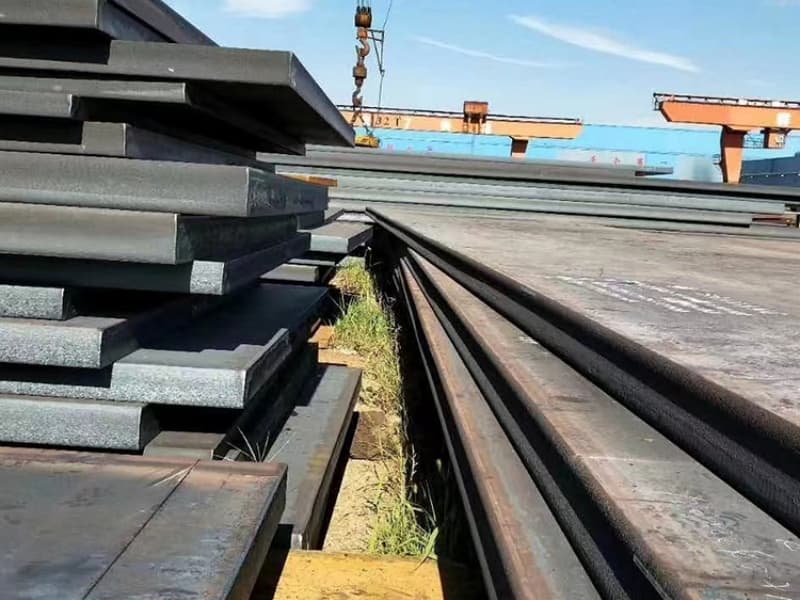
I have seen many clients and project engineers initially get confused by these letter designations. This confusion can lead to over-specifying (and overpaying) or, more dangerously, under-specifying a material. Understanding these grades is not just academic; it is a fundamental part of ensuring your ship’s structural integrity. Let me break down each grade clearly so you can make an informed, confident choice for your next project.
What is the difference between EH36 and AH36 steel?
When your design calls for a 36kg/mm² yield strength steel, choosing between EH36 and AH36 can seem minor. But this one-letter difference defines where and how the steel can be safely used.
The core difference is the minimum service temperature and impact toughness. EH36 steel is required to absorb significantly more impact energy at lower temperatures (-40°C) than AH36 (which is tested at 0°C), making EH36 suitable for ice-class vessels and Arctic operations where brittle fracture is a major risk.
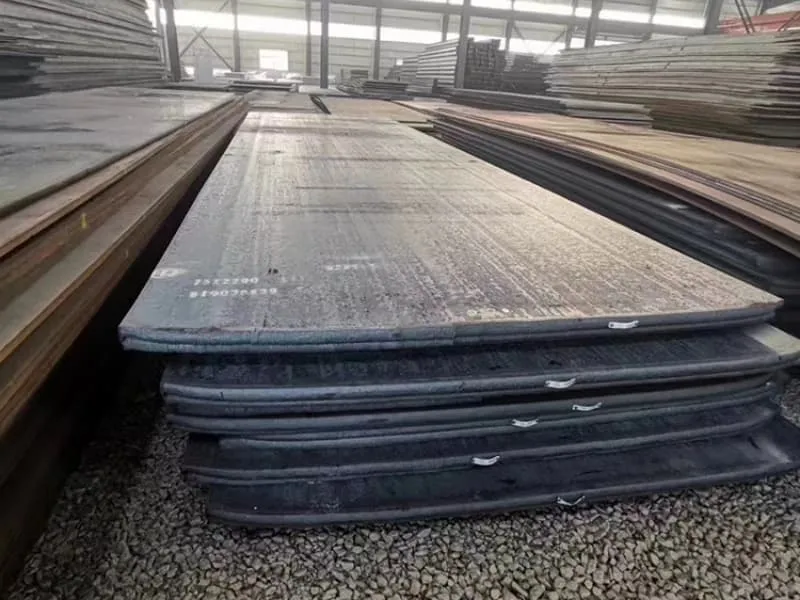
Decoding the "E" and "A": It’s All About Toughness and Temperature
The letters in these grades are not random. They follow a standardized system that tells you exactly what to expect from the material’s mechanical properties, especially its behavior under impact.
First, let’s understand the common ground. Both AH36 and EH36 share the "36". This number refers to the minimum yield strength of the steel, which is 355 MPa or 36 kilograms per square millimeter. So, in terms of basic strength—its ability to withstand static, continuous loads—both grades are identical. They also have similar chemical compositions to achieve this strength. This is why they can be tempting to substitute; on paper, their strength is the same.
Now, let’s look at the critical divergence: the Charpy V-Notch (CVN) impact test. This test measures a material’s toughness, which is its ability to absorb energy and resist fracture when hit suddenly. For ship plates, this is crucial because a ship’s hull faces dynamic loads from waves, impacts with ice, and other forces. The test involves striking a notched sample with a pendulum hammer at a specified temperature. The energy absorbed (in Joules) is recorded.
- AH36 (Grade A): The "A" signifies the most basic quality grade. AH36 is only required to be tested at 0°C (32°F). Its minimum average impact energy for three samples is typically 31 Joules. This is suitable for the hulls of general cargo ships, tankers, and bulk carriers operating in temperate or tropical waters where low temperatures are not a design concern.
- EH36 (Grade E): The "E" signifies an enhanced quality grade with high notch toughness. EH36 must be tested at a much lower temperature of -40°C (-40°F). Its minimum average impact energy requirement is much higher, typically 34 Joules or more at this extreme cold. This ensures the steel remains ductile and resistant to brittle crack propagation in frigid environments.
The practical application dictates the choice. Using AH36 where EH36 is required is a serious safety compromise. In cold conditions, AH36 could become brittle and susceptible to cracking. Conversely, using EH36 for a coastal barge in Southeast Asia is an unnecessary expense. The cost difference comes from stricter process controls during steelmaking, such as finer grain refinement and precise heat treatment, required to achieve the "E" grade toughness.
Here is a direct comparison table:
| Property / Requirement | AH36 Steel | EH36 Steel |
|---|---|---|
| Yield Strength (Min) | 355 MPa | 355 MPa |
| Tensile Strength | 490-620 MPa | 490-620 MPa |
| Key Differentiator | Standard impact toughness | Enhanced low-temperature toughness |
| Charpy V-Notch Test Temp. | 0°C (32°F) | -40°C (-40°F) |
| Typical Min. Impact Energy | 31 J | 34 J |
| Primary Application | General ship hulls (warm/temperate zones) | Ice-strengthened vessels, Arctic shipping |
| Relative Cost | Lower | Higher (due to advanced processing) |
What is the difference between AH and DH steel?
Navigating from AH to DH is a step up in performance. These are two of the most commonly compared grades for mainstream commercial shipbuilding outside polar routes.
The difference between AH and DH steel lies in their guaranteed level of notch toughness at a defined low temperature. DH steel (tested at -20°C) offers improved impact resistance compared to AH steel (tested at 0°C), providing a safer margin for ships operating in cooler climates or demanding sea states.
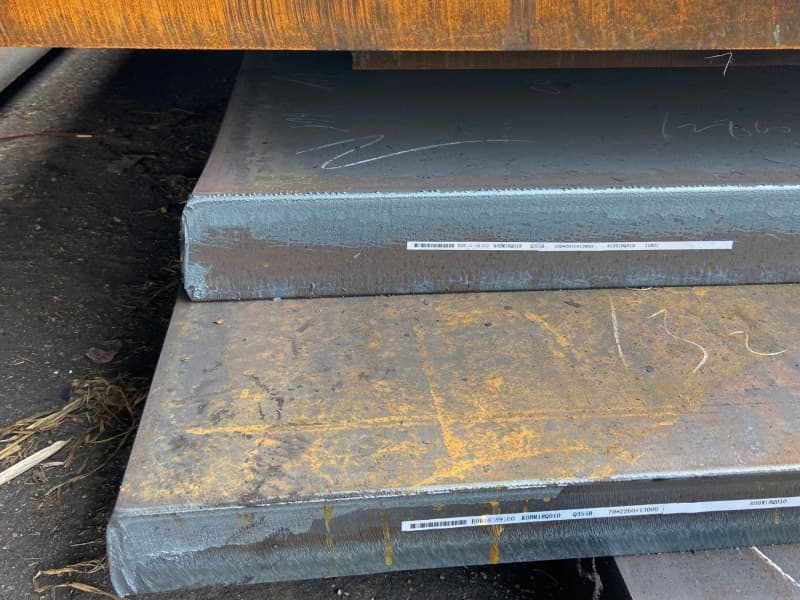
Understanding the Middle Ground: DH as the Balanced Choice
DH grade represents the workhorse for many international shipping routes. It offers a crucial performance upgrade over AH without stepping into the specialized (and costly) realm of EH grade.
Let’s break down the temperature requirement. The most concrete difference is, again, the Charpy V-Notch test temperature.
- AH (A-grade): Tested at 0°C. It is the baseline.
- DH (D-grade): Tested at -20°C (-4°F).
This -20°C threshold is not arbitrary. It covers a wide range of operational scenarios. For example, a container ship traveling from Shanghai to Los Angeles, or a bulk carrier in the North Atlantic in winter, will experience sea temperatures and atmospheric conditions that can bring structural components into this temperature range. Using AH steel here might be acceptable by some rules, but DH steel provides a much more robust safety factor against brittle fracture.
The implications for ship design and classification. Ship classification societies like ABS, LR, and DNV have rules that specify required steel grades for different parts of the ship based on their "application zone". These zones consider the stress concentration and the local temperature the plate will face. Typically:
- AH36 is often permitted for less critical, lower-stress areas or for ships with restricted service (like always in warm waters).
- DH36 is commonly required for the majority of the hull’s strength members (like the keel, bottom plating, and main deck) in oceangoing vessels. It is considered the standard for full-scantling ships.
From a supplier’s perspective, this distinction is daily work. When a client like Gulf Metal Solutions in Saudi Arabia orders plates for a tanker project, they don’t just ask for "ship plate." They specify "DH36" according to the shipyard’s approved drawings. Our job is to ensure the mill certificates explicitly state the grade as DH36 and that the impact test results at -20°C meet the required joules. This documented proof is what the shipyard and classification surveyor will demand. Offering the correct grade without substitution is a cornerstone of the "stable quality" our clients value.
What are the grades of marine steel plates?
The world of marine steel grades can seem like an alphabet soup. Beyond AH/DH/EH36, there is a full spectrum of materials designed for every part of a vessel and every type of service.
Marine steel plates are graded primarily by yield strength (e.g., 32, 36, 40, 46, 50, etc.) and by quality level (A, B, D, E, F) which indicates toughness. Additional grades exist for higher strength (FH, AH40-690), special applications like liquefied gas tanks (Ni-steels), and corrosion-resistant varieties.
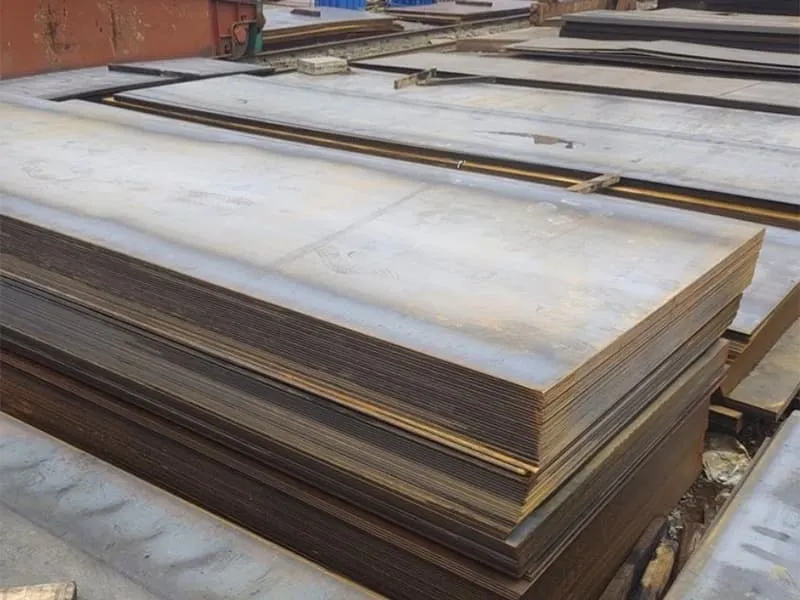
A Comprehensive Guide to the Marine Steel Family Tree
To specify materials correctly, you need a map of the entire landscape. Marine steels are systematically categorized to help designers and builders make precise selections.
First, the foundation: Normal Strength vs. High Strength Steels.
- Normal Strength Steels: These are Grade A steels. They have a yield strength of 235 MPa (approx. 24 kg/mm²). You see them as Grade A, B, D, and E, but with the number "235" (e.g., A235, D235). They are used for less critical, non-strength parts or smaller vessels.
- High Strength Steels (HSLA): This is the category for AH/DH/EH. The "H" stands for High tensile. They have higher yield strengths (315, 355, 390, 420 MPa and beyond) achieved through micro-alloying. They allow for thinner, lighter hulls without sacrificing strength.
Second, the strength levels within High Strength steels. The number (32, 36, 40, 46…) indicates the approximate yield strength in kg/mm². So:
- AH32/DH32/EH32: Yield Strength ≥ 315 MPa. Used for slightly less demanding applications or where weight saving is moderate.
- AH36/DH36/EH36: Yield Strength ≥ 355 MPa. The most common grade for large commercial ships.
- AH40/DH40/EH40 & higher: Yield Strength ≥ 390 MPa and above. Used for specific high-stress areas, military vessels, or where maximum weight reduction is critical.
Third, the specialized grades for extreme duties.
- Grade F (e.g., FH36, FH40): This is the highest ordinary toughness grade, tested at -60°C. It is used for the most critical areas of icebreakers or Arctic LNG carriers.
- Grade Z (e.g., AH36-Z25): The "Z" indicates through-thickness (Z-direction) property. It guarantees resistance to lamellar tearing in highly restrained welded joints like bulkhead connections.
- Low-Temperature & Nickel Steels: For liquefied natural gas (LNG) carriers, tanks are made from special steels with 3.5% or 9% Nickel, or from stainless steel (304L, 316L), to withstand temperatures as low as -163°C.
- Corrosion-Resistant Steels: Some vessels use weathering steels or copper-alloyed steels for certain structural parts to enhance longevity.
How this knowledge is applied in real business. When a new client from the Philippines contacts us for plates for a newbuild container ship, our technical discussion starts with these grades. We ask for the specification from the shipyard or the classification society drawing. We don’t just sell "EH36." We confirm if it’s EH36, or perhaps EH36 with Z25 properties. We then match this requirement with the appropriate mill in our network that holds the specific certification for that grade. This precise matching process is what prevents the "quality inconsistency" many buyers have faced before finding a reliable partner.
What is the meaning of dh36 steel?
Seeing "DH36" on a material list or a mill certificate is an everyday occurrence in shipbuilding. But each character in that code carries specific, non-negotiable meaning.
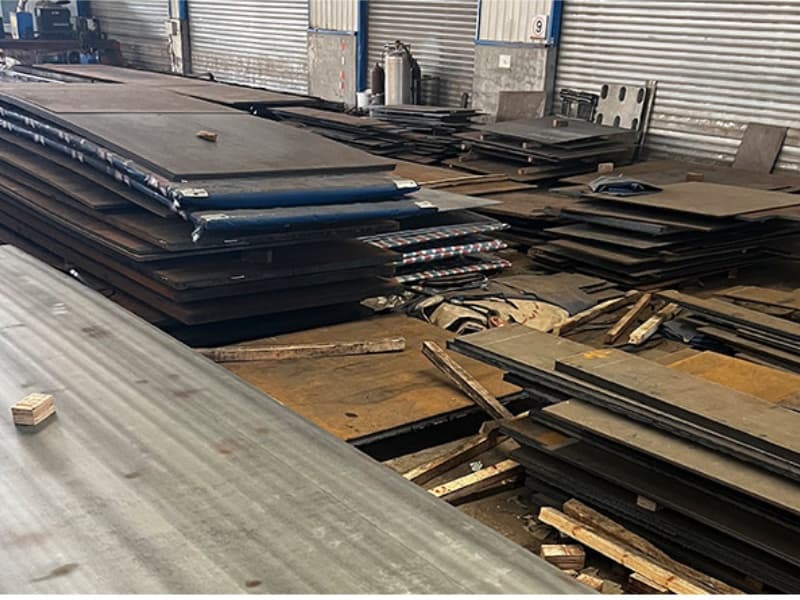
DH36 is a high-strength shipbuilding steel plate1. The ‘D’ indicates it is a quality grade tested for impact toughness at -20°C. The ‘H’ means High tensile strength. The ’36’ denotes a minimum yield strength of 355 MPa (36 kg/mm²). It is a standard choice for critical hull structures.
Deconstructing the Code: A Clause-by-Clause Explanation
Understanding DH36 fully means you can verify its compliance and understand why it’s specified. Let’s decode it one symbol at a time.
The First Letter: D = Notch Toughness Grade2.
This is the most important letter for mechanical performance after strength. According to international standards like ASTM A131 or EN 10225, the letter denotes the temperature at which the steel’s Charpy V-Notch impact test is conducted.
- A = 0°C
- B = 0°C (but with a different set of chemical composition requirements than A)
- D = -20°C
- E = -40°C
- F = -60°C
Therefore, ‘D’ immediately tells engineers and surveyors that this plate material has been proven to remain ductile and crack-resistant at temperatures as low as -20 degrees Celsius. This is a key safety parameter.
The Second Letter: H = High Tensile.
This distinguishes the steel from Normal Strength steels. An absence of ‘H’ would mean it’s a Grade D steel with a yield strength of only 235 MPa. The ‘H’ confirms it belongs to the High Strength Steel category. This means it has been micro-alloyed with elements like Niobium (Nb), Vanadium (V), or Titanium (Ti) to achieve a higher strength through grain refinement and precipitation strengthening, allowing for thinner, lighter sections.
The Number: 36 = Minimum Yield Strength3.
The number is a direct reference to the mechanical strength. ’36’ means the material has a minimum yield point of 355 N/mm² (Megapascals) or approximately 36 kilograms-force per square millimeter. Yield strength is the stress at which the material begins to deform plastically; beyond this point, deformation is permanent. This is the primary design strength parameter. The tensile strength (the point where it breaks) will be higher, typically between 490-620 MPa for DH36.
Putting it all together in practice.
When you receive a Mill Test Certificate4 for a batch of DH36 plates, you must check that:
- The grade is clearly stated as DH36.
- The Yield Strength (Rp0.2) is ≥ 355 MPa.
- The Charpy Impact Test results show the test temperature was -20°C and the absorbed energy values (usually an average of 3 tests) meet the specified minimum (e.g., 34 Joules).
- The chemical composition (C, Mn, Si, P, S, Nb, V, etc.) falls within the limits for DH36 per the relevant standard.
As a supplier, providing this clear, accurate, and verifiable documentation is our primary responsibility. It transforms the code "DH36" from a simple label into a complete package of guaranteed performance data. This is exactly the kind of transparency that builds long-term trust with rational, results-driven buyers who manage large projects.
Conclusion
Selecting the right marine steel grade—AH36, DH36, or EH36—is a critical technical decision based on yield strength, operational temperature, and required toughness. Understanding these codes ensures safety, compliance, and cost-effectiveness for your shipbuilding or repair project.
-
Explore this link to understand the properties and applications of high-strength shipbuilding steel plates in marine construction. ↩
-
Learn about Notch Toughness Grade to grasp its significance in ensuring steel performance under extreme conditions. ↩
-
Discover the importance of Minimum Yield Strength in material selection and design for structural integrity. ↩
-
Find out how a Mill Test Certificate ensures quality and compliance in steel manufacturing and procurement. ↩