
You are in the middle of a marine project. Steel materials are late, specifications are wrong, and your whole timeline is at risk. This stress is real and costly. We see it every day. An integrated supply chain is not just a buzzword. It is the practical solution to these exact problems. It turns chaos into calm and delays into on-time delivery.
Integrated supply for marine angle steel means one reliable partner manages everything. This partner handles quality control, logistics, and documentation from the mill to your job site. This approach eliminates multiple handoffs. It reduces errors and delays. The result is a smoother project and significant cost savings. You get what you need, when you need it, exactly as specified.
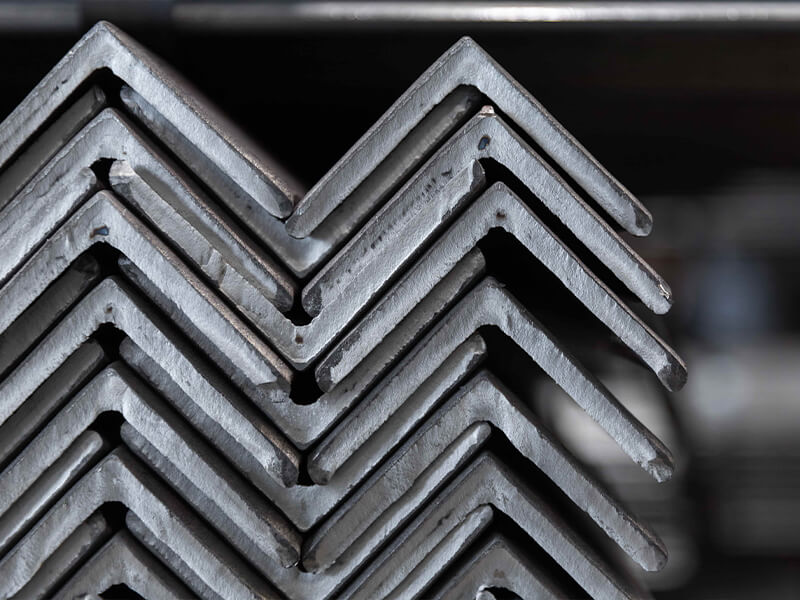
If you think sourcing steel is just about finding the lowest price, you might be setting your project up for hidden troubles. The real cost often lies in delays, rework, and mismatched materials. Let’s look deeper. Why is steel so crucial in marine builds? What specific role does angle steel play? Understanding this foundation shows why an integrated supply model is not a luxury, but a necessity for modern efficiency.
Why is steel important in marine technology1?
Imagine building a ship or an offshore platform with wood or concrete. It sounds impossible, right? The ocean is a brutal environment. Steel is the only material tough enough for the job. It forms the strong skeleton that keeps everything safe and floating. Without the right steel, marine structures simply cannot survive.
Steel is vital in marine technology1 because it provides the essential strength, durability, and weldability needed to withstand harsh sea conditions like corrosion, high pressure, and impact forces. It is the primary material for constructing ship hulls, offshore platforms, and port infrastructures, ensuring safety and longevity in a demanding environment.
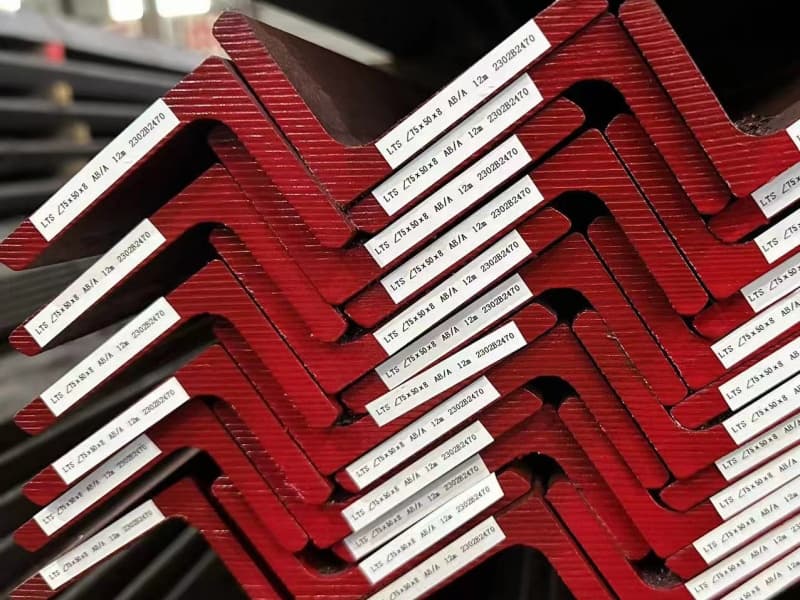
The Multifaceted Role of Marine Steel
Steel’s importance goes beyond just being strong. It is a carefully engineered material chosen for a combination of critical properties.
-
Structural Integrity and Safety: The hull of a cargo ship or an oil tanker bears immense loads. It holds the weight of the cargo and resists the constant pounding of waves. High-strength marine-grade steel plates are designed for this. They have precise chemical compositions to achieve the required yield and tensile strength. This ensures the structure does not bend or break under stress.
-
Corrosion Resistance is Non-Negotiable: Saltwater accelerates rust incredibly fast. Ordinary steel would fail in months. Marine steel, like AH36, DH36, or EH36 grades, is formulated and often treated with coatings to fight this. Elements like copper, chromium, and nickel are added to improve corrosion resistance2. This isn’t just about longevity; it’s about preventing catastrophic structural weakening.
-
Weldability and Fabrication: Marine structures are not cast in one piece. They are built from thousands of steel pieces welded together. The steel must have excellent weldability. This means it can be welded easily without forming cracks in the weld or the area next to it (the heat-affected zone). Poor weldability creates weak points, which are dangerous failure points in a storm.
-
Toughness at Low Temperatures: In arctic routes or deep waters, temperatures are very low. Steel can become brittle and crack in the cold. Marine grades are tested for "impact toughness3" at low temperatures (like -20°C or -40°C). This Charpy V-notch test ensures the steel remains ductile and can absorb sudden impacts without shattering.
Here is a comparison of key properties for common marine steel grades4:
| Grade | Yield Strength (Min) | Tensile Strength | Key Application | Notable Property |
|---|---|---|---|---|
| AH36 | 355 MPa | 490-620 MPa | Ship hulls, mid-sections | Good balance of strength and weldability |
| DH36 | 355 MPa | 490-620 MPa | Offshore structures, ice-class vessels | Improved toughness for lower temperatures |
| EH36 | 355 MPa | 490-620 MPa | Critical hull parts, high-stress zones | Superior toughness for the most demanding conditions |
| FH36 | 355 MPa | 490-620 MPa | Arctic vessels, special offshore projects | Exceptional low-temperature impact toughness3 |
My Insight from the Field
I once worked with a client in Qatar building supply vessels. They sourced cheaper, non-certified steel from a fragmented supply chain. During construction, several plates failed weld tests, showing cracks. The project stopped for weeks. They had to source emergency replacement materials at a high cost. This taught me a hard lesson: the true "cost" of steel includes its guaranteed performance. The right marine-grade steel from a certified mill, delivered with integrated quality control, is the cheapest option in the long run. It prevents expensive stoppages and ensures the final structure is safe and reliable.
What is the purpose of the steel angle?
You have a steel plate for the ship’s hull. Now, how do you build upwards and outwards to create decks, frames, and supports? You need a component that is strong but also easy to connect to other parts. That’s where angle steel comes in. It is the versatile connector and reinforcer of the marine world. Think of it as the industrial version of a corner brace you might use in a wooden shelf, but for massive structures.
The purpose of marine angle steel1, an L-shaped profile, is to provide structural support2, reinforcement, and framing. It is used to create brackets, stiffeners, deck beams, and hull frames. Its shape offers excellent strength-to-weight ratio3 and makes it easy to bolt or weld to plates and other sections, forming rigid connections in shipbuilding and offshore construction.
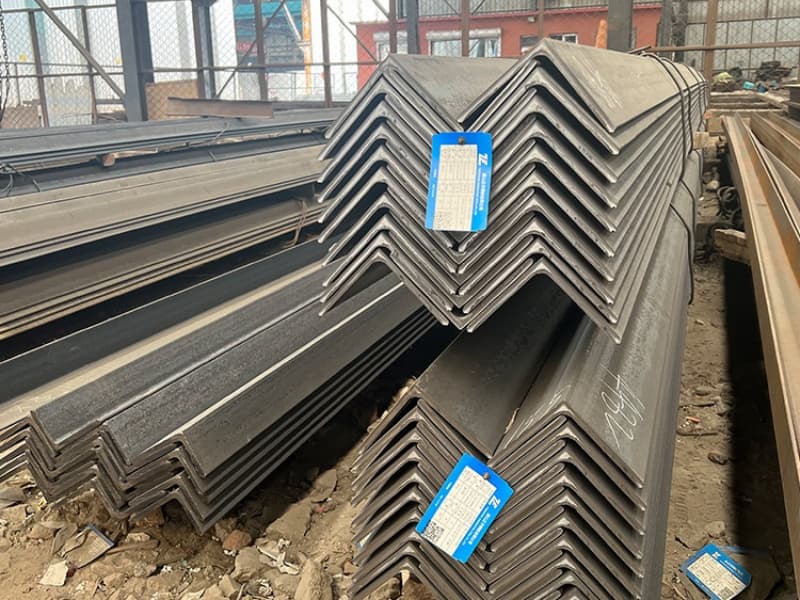
Beyond a Simple "Bracket": The Engineering Workhorse
Angle steel is deceptively simple. Its L-shape is a genius of engineering efficiency, serving multiple critical purposes.
-
Primary Framing and Skeleton Creation: The ribs of a ship, called frames, are often made from large angle bars. These frames run perpendicular to the keel, giving the hull its shape and longitudinal strength. They form the primary skeleton onto which the hull plates are welded. Similarly, in offshore platform decks, angle steel is used to build the grid of beams that support the deck plates.
-
Stiffening and Preventing Buckling: Large, flat steel plates are prone to buckling under pressure, like the side of a tin can if you squeeze it. Angle bars are welded onto these plates as "stiffeners." For example, longitudinal stiffeners made from angle steel run along the length of the hull plate. They add rigidity, allowing the plate to be thinner and lighter while still resisting the water pressure. This is crucial for efficiency and weight savings.
-
Creating Connections and Brackets: This is the most visible use. Angles are perfect for making brackets that connect beams to columns or equipment to the deck. The two legs provide two surfaces for welding or bolting, creating a very strong, stable joint. You’ll find angle brackets holding everything from ladders and railings to heavy machinery on a vessel.
-
Edge Reinforcement and Trim: The edges of hatches, door openings, and deck plates are vulnerable to damage and wear. An angle bar is often used as a trim or edge bar. It reinforces the opening, provides a finished look, and protects the exposed plate edge from corrosion and impact damage.
Why the Shape Matters So Much
The 90-degree angle is key. It provides inherent torsional stability (resistance to twisting) that a flat bar does not. One leg can be attached to a plate (like the deck), while the other leg points upwards to attach a vertical component (like a bulkhead). This creates a clean, strong corner. The shape also makes it easy to handle, store, and fabricate compared to more complex sections.
My Insight from the Field
Our client, Gulf Metal Solutions in Saudi Arabia, initially ordered only marine plates. Later, they asked about "L-shaped steel" for a fabrication project. They were sourcing angles from a different supplier. This caused a mismatch in material certificates and delivery times. When we explained our integrated supply for both plates and angles from the same certified mills, they saw the benefit immediately. Using angles and plates from the same production batch ensures consistent chemistry and properties. This makes welding easier and the final structure more uniform in strength. Now, they bundle orders, simplifying their logistics and improving their own project predictability.
What are the 4 types of angles?
Not all L-shapes are the same. Choosing the wrong type of angle for your marine project can lead to weak joints, corrosion traps, or fabrication headaches. You might think an angle is just an angle, but the subtle differences in design define its best use. Knowing these types helps you specify the exact material your design requires, avoiding costly field modifications.
The four main types of steel angles1 are: 1) Equal Angles2, where both legs are the same length (e.g., 50x50mm); 2) Unequal Angles3, with legs of different lengths (e.g., 100x75mm); 3) Bulb Angles4, which have a rounded bulb at the end of one leg for extra strength; and 4) Lipped Angles5, featuring a short return lip on one leg for enhanced edge stiffness.
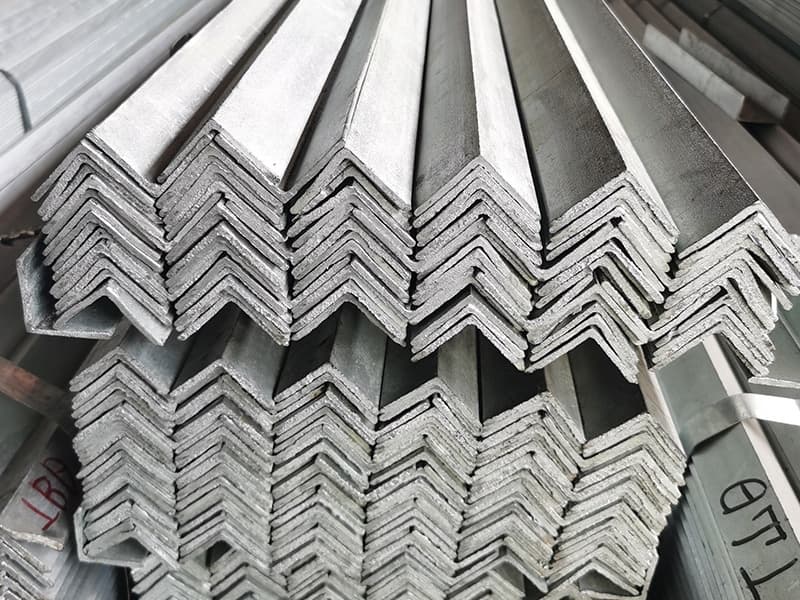
A Detailed Guide to Selecting the Right Angle
Each type has a specific engineering purpose. Let’s break down where and why each one is used in marine projects.
**1. Equal Angles2 (L)
This is the most common and versatile type. Think of it as the standard workhorse.
- Typical Sizes: Leg lengths range from small (20x20mm) for light brackets to very large (200x200mm or more) for primary framing.
- Primary Marine Uses: General stiffeners, frame brackets, deck support brackets, handrail supports, and equipment foundations. Its symmetry makes it easy to use in any orientation.
- Advantage: Standard availability, predictable behavior, and ease of fabrication. It’s the default choice for most non-specialized applications.
**2. Unequal Angles3 (L)
This type is used when the connection requirements are different on two sides.
- Typical Sizes: Examples include 100x75mm, 150x90mm, where one leg is longer than the other.
- Primary Marine Uses: Often used as edge stiffeners for plates where one leg needs to be longer to provide adequate welding surface or support. For instance, along the edge of a bulkhead where one side connects to the hull and the other to a deck. It’s also used in compound sections built up from multiple pieces.
- Advantage: Provides material efficiency. You get the required strength on one axis without wasting material on the other, optimizing weight and cost.
*3. Bulb Angles4 (also called Bulb Flats, though technically different from bulb flat plates*)
This is a specialist marine and shipbuilding section. The bulb adds significant strength.
- Key Feature: One leg ends in a rounded, bulbous thickening. This bulb adds a great deal of strength and stiffness to the section, particularly in bending resistance.
- Primary Marine Uses: Extremely common as stiffeners on ship hulls6 and decks. The bulb provides superior resistance to buckling forces from water pressure. They are the standard choice for longitudinal and transverse stiffeners in modern ship design.
- Advantage: Offers the highest strength-to-weight ratio among angles for stiffening purposes. It is a purpose-designed profile for marine structural efficiency.
**4. Lipped Angles5 (or Return Angles)
This type includes a small 90-degree return lip at the end of one leg.
- Key Feature: The lip acts as a built-in edge stiffener for the angle itself.
- Primary Marine Uses: Used in sections where the free edge of the angle needs extra protection against buckling or damage. Common in lighter structural partitions, ducting supports, or specialized fabrication where edge rigidity is critical.
- Advantage: The lip increases the local stability of the angle’s leg, preventing it from curling or deforming under load, without needing a much heavier section.
My Insight from the Field
A common mistake we see is project engineers specifying a large equal angle (like 150x150mm) when a smaller bulb angle would do the job better. The bulb angle provides greater stiffness for the same weight, or equivalent stiffness with less weight. Weight savings on a ship directly translate to fuel efficiency and cargo capacity. An integrated supplier who understands marine design can advise on this. We recently helped a Vietnamese shipyard redesign a support structure using bulb angles instead of unequal angles. We provided technical data sheets comparing the section modulus. This change saved them over 5 tons of steel weight on a single vessel, which was a major competitive advantage for their client.
What are the disadvantages of using angle steel1?
Angle steel is incredibly useful, but it’s not a perfect solution for every single joint or support in a marine project. Blindly using it everywhere can create problems. These problems include stress points, corrosion hotspots2, and fabrication inefficiencies. Being aware of these drawbacks helps you use angles wisely and know when to consider alternatives like tubular sections or fabricated box girders.
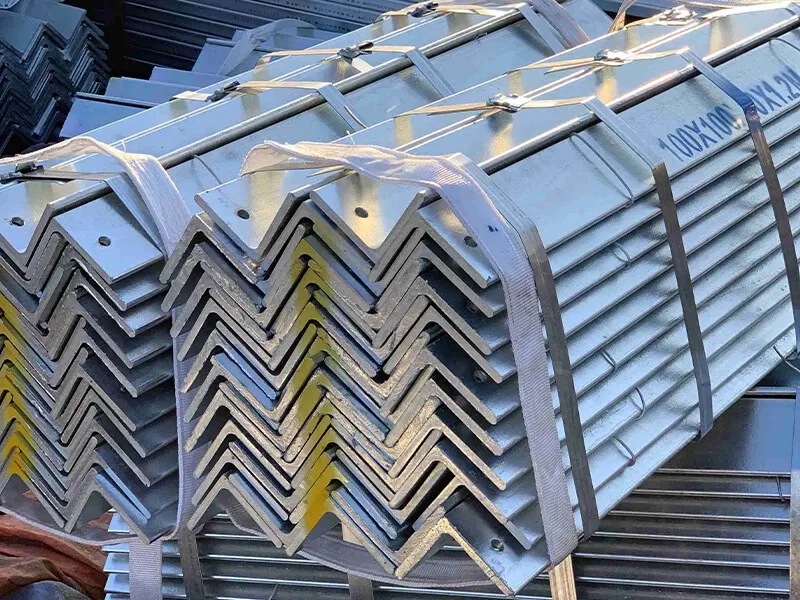
The main disadvantages of using angle steel1 include its open section, which can trap dirt and moisture leading to corrosion; stress concentration3 at the sharp inner corner; potential for local buckling4 of the free leg; and sometimes lower torsional resistance5 compared to closed sections. These factors require careful design, protective measures, and sometimes the use of alternative profiles.
A Critical Look at the Limitations
To use angle steel effectively, you must design around its weaknesses. Ignoring them compromises the structure’s integrity and longevity.
-
The Corrosion Trap – Open Section: This is the biggest practical issue. The inside corner of the angle is a natural trap for water, salt, dirt, and debris. In the marine environment, this creates a perfect spot for accelerated "crevice corrosion." It is difficult to clean and often poorly coated, as paint and spray struggle to penetrate the sharp corner properly. Over time, this hidden corrosion can significantly weaken the section without obvious visible signs on the outside.
-
Stress Concentration at the Root: The sharp 90-degree inner corner is a geometric stress concentrator. Under heavy cyclic loads, like the constant wave action on a ship, fatigue cracks can initiate at this root point. Good design practices mandate grinding the inner corner to a smooth radius or using specific welding techniques6 to mitigate this risk, which adds to fabrication time and cost.
-
Local Buckling of the Free Leg (Leg Buckling): When an angle is used as a compressive member (a column or strut), the free leg—the one not attached to a plate—is vulnerable to buckling sideways. This is called local buckling4. It limits the load-bearing capacity of the angle when used alone in compression. Engineers must use thicker material or add additional bracing to prevent this, which again adds weight and complexity.
-
Lower Torsional Stiffness: Compared to closed sections like circular or rectangular hollow sections (CHS/RHS), an open L-shape has relatively low resistance to twisting (torsion). If a structural member is subject to significant twisting forces, an angle bar is not the ideal choice. It will deform more easily than a tube.
-
Aesthetic and Safety Considerations: The protruding legs and sharp corners of angle steel1 can be hazardous on board a ship, creating snag points for lines or safety hazards for crew. For passenger areas or spaces where aesthetics matter, the angular profile is often considered less attractive and is usually boxed in or covered, adding non-structural materials.
How to Mitigate These Disadvantages
Smart engineering and good practice overcome these issues:
- For Corrosion: Specify thorough blasting and coating before assembly. Use seal-welding in the corner if possible, or apply dense, flexible sealants after painting. Regular inspection of these hidden areas is crucial.
- For Stress Concentration: Always radius the inner corner before welding. Follow strict welding procedures to ensure smooth weld profiles without undercut at the toe.
- For Buckling: Follow design codes that account for slenderness ratios of the free leg. Use angles in back-to-back pairs to form a T-section, or connect them to plates frequently to reduce the unsupported length.
My Insight from the Field
We supplied angle steel1 for a port crane beam renovation in Mexico. The original design used a large single unequal angle as a diagonal brace. After a few years, severe corrosion was found in the inner corner, and a fatigue crack had started. Our solution for the repair wasn’t just to replace it like-for-like. We proposed a change: using two back-to-back equal angles with a small gap between them, sealed at the ends. This formed a quasi-closed section that was much less prone to trapping debris. It also doubled the torsional stiffness. The client accepted, and the repaired structure has performed flawlessly. This experience is now part of our consultative approach. We don’t just sell what’s on the order; we ask about the application to see if a better solution exists.
Conclusion
Integrated supply for marine angle steel cuts through complexity. It delivers not just materials, but project certainty, from certified quality to on-site readiness, turning structural challenges into reliable outcomes.
-
Understanding the pros and cons of angle steel can help you make informed decisions for your projects. ↩ ↩ ↩ ↩ ↩ ↩ ↩ ↩
-
Explore effective strategies to mitigate corrosion in marine environments and enhance structural longevity. ↩ ↩ ↩ ↩ ↩
-
Learn about stress concentration and its impact on design to improve safety and performance. ↩ ↩ ↩ ↩ ↩ ↩
-
Discover prevention techniques for local buckling to ensure the stability of your structures. ↩ ↩ ↩ ↩ ↩
-
Gain insights into torsional resistance to choose the right steel section for your applications. ↩ ↩ ↩
-
Explore advanced welding techniques that can improve the durability and integrity of your structures. ↩ ↩