
You stock too much steel. Your cash is tied up. You stock too little. Production stops.
Effective inventory planning uses vessel build schedules to forecast demand, sets safety stock based on lead time and usage, applies JIT delivery to reduce holding costs, and follows proper storage and rotation practices to prevent damage.
I have helped shipyards move from chaos to control. The ones who plan their L‑section inventory save money, free up yard space, and never stop production. The ones who don’t keep guessing and paying the price. Let me walk you through the four steps that work.
How Do You Forecast Demand for L‑Shaped Steel Based on Vessel Build Schedules?
You guess how much L100x100x10 you need next month. You are off by 20 tons. You run out.
You forecast by breaking down each vessel’s bill of materials (BOM) into phases (hull, deck, superstructure), matching steel sizes to each phase, and building a timeline that shows weekly or monthly usage. Then you roll up all vessels in production.
The BOM method that works
I worked with a shipyard in Malaysia. They used to order steel when the yard supervisor said "we are low." That caused constant shortages and surpluses. Then they started using a simple BOM-based forecast. They cut their emergency orders by 80%.
So let me show you how to do it.
First, get the BOM for each vessel. For L‑shaped steel, the BOM should list:
| Vessel ID | Phase | Size | Grade | Quantity (meters or pieces) | Weight (tons) | Week Needed |
|---|---|---|---|---|---|---|
| V101 | Hull block 1 | L100x100x10 | AH36 | 200m | 15 | Week 4 |
| V101 | Hull block 2 | L100x100x10 | AH36 | 180m | 13.5 | Week 6 |
| V101 | Deck | L125x125x12 | AH36 | 150m | 16 | Week 10 |
Second, group by size and week. Sum up the demand for each size across all active vessels. Group demand by size and week to convert the BOM into a purchase plan.
| Week | L75x75x8 (tons) | L100x100x10 (tons) | L125x125x12 (tons) | L150x150x15 (tons) |
|---|---|---|---|---|
| 4 | 5 | 15 | 0 | 0 |
| 5 | 5 | 12 | 8 | 0 |
| 6 | 0 | 20 | 10 | 5 |
| 7 | 0 | 15 | 12 | 8 |
Third, convert weekly demand into an order schedule. If your supplier lead time is 30 days, you need to order 4‑5 weeks before the steel is needed. A weekly inventory forecast helps turn those needs into a practical order calendar.
| Week Needed | Size | Tons | Order Date (30 days before) |
|---|---|---|---|
| 4 | L100x100x10 | 15 | Week 0 (4 weeks before) |
| 5 | L75x75x8 | 5 | Week 1 |
| 6 | L100x100x10 | 20 | Week 2 |
Fourth, update the forecast weekly. Build schedules change. Do your forecast every Friday for the next 8 weeks. Use a simple spreadsheet. BOM and supply chain planning works best when forecasts are kept current.
I send my clients a blank forecast template. They fill it in weekly. I adjust my stock and shipping.
Your demand forecasting checklist
- You have BOMs for all vessels in production
- You break demand by phase (hull, deck, etc.)
- You create a weekly demand table by size
- You order steel 4‑6 weeks before it is needed in fabrication
What Safety Stock Levels Protect Your Shipyard from Supply Disruptions Without Overstocking?
Safety stock is insurance. Too little – you get caught. Too much – you waste money.
The right safety stock level is calculated as: (Daily usage × Supplier lead time in days) × a buffer factor (1.2 to 1.5). For common sizes that you use every week, keep 2‑4 weeks of extra stock. For rare sizes, keep less or none.
The formula that ended my client’s stockouts
I had a client in Vietnam. He kept one month of safety stock on everything – common and rare sizes. That was 400 tons of steel sitting idle. Then he calculated properly. He reduced his safety stock to 200 tons. He saved $140,000 in working capital. And he still never ran out of common sizes.
So let me break down the calculation.
First, the Safety stock formula.
Safety stock (tons) = (Average daily usage in tons) × (Supplier lead time in days) × Buffer factor
- Average daily usage: total monthly usage ÷ 30
- Supplier lead time: from order to arrival (include production, shipping, customs)
- Buffer factor: 1.2 for stable suppliers, 1.5 for less stable
Second, example for a common size L100x100x10.
| Parameter | Value |
|---|---|
| Monthly usage | 60 tons |
| Daily usage | 2 tons |
| Supplier lead time | 40 days |
| Buffer factor (stable supplier) | 1.3 |
| Safety stock | 2 × 40 × 1.3 = 104 tons |
That 104 tons covers you if a shipment is delayed by up to 12 days (the 0.3 extra buffer gives you 30% of lead time as cushion).
Third, safety stock guidelines by usage frequency.
| Usage Frequency | Example Size | Safety Stock Rule |
|---|---|---|
| Daily (every week) | L100x100x10 | 3‑4 weeks of usage |
| Weekly (most weeks) | L125x125x12 | 2‑3 weeks of usage |
| Monthly (some vessels) | L150x150x15 | 1‑2 weeks of usage |
| Rare (once per year) | L200x200x20 | None – order per project |
Fourth, how to adjust safety stock based on supplier reliability.
| Supplier Reliability | Buffer Factor | Safety Stock (for 2 tons/day, 40 day lead time) |
|---|---|---|
| Very reliable (98%+ on‑time) | 1.2 | 96 tons |
| Average (90‑95% on‑time) | 1.4 | 112 tons |
| Unreliable (below 90%) | 1.7 | 136 tons |
If your supplier is unreliable, you need more safety stock. Or find a better supplier.
Your safety stock checklist
- You have calculated safety stock for each size using the formula
- You adjust the buffer factor based on your supplier’s reliability
- You review safety stock levels quarterly (usage may change)
- You do not keep safety stock on very rare sizes
I help my clients set their safety stock levels. They show me their usage. I show them my lead time reliability. We find the right balance.
How Can Just‑in‑Time (JIT) Delivery Reduce Inventory Holding Costs and Free Up Yard Space?
You order steel for three months at once. Your yard is full. Your cash is in steel.
JIT delivery means you order in smaller quantities but more frequently, synchronized with your fabrication schedule. You receive steel just before you need it. This reduces inventory holding costs, frees up yard space, and cuts the risk of damage or rust from long storage.
How a shipyard cut inventory by 60% with JIT
I worked with a shipyard in Thailand. They used to order 200 tons of L100x100x10 at a time. That filled half their yard. Then they switched to JIT: four deliveries of 50 tons each, timed to fabrication phases. Their yard space freed up. Their inventory value dropped from $350,000 to $140,000.
So let me show you how to set up JIT.
First, break your fabrication schedule into phases. For a typical vessel, the phases might be:
| Phase | Weeks | L‑Section sizes needed |
|---|---|---|
| Hull block assembly | 2‑6 | L100x100x10, L125x125x12 |
| Hull joining | 6‑10 | L100x100x10, L150x150x15 |
| Deck installation | 10‑14 | L75x75x8, L100x100x10 |
| Superstructure | 14‑18 | L75x75x8, L125x125x12 |
Second, schedule deliveries to match each phase. Order the steel for phase 1 to arrive at week 2. Order phase 2 to arrive at week 6, and so on.
| Delivery | Week | Sizes | Quantity (tons) | For Phase |
|---|---|---|---|---|
| 1 | 2 | L100x100x10, L125x125x12 | 60 | Hull blocks |
| 2 | 6 | L100x100x10, L150x150x15 | 50 | Hull joining |
| 3 | 10 | L75x75x8, L100x100x10 | 40 | Deck |
| 4 | 14 | L75x75x8, L125x125x12 | 35 | Superstructure |
Third, work with a supplier who can handle JIT. Not all suppliers can. You need one who:
- Keeps stock of common sizes (not "produce after order")
- Can ship partial containers or LCL
- Provides accurate lead times
- Responds quickly to schedule changes
I offer JIT to my long‑term clients. They give me a rolling 8‑week forecast. I ship every 2‑4 weeks.
Fourth, compare costs: bulk ordering vs JIT.
| Cost Factor | Bulk Order (200 tons) | JIT (4 × 50 tons) |
|---|---|---|
| Average inventory held | 200 tons | 75 tons |
| Holding cost (15% of value/year) | $21,000 | $7,875 |
| Yard space occupied | Full bay | 1/4 bay |
| Risk of rust damage | Higher (steel sits longer) | Lower (fresh steel) |
| Freight cost | Lower (full container) | Slightly higher (LCL) |
Even with slightly higher freight, JIT usually wins on total cost.
Your JIT checklist
- You have a detailed fabrication schedule by phase
- Your supplier holds stock of your common sizes
- You can give your supplier a rolling 8‑week forecast
- You have a reliable way to unload and store smaller, frequent deliveries
I have helped many shipyards transition to JIT. It takes planning but the payoff is large.
What Storage and Rotation Practices Prevent Damage and Ensure First‑In‑First‑Out Usage?
Steel arrives. You put it in the yard. Months later, you find it buried under new steel. Rusted and forgotten.
Proper storage means keeping L‑sections off the ground, under cover, organized by size and grade, and clearly labeled with arrival date. Rotation means using the oldest steel first (FIFO – first in, first out). This prevents rust, damage, and waste.
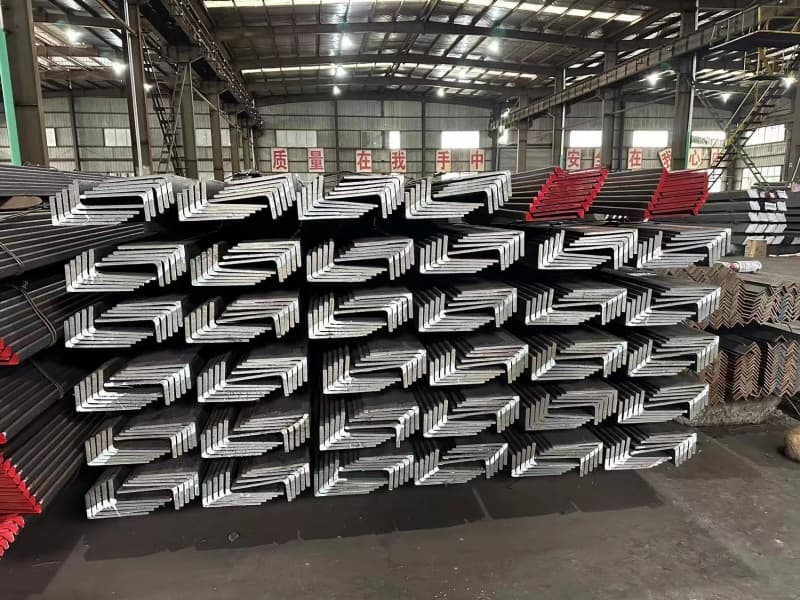
The yard that found 50 tons of forgotten steel
I visited a shipyard in the Philippines. They were about to order 50 tons of L125x125x12. As I walked the yard, I saw a pile covered by tarps. Under the tarps were 50 tons of L125x125x12 that had been sitting for 9 months. It was rusty, but usable after cleaning. They canceled their order. The yard manager had no system for tracking what came in when.
So let me set up a simple system.
First, storage basics that prevent damage.
| Practice | Why |
|---|---|
| Store on wooden sleepers (not directly on ground) | Prevents rust from ground moisture |
| Keep under roof or heavy tarp | Protects from rain and sun |
| Leave space between bundles for air flow | Reduces moisture trapped against steel |
| Use color‑coded tags for grade | Easy visual identification |
Second, the FIFO rotation system. Label every bundle with the arrival date (e.g., "Arrived Mar 15, 2025"). When a new bundle arrives, place it at the back of the storage area. Pull steel from the front.
| Storage Position | Bundle Date | Action |
|---|---|---|
| Front (furthest from door) | Oldest (Mar 15) | Use first |
| Middle | Middle (Apr 10) | Use second |
| Back (closest to door) | Newest (May 5) | Use last |
Third, a simple inventory tracking board. Use a whiteboard or spreadsheet.
| Size | Grade | Bundle ID | Arrival Date | Quantity (tons) | Location | Status |
|---|---|---|---|---|---|---|
| L100x100x10 | AH36 | B101 | Mar 15 | 25 | Bay A1 | Available |
| L100x100x10 | AH36 | B102 | Apr 10 | 30 | Bay A2 | Available |
| L100x100x10 | AH36 | B103 | May 5 | 20 | Bay A3 | Newest |
Fourth, weekly storage audit. Every Friday, walk your storage yard and check:
- Are bundles clearly labeled with arrival dates?
- Is the oldest steel at the front (or clearly marked)?
- Is there any rust or damage that needs attention?
- Are different sizes and grades separated?
I send my clients a storage audit checklist. They fill it out weekly. It takes 15 minutes.
Your storage and rotation checklist
- Steel is stored off the ground on sleepers or racks
- Each bundle has a visible arrival date label
- You use FIFO – oldest steel used first
- You have a simple inventory board (whiteboard or spreadsheet)
- You audit storage weekly
I have seen shipyards cut their rust‑related waste by 80% just by following these storage rules.
Conclusion
Forecast from BOMs, set safety stock with a formula, use JIT delivery, and store with FIFO. That is how you plan L‑section inventory at shipyards.