
Block building is faster than whole-vessel construction. But your L-shaped steel planning can break this speed if you get it wrong.
Marine L-shaped steel planning for block construction means calculating steel needs per individual block instead of per whole vessel, grouping orders by block type and profile size, scheduling deliveries to match each block’s assembly date, and keeping a floating inventory of common sizes for late design changes.
I have worked with many shipyards in Vietnam, Qatar, and Saudi Arabia. They all switched to block construction to save time. But their steel planning often stayed old-fashioned. They ordered material for the whole ship at once. That created piles of unused L-shaped steel sitting in the way. Let me show you a better way. This is the system I use with my clients at CN Marine Steel.
How to Break Down L-Shaped Steel Requirements by Block Instead of by Whole Vessel?
Do you still calculate steel for the entire vessel first? That method hides which block needs what. You end up moving material three times before cutting.
To break down L-shaped steel requirements by block, you first get the block division drawing1 from the shipyard, then list each block’s L-shaped profiles separately, and finally sum up by size and grade only after you know every block’s needs.
Why whole-vessel planning fails for block construction
I saw this mistake in a Philippine shipyard. They ordered 200 tons of L-shaped steel for one tugboat. The steel arrived in one shipment. Then the yard started cutting blocks. But Block 5 needed 100x65x7mm angles. That steel was at the bottom of the pile. Workers spent two days moving other steel just to reach it. That is wasted labor.
Worse, Block 2 had a design change. The naval architect asked for a different leg length. But the steel was already cut for the old design. The yard lost 8 tons of material.
So here is what I tell my buyers: Plan by block, not by vessel. A vessel has 20 to 60 blocks. Each block is like a small ship. It has its own shape, its own stiffeners, and its own L-shaped steel list2.
The four-step breakdown method
Step 1 – Get the block division drawing. This drawing shows how the shipyard splits the hull. Each block gets a number. For a bulk carrier, typical blocks are: bottom block, side block, upper deck block, forepeak block, aft peak block, and engine room block.
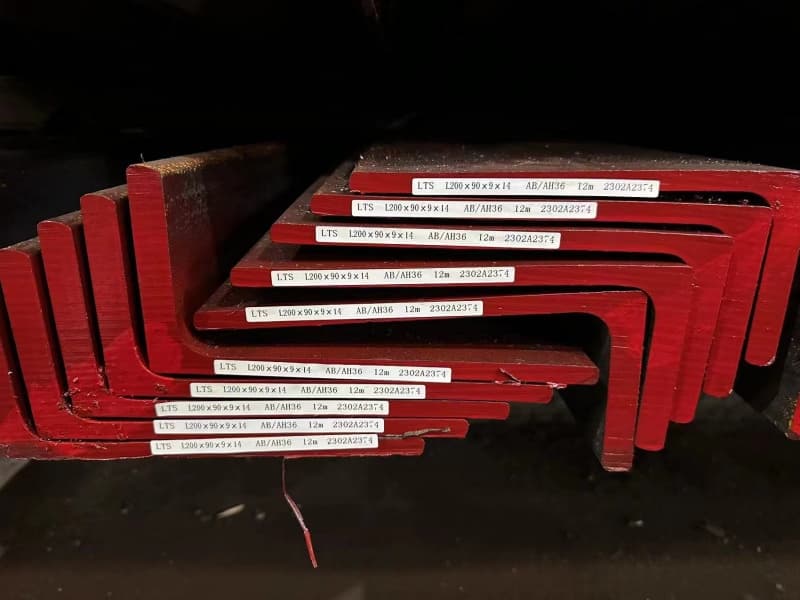
Step 2 – Extract the L-shaped steel list for each block. Every block has a material take-off (MTO) sheet3. Ask for it. If the yard does not have one, that is a red flag. A good MTO lists every piece of L-shaped steel by size (leg length x leg length x thickness, like 150x90x8mm), grade (A, B, AH36, etc.), and length.
Step 3 – Record each block’s needs in a separate tab of a spreadsheet. I use a simple Excel file. Columns: Block number, Size (mm), Grade, Length per piece (m), Number of pieces, Total meters, Total weight (kg). One row per line item.
Step 4 – Combine only after you have all blocks. This is the key. Do not combine early. Keep blocks separate until you finish the list. Then you can sum up identical sizes across blocks. But you keep the block-level data for delivery scheduling4.
Here is an example table for three blocks of a small container ship:
| Block number | Size (mm) | Grade | Pieces | Total meters | Weight (kg) |
|---|---|---|---|---|---|
| Block 01 (Bottom center) | 150x90x8 | A | 24 | 360 | 1,620 |
| Block 01 (Bottom center) | 120x80x7 | A | 18 | 270 | 950 |
| Block 02 (Side shell) | 150x90x8 | A | 32 | 480 | 2,160 |
| Block 02 (Side shell) | 100x75x6 | A | 40 | 600 | 1,560 |
| Block 03 (Deck) | 150x90x8 | B | 20 | 300 | 1,350 |
| Block 03 (Deck) | 120x80x7 | B | 15 | 225 | 790 |
Now you see clearly: Block 01 and Block 02 both use 150x90x8 grade A. Total from those two blocks is 840 meters (360+480). Block 03 uses the same size but grade B. That is a different order. You cannot mix grades.
This block-level breakdown saved a client in Thailand from a major mistake. He almost ordered 5 tons of 100x75x6mm grade B for the whole vessel. But his block list showed that only Block 02 needed grade B. The other blocks used grade A. Mixing grades would have failed the classification society inspection5. He thanked me later.
What Is the Best Way to Group L-Shaped Steel Orders for Different Block Types?
Do you order all L-shaped steel together? That feels simple. But different block types have different priority levels. Grouping them the wrong way delays your critical path blocks1.
The best way to group L-shaped steel orders2 for different block types is to first separate block types into three priority groups – critical path blocks, standard blocks3, and non-critical blocks4 – then place separate mill orders5 or combine only within the same priority group to avoid holding up assembly.
Why not all blocks are equal
Block construction has a sequence. Some blocks must be finished before others can start. For example, the bottom block is usually critical. The engine room block is also critical. The superstructure block can wait.
I learned this from a shipbuilder in Malaysia. He ordered all L-shaped steel for six blocks at once. The mill delivered everything together. But his yard only had space to build two blocks at a time. The steel for Block 04 sat outside for three months. Surface rust formed. He had to blast and prime it again. That cost him $2,000 and two weeks of delay.
So here is my rule: Group orders by block priority, not by convenience.
Three priority groups for block types
Group A – Critical path blocks. These blocks determine the whole project timeline. Examples: bottom block, engine room block, collision bulkhead block. For these blocks, you cannot afford any steel delay. Order their L-shaped steel separately. Pay a small premium for faster mill rolling if needed. Ship them first.
Group B – Standard blocks. These blocks are important but not on the critical path. Examples: side shell blocks, deck blocks, transverse bulkhead blocks. You can group these together. Combine similar sizes and grades from multiple standard blocks into one mill order. This saves money.
Group C – Non-critical blocks. These blocks can be built later. Examples: superstructure blocks, funnel blocks, bow thruster blocks (if not critical). For these, you can even wait for leftover material from other blocks. Or you can order them in larger batches with longer lead times to get lower prices.
Here is a decision table for a typical 50,000 DWT bulk carrier:
| Block type | Priority group | Recommended grouping strategy6 | Lead time target |
|---|---|---|---|
| Bottom block | A (Critical) | Separate order, 15% buffer | 4 weeks before block start |
| Engine room block | A (Critical) | Separate order, 10% buffer | 5 weeks before block start |
| Side shell blocks (4 pcs) | B (Standard) | Group together, one order | 6 weeks before first block |
| Deck block | B (Standard) | Group with other standard blocks | 6 weeks before block start |
| Transverse bulkheads (5 pcs) | B (Standard) | Group together | 6 weeks before first block |
| Superstructure block | C (Non-critical) | Group with next vessel or use leftovers | 8 weeks before block start |
| Funnel block | C (Non-critical) | Order as filler with other mill orders | 10 weeks before block start |
A real example from Saudi Arabia
Gulf Metal Solutions, our client in Dammam, was building three crew boats. Each boat had 12 blocks. They wanted to group all L-shaped steel across all boats to get mill discount. I advised against it. Here is why:
Boat 1 had a tight delivery schedule. Boat 2 and Boat 3 had later delivery dates. If we grouped everything together, the mill would roll all steel at once. That meant Boat 1’s steel would arrive on time. But Boat 2 and Boat 3’s steel would also arrive early. The yard had no space to store steel for three boats. So they said no.
Instead, we did this:
- Group A (Boat 1 critical blocks) – separate order, 45 tons, delivered in 3 weeks
- Group B (Boat 1 standard blocks + Boat 2 standard blocks) – combined order, 110 tons, delivered in 5 weeks
- Group C (Boat 2 critical blocks + Boat 3 blocks) – combined order, 130 tons, delivered in 7 weeks
This way, the yard received steel just before each block started. They saved storage space and avoided double handling. The mill still gave them a good price because each combined order was over 100 tons.
The lesson is simple: Do not group everything. Group smartly by block priority.
How Do You Schedule L-Shaped Steel Deliveries to Match Block Assembly Sequences?
Does your steel delivery schedule look like a list of dates that someone guessed? Block assembly has a rhythm. Your deliveries must dance to that same rhythm.
To schedule L-shaped steel deliveries1 to match block assembly sequences2, you map each block’s start date from the yard’s production plan, then back-calculate delivery dates3 by subtracting mill lead time4 and buffer days, and finally deliver each block’s steel in one batch 1-2 weeks before that block’s assembly begins.
The one-block-one-delivery rule5
Many buyers split L-shaped steel for one block into multiple deliveries. That creates chaos. The block assembly team needs all their steel at once. They cut, bend, and weld continuously. If a 100x75x6mm angle is missing, that block stops.
I saw this happen in a Vietnam shipyard. They ordered L-shaped steel for Block 07 in three separate deliveries. The first delivery had 60% of the material. The second had 30%. The third had 10%. The third delivery was delayed by 10 days. Block 07 could not be completed. The crane moved to another block. When the steel finally arrived, the crane had to come back. That wasted two shifts.
So now I tell my clients: One block, one delivery. Deliver all L-shaped steel for a given block in a single shipment. The only exception is very large blocks over 200 tons. Then you can split into two deliveries spaced one week apart.
How to calculate delivery dates
Here is the formula I use with every client:
Delivery date = Block start date – (Mill lead time + Sea freight time + Port clearance + 7 days buffer)
Let me break it down with an example. A client in Qatar has Block 11 starting on June 15. Mill lead time is 25 days. Sea freight from China to Qatar is 18 days. Port clearance takes 5 days. Add 7 days buffer.
Total days before block start = 25+18+5+7 = 55 days. So order must be placed by April 21. And steel must arrive at the yard by June 8 (one week before block start).
That one week buffer is important. The yard can inspect the steel, move it to the block assembly area, and cut test pieces. If any piece is damaged or wrong size, they have time to tell you before the block starts.
Matching delivery to block assembly sequence for multiple blocks
For a typical ship with 20 blocks, you will have a rolling delivery schedule6. Let me show you a sample schedule for a 1,800 TEU container ship built in 12 months:
| Block number | Block type | Priority | Block start date | Order placement date | Delivery to yard date |
|---|---|---|---|---|---|
| B01 (Bottom aft) | Critical | A | Month 2, Week 1 | Month 0, Week 2 | Month 1, Week 4 |
| B02 (Bottom mid) | Critical | A | Month 2, Week 3 | Month 0, Week 4 | Month 2, Week 1 |
| B03 (Bottom fwd) | Critical | A | Month 3, Week 1 | Month 1, Week 1 | Month 2, Week 3 |
| B04 (Engine room) | Critical | A | Month 3, Week 3 | Month 1, Week 2 | Month 3, Week 1 |
| B05 (Side shell port) | Standard | B | Month 4, Week 1 | Month 1, Week 4 | Month 3, Week 3 |
| B06 (Side shell starboard) | Standard | B | Month 4, Week 2 | Month 2, Week 1 | Month 4, Week 0 |
| B07 (Deck block) | Standard | B | Month 5, Week 1 | Month 2, Week 3 | Month 4, Week 2 |
| B08 (Superstructure) | Non-critical | C | Month 8, Week 1 | Month 4, Week 2 | Month 7, Week 3 |
Notice how deliveries arrive 1-2 weeks before block start. No early piles. No late surprises.
What to do when the yard changes the sequence
Yards change sequences. It happens. A client in Romania had his block sequence reversed because of crane availability. His steel for Block 12 was already on the ship. Block 12 was now the last block, not the fourth block. The steel sat for two months.
To handle this, I add a clause in my sales contract: “Buyer can request to hold steel at supplier’s warehouse for up to 60 days at no extra charge if block sequence changes before shipment.” Our mill in Liaocheng agrees to this for regular buyers. It gives you flexibility.
Why Should You Keep a Floating Inventory of Common L-Shaped Sizes for Block Modifications?
Have you ever faced a last-minute design change that needed 50 meters of a common L-shaped size? Without floating inventory1, you wait for a new mill run. With floating inventory, you fix it in one day.
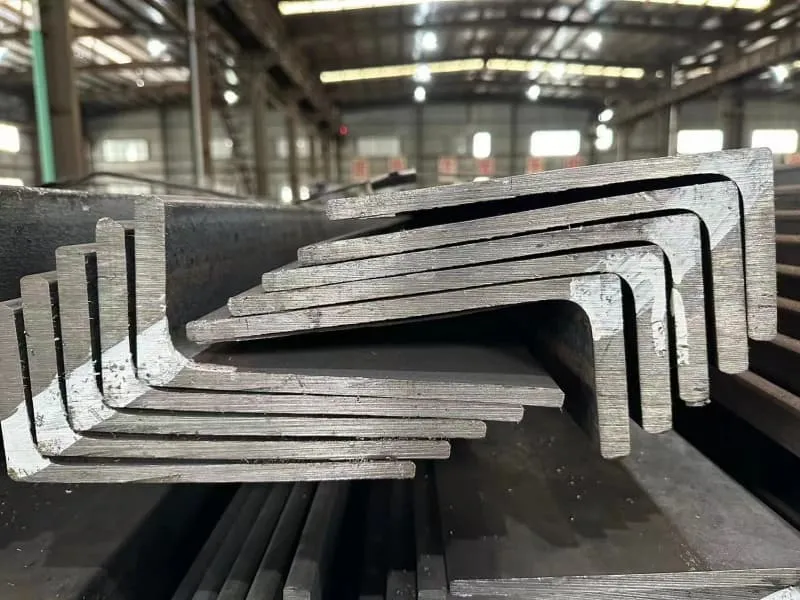
Keeping a floating inventory of common L-shaped sizes2 means storing a small quantity of the most frequently used profiles – typically 100x75x6mm, 150x90x8mm, and 200x100x10mm in grade A3 – that is not allocated to any specific block, so you can pull from it when block modifications4 happen or when a block runs short.
The cost of not having floating inventory
Block construction is not perfect. Even with good planning, things change. The naval architect adds an extra stiffener. The welding distorts a frame, and you need a replacement piece. The cutting machine makes a wrong cut.
A client in Mexico learned this lesson. He was building four fishing vessels. Block 08 needed an extra 12 pieces of 120x80x7mm grade A. He had no floating inventory. The mill’s next rolling slot was 30 days away. He paid for air freight from a Korean trader. The steel cost $1,200 per ton instead of $750. Plus air freight of $800. Total extra cost was $2,600 for 1.2 tons of steel.
If he had kept 2 tons of 120x80x7mm as floating inventory, his extra cost would have been the interest on $1,500 for two months – about $25. Plus he would have used the steel the same day.
Which sizes to keep in floating inventory
Not all sizes need floating inventory. Only the common ones. Here is my recommendation based on 50+ shipyard projects:
| Size (mm) | Grade | Why common | Recommended floating quantity (tons) | Typical reorder point (tons) |
|---|---|---|---|---|
| 100x75x6 | A | Used in side shells, bulkheads, and decks | 3-5 | 1 |
| 120x80x7 | A | Used in bottom blocks and longitudinal stiffeners | 3-5 | 1 |
| 150x90x8 | A | Used in heavy frames and web frames | 4-6 | 1.5 |
| 150x90x8 | AH36 | Used in high-stress areas like engine room | 2-3 | 0.5 |
| 200x100x10 | A | Used in large bulk carriers and tankers | 3-5 | 1 |
| 75x75x6 | A | Used in light structures and superstructure | 2-3 | 0.5 |
For a typical medium-sized shipyard building 2-3 vessels at once, I recommend keeping 15-20 tons of floating inventory in total. That costs about $12,000 to $16,000 in tied-up capital. But it saves you from emergency air freight costs5 that can easily exceed $10,000 for a single incident.
How to manage floating inventory without losing track
Floating inventory only works if you treat it as sacred. Do not touch it for planned work. Here is the system:
Tag it clearly. Each floating piece gets a bright yellow tag that says “FLOATING – DO NOT USE WITHOUT APPROVAL.”
Store it separately. Put floating inventory on a dedicated rack away from block-specific steel. A client in Pakistan uses a different color rack for floating steel. Everyone knows: red rack is for Block 03. Blue rack is for Block 05. Yellow rack is floating.
Set a reorder trigger6. When floating inventory drops below a certain level, reorder immediately. Do not wait. For example, if you keep 4 tons of 150x90x8mm grade A, reorder when it reaches 1.5 tons. By the time the new steel arrives, you still have 0.5 tons left.
Review monthly. At the end of each month, check which sizes were used from floating inventory. If a size was used three months in a row, increase its floating quantity by 1 ton. If a size was never used in six months, reduce it or remove it.
A story from my own experience
Early in my career at CN Marine Steel, I had a client in Thailand. He ordered L-shaped steel for a series of six barges. He refused to keep floating inventory. “Too expensive,” he said. On barge number three, the yard made a cutting error on 24 pieces of 100x75x6mm. They needed replacement steel in 5 days. The mill could not help. I searched our own warehouse. We had 2.5 tons of that exact size from a canceled order. I air-shipped it to him at my cost. That was a one-time goodwill gesture. After that, he started keeping his own floating inventory. He told me later: “That 2.5 tons cost me $1,800 in inventory. But it saved me $9,000 in potential delay penalties. Good deal.”
So now I include floating inventory in every planning consultation. It is not a luxury. It is a tool for continuous production.
Conclusion
Plan L-shaped steel by block, group orders by priority, deliver to block start dates, and keep floating stock for changes.
-
Understanding floating inventory can help you optimize your supply chain and reduce costs. ↩ ↩ ↩ ↩
-
Learn about the most frequently used L-shaped sizes to improve your project efficiency. ↩ ↩ ↩ ↩
-
Discover the applications of grade A steel and its importance in construction. ↩ ↩ ↩ ↩
-
Explore how block modifications can affect your project and how to manage them effectively. ↩ ↩ ↩ ↩
-
Find strategies to minimize unexpected shipping costs and keep your project on track. ↩ ↩ ↩ ↩
-
Learn about reorder triggers to maintain optimal inventory levels and avoid shortages. ↩ ↩ ↩