
You’re designing a steel structure and a standard equal angle just won’t fit or provide the right strength balance. This is where the unequal L angle, an often-overlooked workhorse, becomes the perfect solution. I’ve seen fabricators struggle with design constraints that were easily solved by switching to an unequal angle.
Unequal L-shaped steel has legs of different lengths (e.g., L150x90x10mm), offering asymmetric strength and versatility for connections, edge supports, and bracing where space or load distribution is uneven. Its benefits include design flexibility, material efficiency in non-symmetrical applications, and often a lower weight solution compared to using a larger equal angle. Understanding its specifications unlocks smarter, more economical designs.

For structural engineers, fabricators, and marine builders, this profile is a key tool in the kit. It solves specific problems that equal angles cannot. Let’s explore its dimensions, uses, and the broader context of steel construction, starting with its most basic specification: size.
What size is an unequal L angle?
Ordering the wrong size unequal angle can halt a fabrication line. I once worked with a client in the Philippines who received unequal angles where the longer leg was shorter than specified, causing a mismatch in their connection design. Precise sizing is critical.
Unequal L angles1 are specified by the lengths of their two legs and the thickness, written as L A x B x t (e.g., L150x90x10mm). Common size ranges are from smaller sections like L75x50x6mm to larger ones like L200x150x18mm. The longer leg (A) is always listed first, and both dimensions refer to the external leg lengths from the heel to the toe. Standard thicknesses typically align with those of equal angles.

Standard Sizes and Tolerances for Specification
Unlike equal angles, unequal angles have a more varied size matrix. Knowing the standard availability helps in design and procurement.
Common Unequal Angle Size Series2:
Mills produce these in common series to meet broad structural needs. While custom sizes are possible, they require higher minimum order quantities (MOQ) and cost more.
- Small/Medium Sections: L60x40x6mm, L75x50x6mm, L80x60x8mm, L100x75x8mm.
- Medium/Large Sections: L125x75x10mm, L150x90x12mm, L180x110x14mm, L200x150x18mm.
- Marine & Heavy Sections: For shipbuilding and heavy industry, sizes can go larger, such as L250x180x20mm or more.
Understanding Tolerances3:
The rolled dimensions have permissible variations defined by standards like ASTM A6, EN 10056-1, or JIS G3192.
- Leg Length Tolerance4: Usually ±2mm to ±4mm, depending on the leg size. You must check the specific standard.
- Thickness Tolerance5: Typically ±0.5mm to ±1.5mm, depending on nominal thickness. It is measured away from the rounded toe.
- Straightness Tolerance: There is an allowable camber or bow per meter of length.
Why Size Selection Matters for Function:
The choice of A and B is not arbitrary. It is driven by structural and spatial requirements.
- Example 1: A bracket connecting a beam to a column might use L150x90x12. The 150mm leg bolts to the column flange. The 90mm leg bolts to the beam web. This fits the typical geometry of standard I-beams.
- Example 2: A stiffener on a non-symmetrical plate might use an unequal angle where one leg matches the required stiffener height and the other provides an adequate welding surface.
Procurement Table for Common Unequal Angles6:
| Nominal Size (A x B x t) | Approximate Weight per Meter | Typical Application Context | Notes for Buyers |
|---|---|---|---|
| L100x75x8mm | ~10.6 kg/m | Medium-duty bracing, support brackets in buildings. | A very common, versatile size. Readily available. |
| L150x90x12mm | ~21.6 kg/m | Heavier brackets, connection angles in industrial structures, ship stiffeners. | Good strength-to-weight ratio for many connections. |
| L200x150x18mm | ~48.6 kg/m | Heavy-duty connections, primary bracing members, large marine brackets. | High strength; check mill availability for specific grades. |
| L125x75x10mm | ~15.5 kg/m | Similar to L150x90 but slightly lighter. Common in pre-engineered metal buildings. | Often used as purlin or girt in building envelopes. |
When clients like shipbuilders in Saudi Arabia or fabricators in Mexico need unequal angles, we ask for the exact A, B, and t dimensions first. This allows us to provide an accurate quote from our mill partners and ensures the material will fit their design. Now, let’s look at the wide world of applications for this L-shaped piece of metal.
What is the L shaped piece of metal used in construction?
The L-shaped steel1 angle is one of the most basic and ubiquitous profiles in construction and industry. Its simplicity is its strength. A contractor in Thailand once told me they use L angles in every single project, from small machine bases to massive port cranes.
L-shaped steel1 (angle iron) is a fundamental construction element used for framing, bracing2, supporting, and connecting. It serves as shelf brackets, frame edges, stiffeners3 on plates, diagonal braces in trusses, and support legs for equipment. In marine construction4, it forms ship frames, bulkhead stiffeners3, and deck edge supports. Its 90-degree shape provides inherent rigidity and easy attachment to other members.
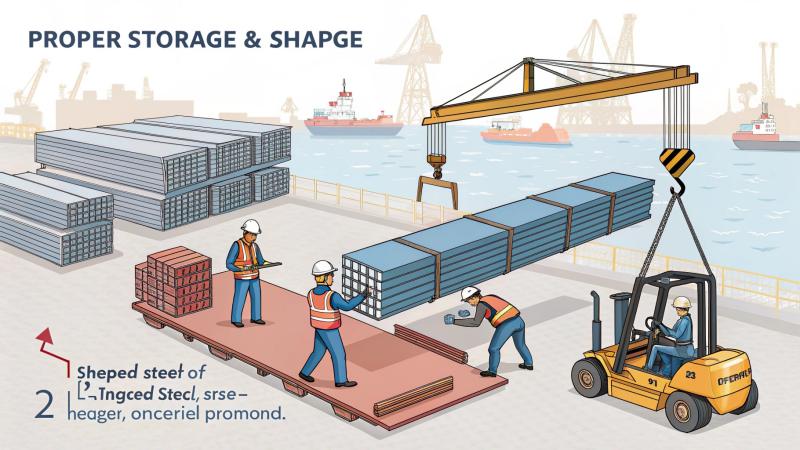
A Deep Dive into Functional Applications
The L angle’s utility comes from its geometry. One leg can be attached to a surface (a wall, a plate, a beam web), while the other leg extends out to support or connect to something else.
1. As a Primary Structural Member:
- Bracing: This is a critical use. Angles are used as diagonal braces in steel frames, transmission towers, and ship hulls. They prevent the structure from racking (deforming) under lateral loads like wind or waves. The L shape is easy to bolt or weld at both ends.
- Framing: Angles form the perimeter frames for doors, windows, hatches, and machine guards. They provide a sturdy edge to which panels or sheets can be fastened.
2. As a Secondary Member or Connection Element:
- Stiffeners: Smaller angles are continuously welded to large steel plates (like a ship’s bulkhead or a storage tank wall) to prevent the thin plate from buckling under pressure. The angle acts as a small reinforcing beam.
- Brackets and Gussets: Pieces of angle are cut and used as connection plates (lug angles) or brackets to join beams to columns or to provide additional support. This is where unequal angles are particularly useful, as they can fit asymmetric connections.
- Supports and Legs: Angles are used as legs for workbenches, supports for platforms, and frames for electrical cable trays.
3. In Marine-Specific Construction:
- Ship Frames: The transverse ribs of a ship’s hull are often made from large equal or unequal L angles. They give the hull its shape and strength.
- Stiffeners on Bulkheads and Decks: A grid of L angles is welded to steel plates to create rigid walls and floors within the ship.
- Edge Angles: Used at the intersection of decks and hull (the sheer strake) or at hatch openings to reinforce the edges.
Application Guide: Equal vs. Unequal Angles
| Application | Likely Choice: Equal or Unequal Angle? | Reason |
|---|---|---|
| Diagonal brace in a square tower leg. | Equal Angle | Symmetrical connection; load is similar in both directions. |
| Connection angle to join a beam web to a column flange. | Unequal Angle (e.g., L150x90) | The longer leg bolts to the column flange (wider surface). The shorter leg bolts to the beam web (narrower surface). Fits the geometry perfectly. |
| Stiffener on a symmetrical plate. | Equal Angle | Provides uniform stiffness. Easy to install. |
| Edge frame for a rectangular access panel. | Equal Angles for long sides, Unequal for corners? | Depends on design. Equal angles are common. |
| Support bracket for a pipe against a wall. | Unequal Angle | One leg bolts flat to the wall, the other extends out to hold the pipe clamp. |
For a supplier, understanding these applications helps us advise clients. When Gulf Metal Solutions asked for "ship L-shaped steel1," we knew to discuss both equal frames and unequal brackets for their fabrication projects. To fully evaluate its use, we must also consider the broader pros and cons of steel structures.
What are the advantages and disadvantages of steel structure?
Choosing steel for a project is a major decision. It’s not always the perfect answer for every situation. A project manager in Qatar was deciding between a concrete warehouse and a steel one. We had an honest conversation about the trade-offs based on his needs for speed and clear span.
Steel structures offer high strength, fast construction, design flexibility, and recyclability. Their main disadvantages include susceptibility to corrosion requiring protection, potential loss of strength in fire necessitating fireproofing, and susceptibility to buckling in slender members which requires careful design. The choice depends on the project’s priorities: speed, span, weight, and lifecycle cost.
A Balanced Analysis of Steel as a Building Material
Steel is a fantastic material, but it has its kryptonite. A rational builder weighs both sides.
Advantages of Steel Structures:
- High Strength-to-Weight Ratio1: Steel is incredibly strong for its weight. This allows for lighter foundations, longer spans without intermediate columns (like in aircraft hangars or ship hulls), and the ability to prefabricate large sections.
- Speed of Construction2: Components are fabricated off-site in controlled conditions. On-site, it’s primarily bolting and welding. This leads to much faster project completion compared to concrete, which requires curing time. This was crucial for a client in Romania needing a fast-track warehouse.
- Design Flexibility and Adaptability3: Steel frames can be easily modified, extended, or dismantled. The material can be formed into a wide variety of shapes (I-beams, angles, tubes).
- Predictable Quality4: Material properties are consistent and certified (via MTCs). Structural behavior is well-understood, allowing for precise engineering.
- Sustainability: Steel is 100% recyclable without loss of properties. Most new steel contains recycled content.
Disadvantages and Mitigation Strategies:
- Corrosion5: This is the biggest challenge, especially in marine or industrial environments.
- Mitigation: Protective coatings (paint, galvanizing), use of weathering steel (A588), and cathodic protection for submerged parts (ships, offshore).
- Fire Resistance6: Steel loses strength rapidly at high temperatures (above 550°C).
- Mitigation: Apply fireproofing materials (spray-on cementitious products, intumescent paint, board systems). This adds cost and time.
- Buckling7: Slender steel members (like columns or thin plates) can fail suddenly by buckling under compression, even if the material strength is high.
- Mitigation: Good design. Use thicker sections, add stiffeners (like L angles!), or use different profiles. This is not a material flaw but a design consideration.
- Fatigue8: Under repeated cyclic loading (like waves on a ship, traffic on a bridge), small cracks can initiate and grow.
- Mitigation: Careful detail design to avoid stress concentrations, use of higher-toughness grades, and regular inspection.
Comparative Table: Steel vs. Concrete for a Warehouse
| Factor | Steel Structure | Reinforced Concrete Structure |
|---|---|---|
| Construction Speed | Very Fast (weeks) | Slow (months, includes curing) |
| Span Capability | Excellent for long spans. | Requires more supports for very long spans. |
| Material Cost | Higher material cost per kg. | Lower material cost. |
| Foundation Cost | Lower (lighter structure). | Higher (heavier structure). |
| Corrosion5 | Requires active protection. | Concrete protects the rebar (unless cracked). |
| Modification | Easy to modify or expand. | Very difficult to modify. |
| Fire Resistance6 | Requires added fireproofing. | Inherently good fire resistance. |
For marine applications, the advantages of steel (strength, fabricability, speed) are overwhelming, which is why it dominates shipbuilding. The disadvantages (corrosion, fatigue) are managed through grade selection, coatings, and meticulous design. This brings us to a specific detail in steel connection design: the lug angle, which has its own drawback.
What is a disadvantage of using lug angles1?
In steel connections, a lug angle is a short piece of angle (often unequal) used to transfer load from one member to another, like from a beam to a gusset plate. While useful, they introduce a specific weakness that engineers must account for. A fabricator in Myanmar had connection failures because the lug angles1 were not detailed correctly.
A key disadvantage of using lug angles1 is that they create an eccentricity in the load path2. The force is not transferred through the center of the main member’s connection, inducing additional bending moments3 (prying action4) that can lead to premature failure of the bolts or the angle itself if not properly designed. This requires more complex calculations and potentially thicker materials.

The Mechanics of the Problem and Design Solutions
Lug angles are practical but imperfect. Understanding the "why" helps in specifying and procuring the right material for them.
What is a Lug Angle?
It’s an auxiliary angle bolted or welded to help connect a member, often when the primary member doesn’t have enough space for all the required bolts. For example, connecting a large angle brace to a gusset plate might require a short lug angle to provide extra bolt holes.
The Eccentricity Problem:
Ideally, the line of force from a tension member should pass through the center of gravity (C.G.) of the bolt group in the connection. This ensures the bolts share the load evenly.
- When you use a lug angle, the force from the main member is first transferred into the lug angle. The lug angle then transfers it into the gusset plate.
- This indirect path often means the force does not pass through the C.G. of the final bolt group. This offset creates a twisting effect (a moment) on the connection.
- This prying action4 tries to peel the lug angle away from the gusset plate. It puts extra tension on some bolts and can bend the legs of the lug angle.
Consequences of Poor Design:
- Bolt Failure: The bolts furthest from the force line become overloaded and can fracture.
- Angle Failure: The leg of the lug angle can yield or tear due to the bending stress.
- Gusset Plate Failure: The plate itself can deform or tear.
Design and Procurement Implications:
Because of this eccentricity, the design must be more robust.
- Heavier Lug Angles: The angle may need to be thicker to resist the bending.
- More or Larger Bolts: The connection may require additional bolts or higher-grade bolts to handle the uneven load.
- Stiffer Connection Details: The geometry might need adjustment to minimize the eccentricity.
This affects you as a buyer or fabricator in two ways:
- Material Specs: The lug angles1 specified on the drawing might call for a thicker unequal angle (e.g., L150x90x15mm instead of L150x90x12mm) to account for the prying stress. You must supply the exact thickness ordered.
- Quality Needs: The bolts and the steel for the lug angle must meet their specified grades precisely. Using a lower-grade bolt or under-thickness angle in this critical, highly stressed detail is dangerous.
Mitigation Strategies in Design:
| Strategy | How It Addresses the Disadvantage |
|---|---|
| Using Double Lug Angles (one on each side of the gusset) | Helps balance the prying action4 and reduces eccentricity. |
| Increasing Bolt Pitch (distance between bolts) | Puts bolts further apart, increasing the connection’s resistance to rotation. |
| Specifying High-Strength Bolts (A325/A490) | Bolts can handle higher tension from prying. |
| Increasing Lug Angle Thickness | The angle itself is stronger in bending. |
| Optimal Positioning | Placing the lug angle to minimize the load offset. |
For a results-driven client who values communication, understanding this detail is important. It explains why a drawing might specify a seemingly "over-sized" unequal angle for a small-looking connection. When we supply angles for such applications, we ensure the thickness tolerance is tight and the MTC confirms the strength grade, so the fabricator’s connection performs as the engineer intended. This attention to detail in every component, from the main frame to the smallest lug, is what builds a reliable structure.
Conclusion
Unequal L-shaped steel is a versatile profile solving asymmetric design needs in construction and shipbuilding. Its effective use requires understanding standard sizes, its broad applications, the general trade-offs of steel structures, and the specific design considerations for connections like lug angles.
-
Understanding the disadvantages of lug angles can help in making informed design choices and avoiding potential failures. ↩ ↩ ↩ ↩ ↩ ↩ ↩ ↩ ↩
-
Exploring the effects of load path eccentricity can enhance your knowledge of structural design and safety. ↩ ↩ ↩ ↩
-
Learning about bending moments is crucial for understanding how forces affect structural components. ↩ ↩ ↩ ↩ ↩
-
Discovering prying action will help you grasp the complexities of load transfer in connections. ↩ ↩ ↩ ↩ ↩ ↩
-
Find effective strategies to protect steel from corrosion, ensuring longevity and durability. ↩ ↩ ↩
-
Explore innovative fireproofing methods that enhance safety in steel construction. ↩ ↩ ↩
-
Understanding buckling prevention is key to maintaining structural integrity under load. ↩
-
Learn about fatigue management to ensure the longevity and safety of steel constructions. ↩