
Sending a vague email asking for “price on angle steel” is the fastest way to get a useless number that changes twice before delivery. After watching buyers waste weeks on back-and-forth clarifications, I can tell you the real cost is not the steel. It is the delay.
To get an accurate marine angle steel quote, you must provide the exact dimensions, grade and classification society, quantity in pieces and metric tons, required impact test temperature, surface finish, destination port, Incoterm, and delivery window. Without these details, every supplier is guessing, and their guess will cost you later.
I work with shipyard buyers and marine steel distributors every day at our office in Liaocheng. The ones who receive the fastest, most accurate quotes are not the biggest customers. They are the ones who send a complete specification sheet on the first email. A buyer from the Philippines once sent me only the size and tonnage. I had to ask for the grade, tolerance, and destination port. His quote shifted from $620 per ton to $655 per ton once we filled in the blanks, but the lead time stayed at 35 days because we locked the rolling slot immediately. His previous supplier gave a lower initial quote but pushed delivery by 60 days because the order details were unclear from the start. That story repeats more often than you would think.
The problem is not that suppliers want to be difficult. It is that marine angle steel is a custom product disguised as a commodity. Every classification society has its own rules. Every mill has its own rolling schedule. Every port has its own freight rate. When you send an incomplete RFQ, the supplier has three choices: guess, ask questions, or pad the quote with contingency. None of those help you. In this article, I will break down exactly what information we need on our side of the desk so you can get a quote that is accurate, comparable, and actionable on the first try.
What Product Specifications Must You Include in a Marine Angle Steel RFQ?
Vague product descriptions lead to mismatched grades, wrong tolerances, and steel that fails classification inspection. If your RFQ does not spell out the exact specification, you are gambling with your project timeline.
A complete marine angle steel RFQ must state the leg dimensions, thickness, length, steel grade, classification society standard, quantity in both pieces and metric tons, and any special testing or surface requirements. This is the minimum technical foundation for an accurate quote.
Dimensions and Tolerances
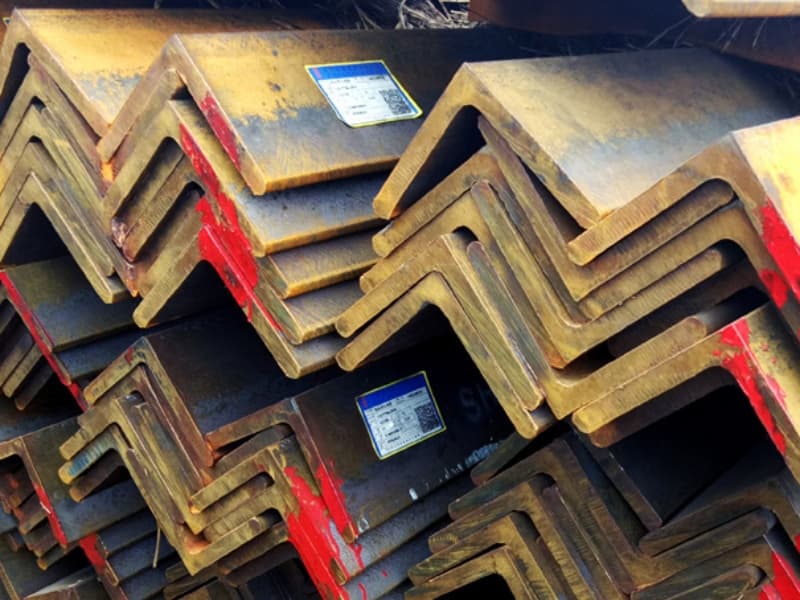
Marine angle steel is not a generic commodity. The leg lengths, thickness, and overall length determine the weight per meter, the cutting waste, and whether the section will fit your shipyard drawings. You should specify the leg size in millimeters, the thickness, and the required length. Standard lengths are 6 meters, 9 meters, and 12 meters, but some projects need exact cut lengths.
Tolerances matter just as much as the nominal size. If your fabricator expects JIS G3192 tolerances but the mill rolls to a looser standard, you will face fit-up problems during welding and assembly. For example, under JIS G3192, the side length tolerance for angles between 90 mm and 140 mm is plus 1.8 mm to plus 2.0 mm. The thickness tolerance for side widths over 200 mm is plus 1.4 mm. These numbers look small, but on a ship frame where every bracket must align, they add up fast.
You should also tell us whether you need equal-leg or unequal-leg angles. Equal-leg angles like 150 x 150 x 12 mm are common for symmetric frames. Unequal-leg angles like 150 x 90 x 10 mm are used when one side carries more load or when space is limited on one face. The weight per meter differs significantly between the two, so the total order weight and the price will change.
I always ask buyers to tell me which dimensional standard governs their project. If they do not know, I ask for the drawing reference. It is better to spend five minutes clarifying than to receive 50 tons of steel that sits in the corner because it does not match the bracket slots. Last year we had a shipment returned from a yard in Vietnam because the buyer specified 12-meter lengths but his crane could only handle 9-meter bundles. A simple question about lifting capacity would have saved everyone three weeks.
Grade and Classification Society
This is the single most important line in your RFQ. Marine angle steel must meet the rules of a classification society such as ABS, DNV, Lloyd’s Register, BV, KR, or CCS. The grade you choose depends on the structural application and the design temperature.
For general ship framing in mild conditions, Grade A or B may be sufficient. For high-strength applications like deck girders or heavy brackets, you need AH32, AH36, DH32, or DH36. The “H” stands for high strength, and the number after it indicates the minimum yield strength in megapascals. AH36 offers a minimum yield of 355 MPa. If your vessel operates in cold waters, DH36 or EH36 provides better toughness at lower temperatures.
The Mill Test Certificate must confirm the grade and show the Charpy V-Notch impact test results at the required temperature. I have seen buyers accept a generic MTC only to find later that the impact test was performed at 0 degrees Celsius when their spec required minus 20 degrees. That is a rejected batch, and the replacement time can stretch your schedule by weeks.
You should also state whether you need the material normalized or thermo-mechanically rolled. Normalized steel undergoes a heat treatment cycle that refines the grain structure and improves toughness. Thermo-mechanically rolled steel achieves similar properties through controlled rolling temperatures, which can offer cost savings on larger sections. The choice depends on your classification society rules and the structural engineer’s preference.
| Specification Element | What to Include | Example Entry |
|---|---|---|
| Leg dimensions | A x B in mm | 150 x 90 mm |
| Thickness | t in mm | 10 mm |
| Length | Standard or cut | 12 meters |
| Grade | Society + grade | ABS AH36 |
| Standard | Dimensional tolerance | JIS G3192 or EN 10056-1 |
| Impact test temp | Charpy V-Notch | minus 20 degrees C longitudinal |
| Surface finish | Blast, primer, or plain | Blast cleaned to Sa 2.5 |
| Quantity | Pieces and weight | 200 pieces, approx. 26 MT |
Special Technical Requirements
Beyond the basic grade and size, many projects need additional properties. Z-direction performance is required for plates and angles that carry heavy through-thickness loads. Ultrasonic testing may be specified for thicker sections. Some buyers require a specific surface treatment, such as a shop primer or hot-dip galvanizing, before the steel leaves the mill.
If your project needs any of these extras, state them upfront. They affect the price, the lead time, and the mill selection. Not every rolling mill can provide Z-direction testing or special surface coatings. If you add these requirements after the quote is issued, the price will change and the delivery schedule may shift because the mill has to re-sequence the rolling program.
Why Do Commercial and Logistics Details Change the Quotation You Receive?
Technical specs get you the right steel, but commercial terms get you the right price. Two buyers ordering identical angle sections can receive quotes that differ by 15 percent or more simply because one asked for CIF Dammam and the other left the logistics undefined.
The Incoterm, destination port, payment terms, and delivery schedule directly affect the final price because they determine who pays for freight, insurance, handling, and financing. A supplier cannot give you an accurate all-in quote without these commercial details.

Incoterms and Destination
The most common terms for marine steel exports from China are FOB, CFR, and CIF. Under FOB, we deliver the steel to the port of loading and you arrange the ocean freight. Under CFR, we pay the freight to your destination port but you handle insurance. Under CIF, we cover both freight and marine insurance.
The destination port matters because shipping rates vary by route. A shipment to Jebel Ali costs less than a shipment to a smaller port in the Philippines with limited vessel frequency. If you tell us the destination, we can calculate the freight component accurately. If you do not, we have to assume a generic rate or exclude freight entirely, which makes comparison shopping impossible.
I remember a buyer from Saudi Arabia who initially asked for an FOB quote because he thought it would be cheaper. After we ran the numbers, he discovered that our CIF rate to Dammam was actually lower than his own freight forwarder could offer because we consolidate container shipments every week. He saved money and reduced his admin burden just by switching the Incoterm. That is why I always ask buyers to state their preferred term and port upfront.
Payment Terms and Delivery Schedule
Standard export terms for Chinese steel suppliers are 30 percent deposit by T/T and 70 percent against copy of Bill of Lading. For larger orders or repeat customers, we sometimes negotiate different structures such as 20 percent deposit, 50 percent against inspection report, and 30 percent against B/L.
The delivery schedule also affects the quote. If you need the steel in 4 weeks, we may have to pull from stock or pay a rolling slot premium. If you can accept 8 to 10 weeks, we can schedule production during a regular mill window at standard rates. Rush orders always cost more, and not every size is available from stock.
You should also tell us if you need partial shipments or a single delivery. Some shipyard projects progress in sections, and buyers prefer to receive steel in three or four smaller lots rather than one large batch. This reduces storage pressure at the yard but increases handling and shipping costs. When you communicate your preferred shipment schedule upfront, we can quote the logistics accurately instead of assuming a single container load.
| Commercial Element | Why It Matters | Typical Options |
|---|---|---|
| Incoterm | Determines cost allocation | FOB, CFR, CIF |
| Destination port | Affects freight rate | Dammam, Jebel Ali, Ho Chi Minh City |
| Payment terms | Influences price and risk | 30/70 T/T, L/C at sight, 20-50-30 milestone |
| Delivery window | Stock vs. mill production | 4 weeks (stock) vs. 8-10 weeks (mill) |
| Inspection | Third-party or mill MTC only | SGS, Bureau Veritas, buyer representative |
| Packaging | Protects steel during transit | Bundled with steel straps, VCI film, plastic caps |
Inspection and Documentation
Most buyers require a Mill Test Certificate confirming the chemical composition, mechanical properties, and impact test results. For marine applications, the MTC should be traceable to a classification society recognized surveyor. EN 10204 3.1 or 3.2 is the standard document level.
Third-party inspection adds cost but reduces risk. Agencies like SGS or Bureau Veritas can witness tests at the mill, inspect surface quality, and verify dimensions before shipment. I recommend third-party inspection for first-time orders or large project contracts. For repeat orders from a trusted mill, some buyers rely on the mill’s own MTC to save time and cost.
When Gulf Metal Solutions placed their first order with us, they requested SGS inspection at the loading port. We coordinated the surveyor, provided mill access, and sent the inspection report with the shipping documents. That process added about $800 to the order but gave them complete confidence in the material before it left China. On their second order, they accepted our mill MTC because the first shipment had passed every check. That progression is typical for professional buyers.
Conclusion
An accurate marine angle steel quote starts with a complete RFQ. Give your supplier the dimensions, grade, quantity, technical requirements, Incoterm, destination, and delivery window on day one, and you will receive a price you can trust.