
I have seen too many projects face delays because the steel plate was not right for the job. You are building for the ocean, which means constant pressure from waves, salt, and low temperatures. If your material fails, the whole structure fails. This is about safety and keeping your timeline on track.
The best choice for offshore and FPSO projects is usually a thermomechanical rolled, fine-grain steel plate that meets strict international standards like EN 10225 or ASTM A131, with certified strength and toughness for low temperatures [citation:1][citation:4].
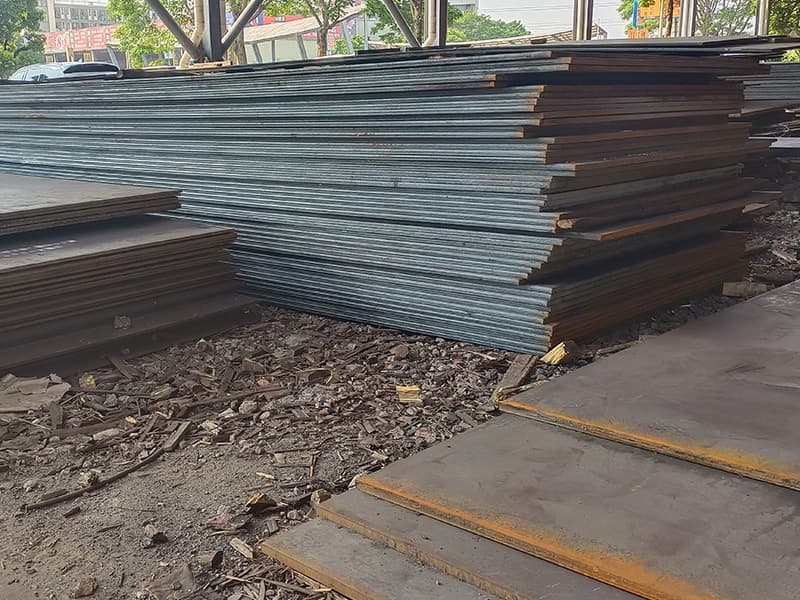
You might be asking yourself if the standard shipbuilding plate you used last year will work for this new offshore platform. The truth is, the gap between regular ship steel and specialized offshore steel is huge. The ocean does not forgive mistakes. Let me walk you through exactly what to look for so you can specify the right material the first time, avoiding costly rework and keeping your clients happy.
What Are the Key International Standards and Grades for Offshore Steel Plates?
When I first started visiting mills in China, I was confused by the different names for steel plates. My clients would ask for "EH36" or "S355," and I had to learn fast. The standards are not just random letters; they are the language we use to guarantee safety.
There are two main paths you will see in our industry. You have the ASTM standards1, which are very common for ships and many offshore projects. Then you have the EN standards2, which are often specified for fixed structures in the North Sea and other harsh areas [citation:4].
The table below breaks down the most common standards and grades we supply to our partners in places like Saudi Arabia and Vietnam. This helps us ensure we are all speaking the same language from the very first email.
| Standard | Common Grades | Typical Yield Strength | Primary Application |
|---|---|---|---|
| ASTM A131 | AH36, DH36, EH36 | 355 MPa (51 ksi) | Ship hulls, structural parts of FPSOs [citation:2][citation:4][citation:6] |
| EN 10225 | S355G10+M3, S420MLO | 355 – 420 MPa | Fixed offshore platforms, jackets, topside modules [citation:1][citation:9] |
| API | API 2H Grade 50 | 350 MPa (50 ksi) | Offshore oil rigs, critical welded structures [citation:4] |
| Higher Strength EH | EH500 | 500+ MPa | Ultra-heavy plates for large-scale drilling equipment [citation:7] |
Going Deeper into the Differences
You might look at that table and think, "EH36 and S355G10+M seem similar." On paper, the yield strength is close. But the difference is in the details that matter for safety.
The main difference is in the testing and the delivery conditions. EN 10225 is a very strict standard made just for offshore. It requires more testing than the general ship standard ASTM A131. For example, S355G10+M steel is usually made with thermomechanical rolling. This process gives the steel a very fine grain structure, which means it is much tougher and easier to weld, especially in thick plates [citation:1].
Let us look at the Charpy V-Notch impact test4. This test tells us how much energy the steel can absorb before breaking, especially in cold weather.
| Grade | Minimum Impact Energy at -40°C | Typical Use Case |
|---|---|---|
| EH36 | 34 J (typically) | General hull construction in cold environments [citation:4] |
| S420MLO | 60 J (typically) | Critical nodes and supports in arctic offshore structures |
| High-strength 420MPa class | >200 J | High-spec platforms where crack arrest is critical [citation:3] |
Why does this matter for you? If you are a project contractor building a platform for Qatar or Mexico, you need to know the water temperature. For a long time, many projects used 355 MPa steel. But now, as we build in deeper water and harsher conditions, there is a real push toward 420 MPa and even 500 MPa grades [citation:3]. These higher strength grades5 let us use thinner plates, which makes the whole structure lighter. But they also require much better toughness. One research paper I read showed that a 420 MPa class plate achieved over 200J of impact toughness6 at -40°C, which is incredible for safety [citation:3].
The steel mills we work with have to control the chemistry very carefully. They use less carbon to improve weldability and add small amounts of elements like Niobium (Nb) to refine the grain [citation:3]. This is not simple steel. It is a high-tech product designed to stop cracks before they start.
How Do Strength, Toughness1, and Z-Direction Properties Really Work?
I remember talking to a buyer from Malaysia who was frustrated. He kept getting plates that looked fine but cracked during welding. He thought he just needed "stronger" steel. But the problem was not strength; it was toughness and resistance to lamellar tearing.
We need to break down these three properties because they are the foundation of a safe offshore structure.
Strength is the easy one. It is how much force the steel can handle without bending. For most offshore projects, you are looking at a minimum yield strength of 355 MPa [citation:4]. Grades like AH36 or S355 fit here. For more demanding applications, we go up to 420 MPa, 460 MPa, or even 690 MPa [citation:9]. It is a simple number, but it is just the starting point.
Toughness is trickier. Strength is about force, but toughness is about energy. It is the steel’s ability to absorb a hit without breaking, especially when it is cold. In the North Sea or at deep sea levels, the water is freezing. If your steel is not tough, a crack can start and run right through a plate. This is why we demand Charpy impact tests2 at -40°C or even lower [citation:4][citation:9]. Modern high-strength steels achieve this through a very fine microstructure, mixing phases like bainite and ferrite to stop cracks from growing [citation:3].
Lamellar Tearing Resistance (Z-direction)3 . This is the one that caused my buyer in Malaysia so much trouble. Lamellar tearing happens when you are welding thick plates together in a "T" or "corner" joint. The welding process pulls on the plate in the through-thickness direction (the Z-direction). Normal steel is strong along its length and width, but weak through its thickness. If there are impurities or inclusions (like sulfide stringers) in the steel, the weld pull can literally tear the plate open from the inside.
To fix this, we use steel that has been treated to reduce sulfur content and sometimes include rare earth elements to control the shape of inclusions. This is often called "Z-quality" steel. It is a must-have for the nodes and connection points on FPSOs and jackets where the welding is complex and the stresses are high.
What Is the Right Way to Select Steel for Harsh Marine Environments?
When a client from Qatar or Saudi Arabia sends me an inquiry, I do not just look at the grade. I try to picture the final structure. Is it a fixed platform? An FPSO hull? A module on deck? The selection process is a puzzle, and every piece has to fit.
The first step is always the classification society1. Your design is approved by a body like ABS, DNV, or BV. They set the rules. They will tell you what grades are allowed for different parts of the structure [citation:4]. If the spec says "ABS EH36," then that is what you need. We always provide Mill Test Certificates (MTCs) stamped by these societies to prove compliance.
Next, we look at the operating environment2.
- Corrosion: In the splash zone, where waves constantly hit, corrosion is severe. Standard steel will not last. You need either a thicker plate with a corrosion allowance, or a steel with enhanced corrosion resistance. Some of our clients use EH36 with extra nickel or copper. For very long life, you might need a clad plate with stainless steel.
- Fatigue Loading: An FPSO does not sit still. It flexes with every wave, constantly. This cyclic loading leads to fatigue. You need steel with a clean, uniform microstructure to resist the start of fatigue cracks. This is where the quality of the mill really shows. Good steel comes from a clean melt and proper rolling.
- Temperature: This decides the Charpy test temperature. For a project going to Vietnam, -20°C might be fine. For one going to Romania in winter, you might need -40°C or even lower [citation:9].
Finally, we consider weldability. Offshore structures are built from welded plates. If the steel is hard to weld, it costs you time and money. Modern offshore steels have a "carbon equivalent" (CEV) value. A lower CEV means it is easier to weld without preheating, which saves a lot of time in the fabrication yard [citation:4].
Why Are Certification, Testing, and Traceability Non-Negotiable for FPSOs?
I will never forget a shipment we sent to a client in Saudi Arabia. Before we even loaded the steel, the client sent a third-party inspector to our warehouse. They checked every single plate, compared the heat numbers to the certificates, and witnessed the final ultrasonic testing. This is the reality of the offshore business.
In this industry, you are not just buying steel. You are buying a paper trail that proves the steel is exactly what it says it is.
The most common proof is the EN 10204 3.1 certificate1 [citation:5]. This is a document from the mill itself. It states that the steel meets the standard and includes all the test results from the batch. The mill’s independent inspection department signs off on it. For most projects, this is the minimum requirement.
But for critical components, you need a 3.2 certificate2 [citation:5]. With a 3.2 certificate, an independent third party—like Lloyds Register or DNV—has to be there at the mill. They witness the tests and inspect the material. They then certify that the results are correct. This is the highest level of assurance.
Here is what that traceability looks like in practice:
- The Heat Number: Every plate is stamped with a unique heat number. This ties it back to the exact batch of molten steel it came from.
- The Mill Test Certificate (MTC)3: This document lists the chemical composition (Carbon, Manganese, etc.) and mechanical properties (yield, tensile, impact) for that heat.
- The Classification Stamp: The plate is also stamped with the society’s mark (e.g., ABS, DNV) to show it was made under survey.
- Third-Party Inspection4: If 3.2 is required, the inspector puts their stamp on the MTC too [citation:5].
I always tell our clients: we can support SGS or any third-party inspection you need. We want you to have that confidence before the steel leaves China. For one of our regular buyers in Mexico, this traceability is why they keep coming back. They know that when the package arrives at their yard, every single plate can be verified, and their client (the shipyard) will accept it without delay.
Conclusion
Selecting marine steel plate for offshore and FPSO projects means looking past the price and focusing on certified strength, verified toughness, and a clear paper trail for every single plate.
My Insights for You:
Throughout this article, I have shared my experiences working with buyers from Qatar to Vietnam. One thing I have learned is that a fast, clear response builds more trust than almost anything else. When our client from Saudi Arabia mentioned that we were the first supplier to respond within two hours, it was not an accident. It is how we work.
We are not just a trading company in Liaocheng. We are your long-term partner. We have long-term relationships with certified mills, which means we can offer you flexible MOQs and competitive prices without sacrificing quality. We know the shipping routes to Dammam, to Malaysia, to Romania. We speak your language, both in English and in technical specs. When you work with us, you get a dedicated sales rep who understands your project and can get you the S355G10+M or EH36 plates you need, with the right certifications, packed better than you expect, and delivered on time. Let’s talk about your next project.
-
Understanding the EN 10204 3.1 certificate is crucial for ensuring compliance and quality in steel procurement. ↩ ↩ ↩ ↩
-
Explore the significance of a 3.2 certificate for critical components and its role in quality assurance. ↩ ↩ ↩ ↩
-
Learn about the essential details in an MTC that guarantee the quality and specifications of steel. ↩ ↩ ↩
-
Discover how third-party inspections enhance trust and reliability in the steel supply chain. ↩ ↩
-
Higher strength grades can enhance safety and reduce weight in offshore constructions, making them essential to explore. ↩
-
Understanding impact toughness is vital for ensuring the durability and safety of steel in cold environments. ↩