
Your marine angle steel order is confirmed. The price is good. The delivery date is set. You think everything is under control. Then the steel does not arrive. Or it arrives wrong. Or it fails class inspection.
Shipyards often overlook four hidden risks in marine angle steel supply chains: supplier financial instability that suddenly halts production, inconsistent mill certificates and missing traceability that cause class rejections, variable lead times and logistics failures that add hidden costs, and overlooked tolerances and weldability issues that wreck fabrication schedules. These risks are not on the purchase order, but they are real.
I am Zora Guo from cnmarinesteel.com. I have supplied marine angle steel to shipyards across Asia and the Middle East. I have also seen projects fail because they ignored the risks in their supply chain. Let me walk you through the four risks that are easy to miss but expensive to fix.
How Do Supplier Financial Instability and Mill Capacity Constraints Suddenly Disrupt Your Order Flow?
Your supplier seems reliable. They quote good prices. They promise on‑time delivery. Then, without warning, your order stops. The supplier has run out of cash.
Supplier financial instability is the most dangerous hidden risk because it is invisible until it is too late. A supplier that is struggling to pay its mill or purchase raw materials cannot deliver your steel. The Royal Navy‘s Fleet Solid Support project is a real example: Liberty Steel Dalzell ran out of funds for raw material procurement and could not commence formal production. Employees received only 80% of their wages and remained on standby. Mill capacity constraints are equally dangerous. If your supplier relies on a single mill and that mill has a breakdown, your order stops. No backup mill means no steel. Shipyards often ignore these risks because they focus on price and delivery promises, not on the supplier‘s financial health or mill relationships.
Let me break down what to look for.
The Financial Health Blind Spot
Shipyards often check the steel price and delivery date, but they rarely ask for the supplier‘s bank references or credit history. A supplier that is financially weak may:
- Delay payments to the mill, causing the mill to stop rolling your order
- Be unable to purchase raw materials (steel billets) in advance, extending lead times
- Cut corners on quality to save money, leading to rejections
- Go bankrupt mid‑contract, leaving you with no steel and no recourse
In the Liberty Steel Dalzell case, the plant relied on purchasing steel billets from British Steel. An inability to pay for those billets forced an interruption of its billet supply chain. Small‑scale trial production yielded only about 1,000 tons of steel plates — equivalent to “roughly three days‘ output” by factory standards.
Mill Capacity — The Hidden Bottleneck
Even if your supplier is financially healthy, their mill may not have spare capacity. A mill running at 95% capacity cannot absorb an urgent order. If they have a breakdown, your order is delayed for weeks.
Questions to ask your supplier:
- “What is the current capacity utilization of your primary mill?”
- “Do you have a backup mill? Is it qualified to produce marine angle steel?”
- “What is the mill‘s lead time for new orders? How does that compare to 6 months ago?”
- “Can you provide a written capacity commitment for my order?”
If your supplier cannot answer these questions, you are taking a risk.
The Cost of Ignoring This Risk
A shipyard in Thailand chose a low‑price supplier. The supplier had no backup mill. During production, the mill had a breakdown. The supplier could not shift the order. The steel arrived 12 weeks late. The shipyard lost $500,000 in idle labor and penalties. The supplier‘s price was $20/ton cheaper, but the delay cost $50/ton in project cost. The cheaper supplier was the more expensive choice.
How to Protect Yourself
- Ask for financial references — bank letters, credit reports, payment history with mills
- Verify the supplier‘s mill relationships — visit the mill if possible, or ask for a video call showing the production line
- Require a backup mill — the supplier should have at least one qualified alternative mill
- Get a capacity commitment in writing — “The supplier guarantees monthly capacity of X tons for the duration of this contract”
Why Do Inconsistent Mill Certificates, Heat Number Gaps, and Missing Traceability Cause Class Rejections?
The steel arrives. The mill certificate looks fine. But the heat numbers do not match the plates. The class surveyor rejects the steel. You cannot use it.
Inconsistent mill certificates and missing traceability are common hidden risks. A mill certificate may have the correct grade and test results, but if the heat number on the certificate does not match the stamp on the plate, the steel is not traceable. Class societies require full traceability from the heat to the final weld. Without it, the steel cannot be used in a classed vessel. Shipyards often assume the certificates are correct and do not verify them until the surveyor arrives. That is too late.
Let me explain why this happens and how to catch it.
The Certificate vs. The Plate
Every heat of steel has a unique heat number. That number is stamped or painted on every plate from that heat. The mill certificate shows the test results for that heat number. The two must match.
Common problems:
- The heat number on the certificate is different from the stamp on the plate (the supplier mixed plates from different heats)
- The stamp is illegible (rust, paint, or poor stamping)
- The certificate shows one thickness, but the plate measures another (wrong plate was shipped)
- The certificate is missing the class society stamp (the mill was not approved for that grade)
The Class Surveyor‘s First Check
The class surveyor does not start with mechanical tests. They start with traceability. They check:
- Does every plate have a heat number stamp?
- Does the heat number match the mill certificate?
- Is the certificate stamped by the class society?
- Is the grade on the certificate the same as the grade on the plate?
If any of these checks fail, the surveyor stops. The steel is rejected. Your project stops.
A Real Example
A shipyard in Qatar received 200 tons of angle steel. The mill certificates showed AH36. The plates were stamped AH36. But when the surveyor checked, the heat numbers on the certificates did not match the stamps on the plates. The supplier had mixed plates from two different heats into one certificate. The surveyor rejected the entire shipment. The shipyard had to send samples for independent testing to verify the steel. The testing took 3 weeks. The project was delayed.
How to Protect Yourself
- Require the supplier to send photos of the stamped plates before shipping
- Check the heat numbers on the packing list against the mill certificates before you accept the shipment
- Use third‑party inspection at the mill before shipment — the inspector verifies the heat numbers match
- Refuse steel without legible stamps — do not accept “the stamp is under the paint”
What Hidden Costs Do Variable Lead Times, Port Delays, and Inland Transport Failures Add to Your Project?
Your steel is produced. It is shipped. Then it waits at the port for 3 weeks. Your project runs out of steel. You pay for idle labor.
Variable lead times and logistics failures add hidden costs that are often not included in the supplier‘s quote. A 4‑week mill delay combined with 2 weeks of port congestion and 1 week of inland transport failure adds 7 weeks to your project. The cost of idle labor, extended yard rental, and late delivery penalties can exceed the cost of the steel itself. Shipyards often ignore these risks because they assume the supplier‘s quoted lead time is fixed. It is not.
Let me break down the hidden costs.
Lead Time — The Moving Target
The supplier quotes 8 weeks. You plan your production accordingly. But the mill is backlogged. The supplier delays your order by 2 weeks. Then the vessel is delayed at port by another 2 weeks. Your 8‑week lead time becomes 12 weeks.
| Actual lead time breakdown: | Component | Typical | Extended |
|---|---|---|---|
| Mill rolling | 2‑4 weeks | 4‑6 weeks (backlog) | |
| Testing and certification | 1‑2 weeks | 2‑3 weeks | |
| Packing and loading | 3‑5 days | 1‑2 weeks | |
| Sea freight | 2‑4 weeks | 4‑6 weeks (port congestion) | |
| Customs clearance | 1‑2 weeks | 2‑4 weeks | |
| Inland transport | 1‑2 weeks | 2‑3 weeks | |
| Total | 8‑12 weeks | 14‑22 weeks |
Port Congestion — The Unpredictable Delay
Port congestion is a major hidden cost. A vessel waiting for berth can cost $10,000‑20,000 per day in demurrage. A 3‑week delay adds $210,000‑420,000 to your project cost.
Port congestion is unpredictable. It can happen at the loading port (e.g., Qingdao, Shanghai) or the discharge port (e.g., Jeddah, Dubai). Shipyards often ignore this risk because they assume the port will be fine. It often is not.
Inland Transport — The Final Mile Risk
After the steel leaves the port, it travels by truck or rail to your yard. Trucks break down. Drivers do not show up. Roads are closed. These delays are small individually — 1‑2 days — but they add up.
The Hidden Cost Calculation
| Delay cause | Typical delay | Cost impact |
|---|---|---|
| Mill backlog | 2‑4 weeks | $100,000‑200,000 |
| Port congestion | 2‑4 weeks | $140,000‑400,000 |
| Inland transport | 1‑2 weeks | $50,000‑100,000 |
| Total | 5‑10 weeks | $290,000‑700,000 |
How to Protect Yourself
- Add a buffer to every lead time — if the supplier quotes 8 weeks, plan for 12 weeks
- Ask the supplier for real‑time tracking — know where your steel is at every stage
- Book logistics early — do not wait for the steel to be ready before arranging transport
- Have a contingency plan — if the primary port is congested, can you discharge at an alternative port?
Why Do Overlooked Tolerances, Surface Defects, and Inconsistent Weldability Wreck Fabrication Schedules?
The steel arrives. It looks fine. Then your welders start working. The welds crack. The surface has pitting. The steel does not fit the jigs. Your fabrication stops.
Overlooked tolerances, surface defects, and inconsistent weldability are the most expensive hidden risks because they are not found until fabrication has started. If the leg length is 2mm short, the angle steel does not fit the welding jig. If the surface has pitting, the welds are weak. If the carbon equivalent varies between batches, the welding procedure must be adjusted. Each of these problems stops fabrication. Rework takes weeks. Shipyards often focus on grade and thickness, but they overlook the tolerances and surface quality that matter most to fabrication.
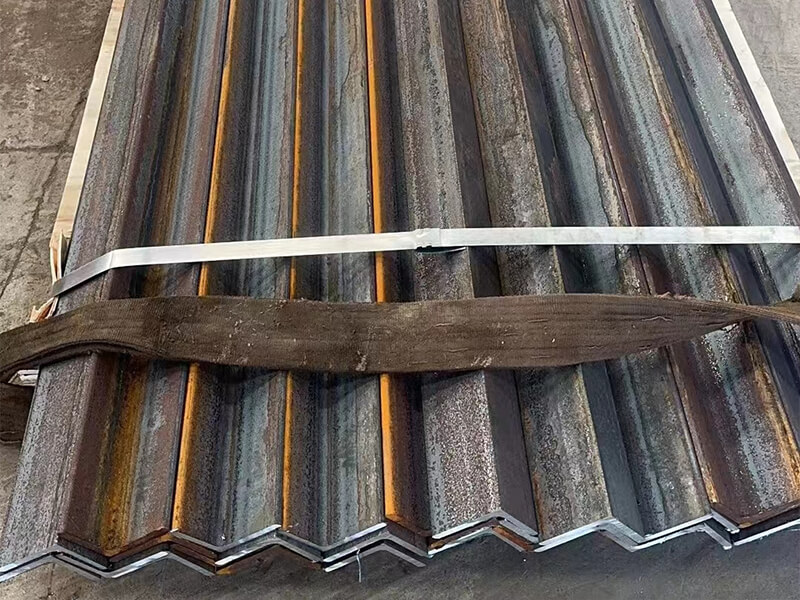
Let me explain what to check.
Dimensional Tolerances — The Fit Problem
Angle steel has two leg lengths and a thickness. If any dimension is out of tolerance, the steel does not fit the design.
What to check:
- Leg length tolerance — typically ±2mm for legs up to 150mm
- Leg thickness tolerance — under‑tolerance of 0.3‑0.5mm depending on thickness
- Straightness — bow of 3mm per meter maximum
- Twist — 2mm per meter maximum
If the leg is 2mm short, the welding jig will not hold the steel properly. The weld may be misaligned. The structure may be weaker.
Surface Defects — The Welding Problem
Surface defects cause welding defects. Pitting, laminations, and edge cracks are common problems.
| Surface defect | Risk | Solution |
|---|---|---|
| Pits deeper than 0.5mm | Weld porosity, weak joints | Grind out and repair, or reject |
| Laminations (edge cracks) | Weld cracking, structural failure | Reject the plate |
| Rolled‑in scale | Poor weld penetration | Grind before welding |
| Rust beyond mill scale | Weld contamination | Blast or grind before welding |
Inconsistent Weldability — The Procedure Problem
Marine angle steel is welded using a specific procedure (WPS). The procedure is designed for a specific carbon equivalent (CEV) range. If the CEV varies between batches, the weld may crack.
Common weldability problems:
- CEV too high — hydrogen cracking, preheating needed
- CEV too low — brittle welds, low strength
- Variable CEV between batches — welders do not know which procedure to use
A Real Example
A shipyard in Malaysia received angle steel that met the grade and thickness requirements. But the leg length was 3mm short. The steel did not fit the jig. The yard had to modify the jig — a 5‑day delay. Then they found pitting on 10% of the steel. They had to grind and repair each pit — another 3 days. Total delay: 8 days. Cost: $40,000.
How to Protect Yourself
- Specify tolerances in your purchase order — do not assume “standard” tolerances
- Require surface quality inspection — visual and UT before shipment
- Check CEV range — request the CEV for each heat and verify it is within your WPS range
- Use third‑party inspection at the mill to catch these problems before shipping
Conclusion
Shipyards ignore four hidden risks in marine angle steel supply: supplier financial instability, inconsistent certificates, lead time delays, and overlooked tolerances. Each risk can cost you weeks of delay and hundreds of thousands of dollars. Check your supplier‘s financial health, verify traceability, plan for delays, and specify tolerances. A little due diligence goes a long way.