
Ship designers want lighter, stronger hulls. That changes everything for marine angle steel. Are your orders still the same sizes as five years ago?
Marine angle steel demand has shifted to smaller but stronger sections. Lightweight hulls need high‑strength low‑alloy (HSLA) grades. Larger ships use more angle steel per vessel. Double hulls and longitudinal framing change where and how angle steel is used.
I have supplied marine angle steel to shipyards for more than ten years. I have seen the demand change from thick, heavy sections to thinner, high‑strength profiles. Let me walk you through four questions. Each one explains how ship design evolution affects what you should order.
How Does the Shift to Lightweight Hull Design Change the Required Sizes and Grades of Marine Angle Steel?
An old ship uses heavy angle steel. A new ship uses thinner angle steel but with higher strength. That is the shift.
Lightweight hull design means smaller leg sizes (e.g., from 150×150 mm down to 100×100 mm) but higher grades like A36 or DH36 instead of ordinary A36. The strength per kilogram goes up. The total tonnage per vessel goes down, but the demand for premium grades increases.
I remember a customer in Vietnam who built fishing boats. He always used 150x150x12 mm angle steel. That was heavy and strong enough. Then he started building a new design. The naval architect told him to use 120x120x10 mm DH36 grade. The boat got 15% lighter. It used less fuel. But the angle steel cost more per ton. He asked me why. I explained that DH36 has a higher yield strength. You can use less steel for the same stiffness. That is the trade‑off.
So what exactly changes in lightweight design?
How lightweight design changes angle steel requirements
| Old design | New design | Why the change |
|---|---|---|
| Leg size 150 mm or larger | Leg size 90‑120 mm | Smaller sections still work because steel grade is stronger |
| Ordinary A36 grade (yield 235 MPa) | DH36 or EH36 (yield 355 MPa) | Higher strength means you can reduce thickness by 30% |
| Equal leg angle | Equal or unequal leg | Unequal legs save weight where one side carries less load |
| Thicker legs (12‑15 mm) | Thinner legs (8‑10 mm) | Corrosion allowance is still there, but base thickness is smaller |
The driving force is fuel efficiency. Ship owners want to burn less fuel. A lighter hull burns less fuel. So designers remove every kilogram they can. Angle steel is a big part of the hull structure. By switching from A36 to DH36, you can reduce the leg thickness by about 25% and still get the same strength.
But there is a catch. Thinner sections are harder to weld. The heat from welding can warp a thin angle steel more easily. So the yard needs better welding procedures. Also, thin sections corrode faster if the corrosion allowance is not maintained. That is why designers still ask for a 2‑3 mm corrosion allowance even on thin sections.
Another change is the use of unequal leg angles. A typical equal leg angle like 100×100 mm has both legs the same size. But in many connections, one leg carries more load than the other. So you can use an unequal leg like 100×75 mm. The longer leg handles the main load. The shorter leg just connects. This saves steel.
I also see more demand for DH36 and EH36 grades. DH36 is for normal cold regions. EH36 is for very cold regions like the Arctic. Shipyards in Russia and Canada ask for EH36. The price is higher. But the ship will not get brittle in freezing water.
For you as a buyer, this means you need to keep smaller and lighter angle steel in stock. The old 150×150 mm sections are still used for large ships. But for medium and small vessels, the demand is for 100×100 mm, 120×80 mm, and 90×90 mm in DH36. I have adjusted my own inventory to match this shift. My warehouse in Liaocheng now stocks more high‑strength small sections than heavy ordinary ones.
What Impact Do Larger Containerships and Bulk Carriers Have on the Volume and Strength Demand for Angle Steel?
A container ship that carries 20,000 boxes is much bigger than one that carries 5,000 boxes. Bigger ship means more steel. But also stronger steel.
Larger containerships and bulk carriers increase both the volume and the required strength of angle steel. A single large vessel uses 2‑3 times more angle steel than a smaller vessel. And the grades move from A36 to AH36, DH36, or even higher. The leg sizes also grow because the hull is bigger.
A customer in Malaysia builds bulk carriers. Five years ago, he built 30,000 DWT vessels. Each vessel used about 800 tons of angle steel. Now he builds 80,000 DWT vessels. Each uses 2,000 tons of angle steel. That is 2.5 times more per ship. But his order frequency has dropped. He builds fewer ships per year. So the total annual tonnage stayed the same. But the grade changed from A36 to mostly AH36 and DH36.
So what is the real impact?
How larger ships change angle steel demand
| Ship size | Typical angle steel grade | Typical leg size | Tonnage per vessel |
|---|---|---|---|
| Small (10,000 DWT) | AH36 | 75×75 to 100×100 | 300‑500 tons |
| Medium (30,000 DWT) | A36 + some AH36 | 100×100 to 120×120 | 600‑1,000 tons |
| Large (80,000 DWT) | AH36 + DH36 | 120×120 to 150×150 | 1,500‑2,500 tons |
| Very large (200,000 DWT) | DH36 + EH36 | 150×150 to 200×200 | 3,000‑5,000 tons |
Larger ships have deeper hulls. The distance between decks is bigger. That means the stiffeners (including angle steel) need to be longer and stronger. They also need to resist larger wave forces. A small ship might use A36 for most stiffeners. A large ship uses AH36 for the middle and DH36 for the bottom where forces are highest.
Another factor is the number of angle steel pieces. A large ship has more frames, more longitudinals, and more brackets. Each of these uses angle steel or sections cut from angle steel. So the total length of angle steel per vessel goes up significantly.
I also see a change in surface finish requirements. Large ships are built in big yards with automated welding. The angle steel needs to be straight. The surface needs to be clean for robotic welding. If the angle steel is bent or rusty, it jams the welding robot. So large shipyards now ask for primer‑coated angle steel. The primer protects against rust and helps welding. That adds a little cost but saves time at the yard.
For suppliers like me, larger ships mean we need to supply bigger leg sizes and higher grades. We also need to handle longer lengths. A small ship might use 6‑meter lengths. A large ship uses 12‑meter or even 15‑meter lengths. That requires special packaging and transport.
So if your customers are building larger vessels, you need to stock bigger and stronger angle steel. And you need to check your logistics. Can you handle 15‑meter lengths? Can you load them into containers or break bulk? I help my customers arrange break‑bulk shipping for long lengths.
Why Are High‑Strength Low‑Alloy (HSLA) Angle Steel Grades Gaining Preference in Modern Shipbuilding?
You can use A36 angle steel. It is cheap. But you need a big, heavy section. HSLA gives you the same strength with a smaller, lighter section.
HSLA grades like AH36, DH36, and EH36 gain preference because they offer higher yield strength (355 MPa vs 235 MPa for A36) without adding much cost. This allows designers to reduce steel weight by 20‑30%. That saves fuel and increases cargo capacity over the ship’s 25‑year life.
I have a customer in Saudi Arabia. He used to buy A36 angle steel for all his projects. Then his client asked for a class society certification. The class society required AH36 for certain parts of the hull. He was nervous about the higher price. But he tried it. He found that he could use a smaller leg size. The total cost per meter was actually the same. And the ship passed inspection easily. Now he buys mostly AH36 and DH36.
So why is HSLA better? Let me break down the numbers.
A36 versus HSLA grades for angle steel
| Property | A36 | AH36 | DH36 | EH36 |
|---|---|---|---|---|
| Minimum yield strength (MPa) | 235 | 355 | 355 | 355 |
| Tensile strength (MPa) | 400‑550 | 490‑620 | 490‑620 | 490‑620 |
| Impact test temperature (°C) | Not required | 0 | -20 | -40 |
| Typical cost premium over A36 | 0% | +8‑12% | +12‑15% | +18‑25% |
| Weight saving possible | 0% | 20‑25% | 20‑25% | 25‑30% |
The math works like this. A36 angle steel with 100x100x10 mm legs has a certain strength. You can replace it with AH36 angle steel of 100x100x8 mm. The AH36 section is 20% lighter. It costs about 10% more per ton. So the cost per meter is about the same. But you get a lighter ship. That lighter ship saves fuel every day for 25 years. The fuel saving is much bigger than the small extra cost.
HSLA grades also perform better in cold weather. DH36 is tested at -20°C. EH36 at -40°C. If your ship sails to northern Europe or Canada, you need DH36 or EH36. Ordinary A36 can become brittle and crack in freezing water.
Another advantage is weldability. HSLA grades are designed for shipbuilding. They have low carbon equivalent. That means they weld easily without preheating. A36 also welds well. But some other high‑strength steels are hard to weld. HSLA angle steel is not. That is why shipyards like it.
I also see a trend towards even higher grades like EH40 and EH47 for very large ships. These have yield strength of 390 and 460 MPa. But they are more expensive and harder to roll. Most shipyards still use AH36 and DH36. That is the sweet spot.
For you as a buyer, this means you should learn the HSLA grades. Do not just order “angle steel”. Specify the grade. For most projects, AH36 is the best choice. For cold climates, DH36 or EH36. Keep some A36 for non‑structural parts like walkways and railings. That saves money where strength is not critical.
I keep a stock of AH36 and DH36 angle steel in my Liaocheng warehouse. Many of my customers in Vietnam, Mexico, and Saudi Arabia now order these grades exclusively. They have learned that the extra cost pays back quickly.
How Do New Structural Arrangements (Double Hulls, Longitudinal Framing) Influence the Use of Angle Steel versus Other Profiles?
Double hulls have two layers of steel with a gap in between. That gap needs stiffeners. Angle steel is perfect for that role.
Double hulls and longitudinal framing increase the use of angle steel because these designs need many small, stiff members that run continuously. Angle steel competes with bulb flat steel and flat bars. For tight spaces like double hull voids, small angle steel (e.g., 50×50 mm or 65×65 mm) is often the only profile that fits.
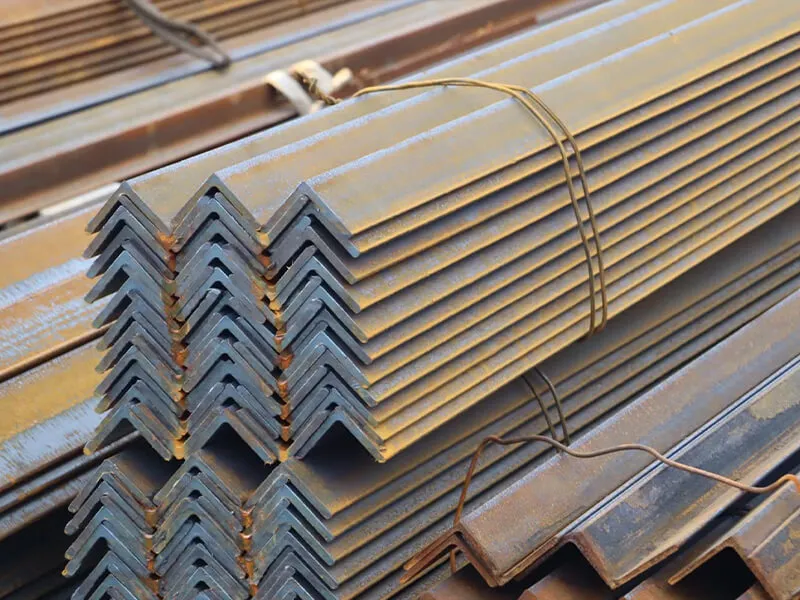
A customer in the Philippines builds oil tankers. All tankers now have double hulls by law. The space between the inner and outer hull is only 1‑2 meters wide. Workers need to climb inside to weld stiffeners. Big profiles do not fit. Bulb flat steel is too tall. Flat bars are not stiff enough. Small angle steel is the answer. He buys 65x65x6 mm angle steel in DH36. That fits in the tight space and gives enough strength.
So how do modern structural arrangements change the game?
Comparison of profiles in new ship designs
| Structural feature | Preferred profile | Why angle steel wins or loses |
|---|---|---|
| Double hull void (narrow space) | Small angle steel | Fits in tight spaces. Bulb flat is too tall. |
| Longitudinal framing (long, continuous stiffeners) | Bulb flat steel | More efficient than angle steel for long spans. Angle steel is second choice. |
| Transverse framing (short frames) | Angle steel or flat bar | Angle steel gives more stiffness per weight. |
| Brackets and connections | Angle steel cut to shape | Easy to cut and weld into corners. |
| Bottom of double bottom (high stress) | Bulb flat or large angle steel | Both work. Bulb flat is more common for very high loads. |
Longitudinal framing is popular on large ships. Instead of many small transverse frames, you have long continuous stiffeners running from bow to stern. Bulb flat steel is very good for this because its shape is optimized for bending in one direction. Angle steel works too, but it is less efficient for long spans. So for longitudinal stiffeners, bulb flat is winning. For everything else, angle steel is still strong.
Double hulls create many small compartments. Each compartment needs its own set of stiffeners. The stiffeners are short – often less than 2 meters. For short spans, the efficiency of bulb flat does not matter. Angle steel is cheaper and easier to cut. So angle steel dominates in double hulls.
Another new trend is the use of laser‑welded sandwich panels. These panels have two thin plates with a corrugated core. They replace traditional stiffeners. In these panels, angle steel is not used. But these panels are still expensive. Most shipyards still use traditional stiffeners. So angle steel demand remains strong.
I also see more demand for unequal leg angle steel in new designs. The short leg fits against the hull plate. The long leg sticks out as the stiffener. This saves space in double hull voids. Unequal leg angles like 80×60 mm or 100×75 mm are becoming popular.
For you as a buyer, this means you need to know which profile is best for each part of the ship. I often advise my customers: “Use bulb flat for long deck and bottom stiffeners. Use angle steel for double hull, bulkheads, and brackets. Use flat bars for light duty only.” This mix gives the best performance and cost.
I keep both angle steel and bulb flat steel in stock. Many wholesalers buy both from me. They know that shipyards now use a mix of profiles. Being able to supply both gives them an advantage over competitors who only sell one type.
Conclusion
Ship design evolution pushes marine angle steel to smaller, stronger, and more specialized profiles. Keep up with grades and sizes.